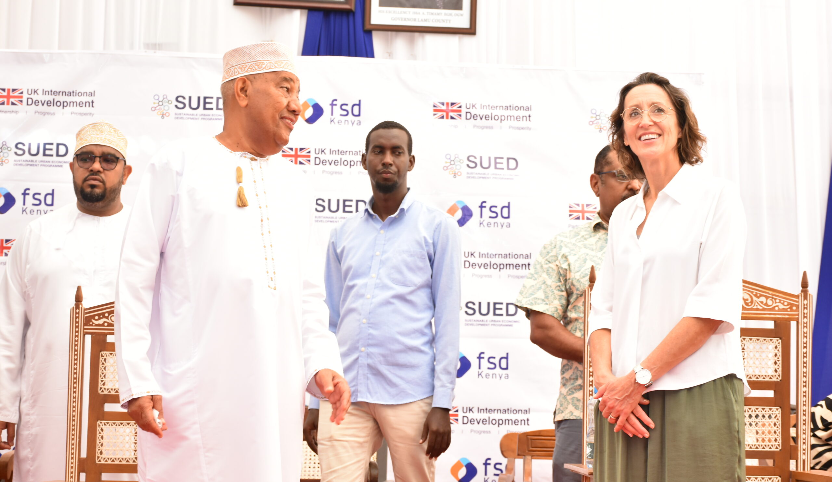
The Lamu County government, in partnership with the United Kingdom (UK) government through the Sustainable Urban Economic Development (SUED) Programme, has commissioned a coconut processing plant, which is set to benefit over 5,000 smallholder farmers.
Speaking on Friday February 13 during the commissioning of the plant, Lamu Governor Issa Timamy said the plant will add value to the coconut sector and add income to farmers.
“The commissioning of the Kentaste coconut processing plant marks a major milestone in Lamu County’s economic transformation. By adding value to our coconut sector here at home, we are creating jobs, strengthening farmer incomes, and positioning Lamu as a competitive agro-processing hub.
“This investment reflects what is possible when county leadership, development partners, and the private sector work together to deliver inclusive and sustainable growth for our people,” said Governor Timamy.
Deputy High Commissioner and Development Director at the British High Commission, Diana Dalton, reaffirmed the UK government’s commitment to supporting sustainable growth in Kenya through programmes that help counties attract private investment.

“This facility is a positive demonstration of the progress that can be achieved when Kenya and the UK work together to add value to products before they are exported. Coastal farmers are at the heart of this initiative, enabling them to sell more produce for more money,” said Dalton.
She continued, “We are proud to support a project like this that brings inclusive growth to a historically marginalised region, offering new work opportunities to young people, women and too often excluded groups, including people with disabilities.”
Kentaste Products Limited, Director Kyle Denning, on his part, said the plant demonstrates the company’s commitment to local value addition and to collaborating with farmers and county authorities.
Denning highlighted that by processing coconuts locally, Kenstate aims to strengthen the coconut value chain and ensure a reliable market for farmers in Lamu.
“For Kentaste, this factory represents a long-term commitment to Lamu to its farmers, its people, and its future. By investing in local processing, we are strengthening the coconut value chain, creating jobs, and ensuring farmers have a reliable market for their produce.
“With the support of Lamu County, SUED, and FSD Kenya, this plant allows us to grow sustainably while building resilience across the communities we work with,” he stated.
The processing plant is expected to strengthen local agricultural value chains by providing a reliable market to coconut farmers and creating more than 90 full-time employment opportunities.
Coconut farmers in Lamu will now have the chance to earn more from value‑added products like coconut milk and cream instead of selling raw coconuts.
The plant will use zero‑waste, climate‑friendly methods to ensure that every part of the coconut is put to good use.
The coconut products will reach the international markets faster and more efficiently thanks to the Lamu Port, which is nearby.
The SUED programme, which is implemented by FSD Kenya as the managing agent, supports selected counties in Kenya to unlock sustainable, inclusive economic growth.
In 2023, SUED partnered with Equator Kenya Limited (EKL) to set up a chilli processing plant in Malindi, Kilifi County.
The project seeks to integrate more climate-smart technology at the chilli processing facility and to expand its network of farmers.
The UK government contributed Ksh 43 million in seed funding, while EKL invested Ksh 154 million into the project.
With SUED’s support, EKL is expected to double its annual dried chilli production from 70 metric tonnes to 150 metric tonnes.