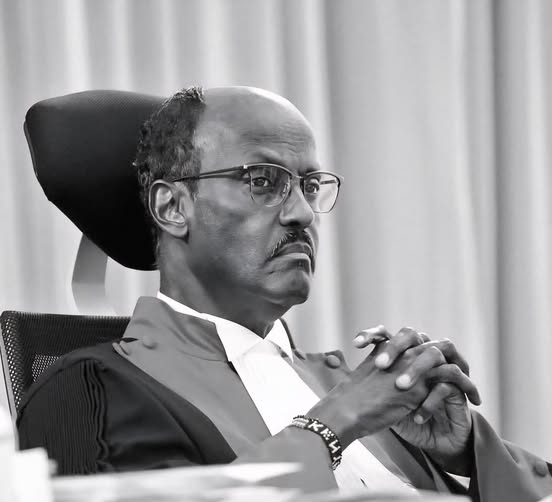
The legal fraternity has been plunged into mourning following the death of Supreme Court Judge Mohammed Ibrahim on Wednesday, December 17, shortly after 4.30pm.
Sources close to the family said Justice Ibrahim had been receiving treatment in an Intensive Care Unit in India, but doctors later advised that he be flown back to Kenya for his final days.
His passing marks the end of a distinguished legal and judicial career that spanned more than four decades and left a lasting imprint on Kenya’s justice system.
Justice Ibrahim was appointed to the Supreme Court of Kenya on June 16, 2011, becoming one of the founding judges of the apex court following the promulgation of the 2010 Constitution.
From the court’s earliest days, he played a central role in shaping its jurisprudence, administrative culture, and public mandate at a time when Kenya’s constitutional democracy was still taking root.
Within the Supreme Court, Justice Ibrahim carried heavy administrative and governance responsibilities. He served as Chairperson of the Judiciary Committee on Elections, a highly sensitive role that placed him at the centre of judicial preparedness during electoral cycles.
He also oversaw the ad hoc Judiciary Working Committee on Election Preparations, strengthening coordination and institutional readiness in the handling of election disputes.
His portfolio extended to liaison with key judicial bodies, including the Kenya Magistrates and Judges Association, the Kenya Women Judges Association, and the Judiciary Staff Association.
Through this work, he helped foster cohesion, dialogue, and professionalism within the Judiciary. He also coordinated the Court’s engagement with civil society and marginalised groups, reflecting his lifelong commitment to access to justice and inclusion.
Beyond the Bench, Justice Ibrahim oversaw Supreme Court publications, annual reports, and library services, and contributed to the development, monitoring, and evaluation of the Court’s strategic plans.
Before joining the Judiciary, Justice Ibrahim was a trailblazing advocate. Admitted to the Bar in January 1983, he became the first Kenyan Somali to qualify as an Advocate of the High Court of Kenya.
He practised at Waruhiu & Muite Advocates before founding Mohammed Ibrahim & Associates, later Ibrahim & Isaack Advocates, where he handled civil, constitutional, and commercial litigation.
He was widely respected for defending minority rights, including challenging discriminatory identity vetting practices against Kenyan Somalis.
He was appointed a High Court Judge in 2003, serving in Nairobi, Eldoret, and Mombasa before his elevation to the Supreme Court.
Chief Justice Martha Koome mourned him as a jurist of exceptional humility and integrity, describing him as a steadfast guardian of constitutionalism, electoral justice, and human dignity.
“The Judiciary mourns the loss of a distinguished jurist whose life exemplified fidelity to the Constitution, service to country, and compassion for the voiceless,” CJ Koome said.
Justice Mohammed Ibrahim will be remembered as a principled judge, a quiet mentor, and an institution builder whose influence on Kenya’s justice system will endure for generations.