By Andrew Kariuki
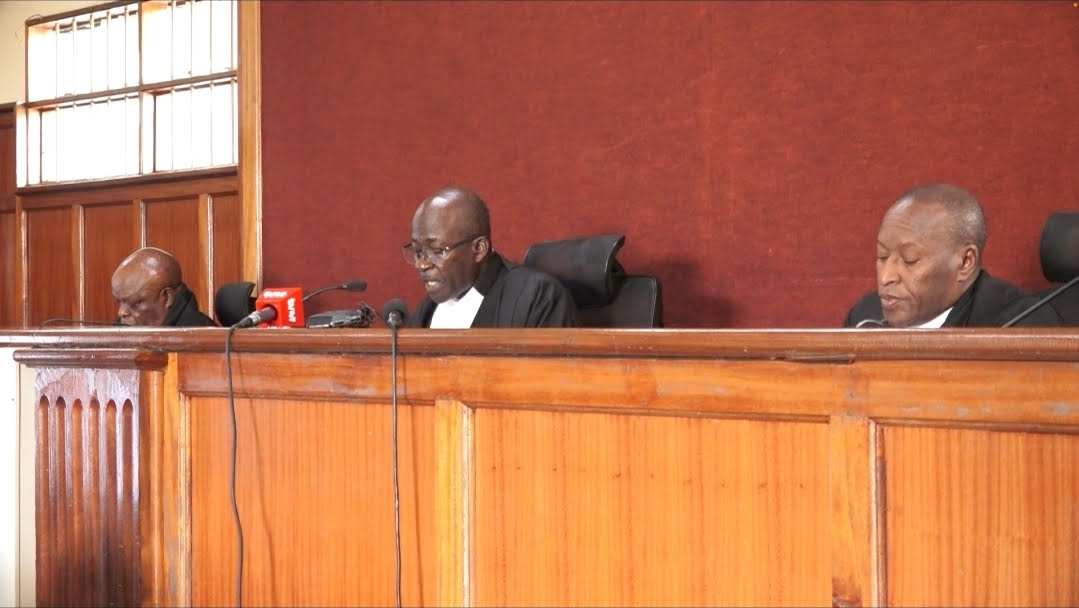
A three-judge bench of the High Court have made a land a ruling after they ruled that the Small Claims Court has no jurisdiction to hear personal injury claims arising from road traffic accidents, directing that such matters must instead be handled by Magistrates’ Courts.
In a judgment delivered on Thursday, Justices Alfred Mabeya, Eric Ogola and Reuben Nyakundi held that claims involving bodily harm fall outside the mandate of the Small Claims Court, whose statutory design is limited to simplified, low-value disputes.
As a result, the judges ordered that all pending personal injury cases currently before the Small Claims Court be transferred to Magistrates’ Courts with the appropriate jurisdiction.
The transferred matters are to be treated as properly filed, ensuring that litigants are not prejudiced by procedural technicalities.
The bench also addressed constitutional concerns raised over enforcement provisions in the Small Claims Court framework.
It found that Rule 25 of the Small Claims Court Rules, allowing arrest and committal to jail under the Tribunal Procedure Act, was inconsistent with Article 24 of the Constitution and therefore unconstitutional.
The court similarly faulted Sections 37, 39 and 40 of the Small Claims Court Act, read together with Articles 94 and 96 of the Constitution, for the same inconsistency.
However, the judges clarified that alleged breaches of Sections 34 and 38 of the Act, as well as Rules 18 and 23 of the Small Claims Court Rules, do not amount to violations of Articles 50 or 1 of the Constitution.
The case was brought by James Muriithi Gathaiya, who petitioned the High Court seeking clarity on whether personal injury claims could properly be filed before the Small Claims Court.
He argued that ambiguous wording in the Act and Rules had led to confusion among litigants and legal practitioners, resulting in many injury claims being filed in the wrong forum.
According to the petitioner, numerous cases were later struck out on jurisdictional grounds, after claimants had already incurred legal expenses and experienced delays in accessing justice.
In its analysis, the court examined the legislative intent behind the establishment of the Small Claims Court and concluded that Parliament did not envisage it as a forum for resolving personal injury disputes.
The judges noted that road accident claims often involve complex questions of liability, medical evidence, expert testimony and assessment of damages, issues that require a more robust procedural framework.
While acknowledging that Section 12(1)(d) of the Act could appear broad on a literal reading, the court held that interpreting it to include bodily injury claims would undermine the purpose of the statute and blur the distinction between the Small Claims Court and Magistrates’ Courts.
To cushion litigants who had relied on the Small Claims Court in good faith, the judges issued transitional orders to prevent further hardship, allowing pending cases to proceed in the proper courts without restarting the litigation process.
The court declined to award damages on the constitutional challenge and upheld most provisions of the Small Claims Court Act, limiting its findings of unconstitutionality to specific enforcement-related sections.