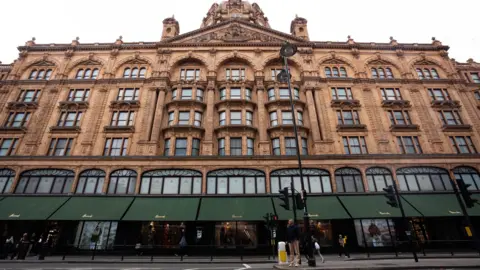
More than £2m was spent at Harrods on behalf of a then-Nigerian oil minister accused of accepting bribes from industry figures interested in government contracts, a court in London has heard.
Diezani Alison-Madueke, 65, is alleged to have been provided with “a life of luxury in the United Kingdom”, including the use of multimillion-pound properties, a chauffeur driven car, travel by private jet, and £100,000 in cash.
Other benefits she allegedly received included £4.6m spent on refurbishing properties in London and Buckinghamshire, the trial at Southwark Crown Court was told.
She denies five counts of accepting bribes and a charge of conspiracy to commit bribery.
Alison-Madueke was minister of petroleum resources between 2010 and 2015 under then-President Goodluck Jonathan.
Jurors were told that over £2m was spent on behalf of Alison-Madueke at Harrods using the payment cards of Nigerian businessman Kolawole Aluko and the debit card of his company Tenka Limited.
The defendant had her own personal shopper at the store, only available to Harrods Rewards Black Tier members who must spend over £10,000 a year, the court heard.
Jurors were also told she lived some of the time in the UK where she was provided with a housekeeper, nanny, gardener and window cleaner.
The salaries and other running costs were paid for by the owners of energy companies who had lucrative contracts with the state-owned Nigerian National Petroleum Corporation, the court was told.
“This case is about bribery in relation to the oil and gas industry in Nigeria during the period 2011 to 2015,” said Alexandra Healy KC, prosecuting.
“During that time those who were interested in the award and retention of lucrative oil and gas contracts with the state-owned Nigerian National Petroleum Corporation or its subsidiaries the Nigerian Petroleum Development Company and the Pipelines Product Marketing Company, provided significant financial or other advantages to Alison-Madueke.”
Healy added: “It might seem strange to be dealing here in the UK with a case that concerns bribery in relation to the Nigerian oil and gas industry.
“We live in a global society. Bribery and corruption undermine the proper functioning of the global market.
“There is an important public interest in ensuring that conduct in our country does not further corruption in another country.”
Jurors were also shown photographs inside a property called The Falls in Gerrard’s Cross, Buckinghamshire, which was bought in 2010 by Nigerian businessman Olajide Omokore, owner of a company called Atlantic Energy.
From late 2011 Alison-Madueke allegedly had exclusive use of the house which has a cinema room. The court heard she stayed there three or four times over two years, and spent six weeks at the property writing a book about the president of Nigeria.
She was assisted by a chef and the driver of car whose role included dropping off shopping for Alison-Madueke, whom he knew as “HM” – short for honourable minister.
It was said that this, along with £300,000 worth of refurbishment, was paid for by Tenka Limited. The court was told Aluko also had contracts with state-owned entities that were in the process of securing new oil contracts.
The court heard that between May 2011 and January 2014, £500,000 was also paid in rent for two flats in a block in central London where Alison-Madueke and her mother lived.
Records seized at the Tenka offices in Nigeria show the company settled the bill, it was claimed.
Alison-Madueke sat in the dock besides oil industry executive Olatimbo Ayinde, 54, who is charged with one count of bribery relating to Alison-Madueke and a separate count of bribery of a foreign public official.
Alison-Madueke’s brother, former archbishop Doye Agama, 69, is charged with conspiracy to commit bribery and joined the trial by video link for medical reasons.
Ayinde and Agama also deny the charges against them.
The trial – expected to last about 12 weeks – continues.
Oil plays a significant role in Nigeria’s economy, but the population at large has not seen the benefits.
It is one of the 13 members of the Organisation of Petroleum Exporting Countries (Opec), set up to deal with the worldwide supply of oil and its price.