
The Judiciary has flagged as fake a notice informing Kenyans of over 200 employment opportunities under the Ajira project across 30 counties countrywide.
Through its social media handles on Thursday, February 5, the Judiciary announced that an advertisement for short-term job vacancies in the project was fake, cautioning Kenyans against being duped into applying for non-existent jobs.
In the now-flagged advertisement, the short-term job vacancies were in three categories: Digitisation Agents (Data Entry), Digitisation Agents (Scanner Operators), and Digitisation Team Leaders.
The advertisement revealed that the job vacancies were part of the Judiciary’s aim to automate both court and registry operations under the overall Case Tracking System (CTS) initiative.
The fake advertisement had revealed that the project scope would encompass scanning all active case files, capturing case particulars, and uploading the scanned digital files onto the Case Tracking System (CTS).
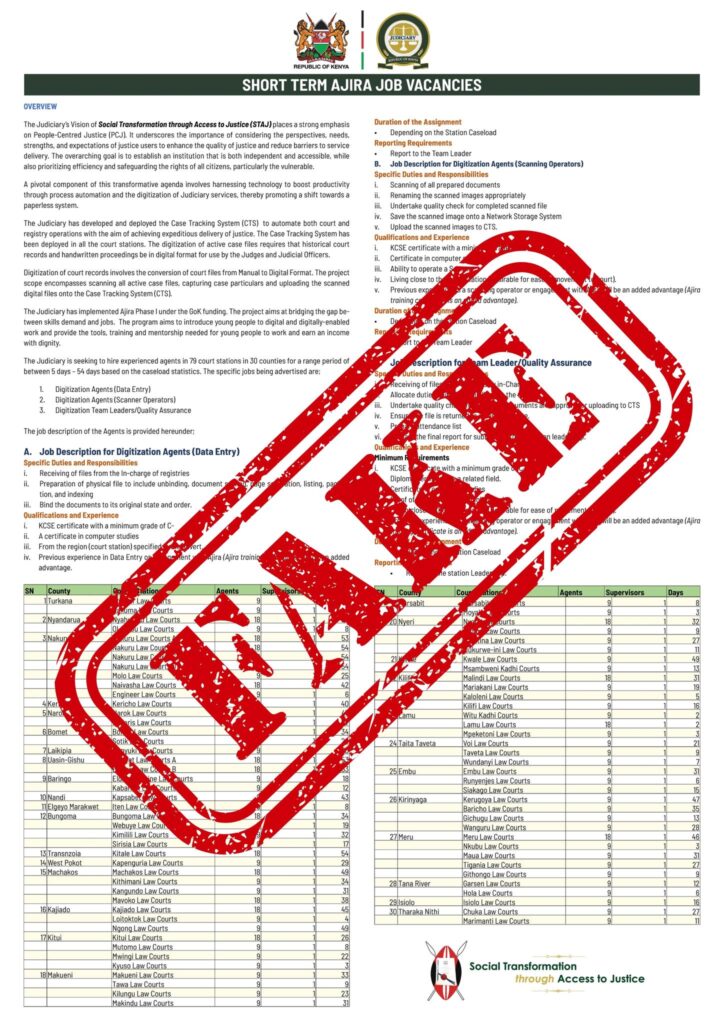
Through the CTS initiative, Kenyans would be able to get job opportunities on a short-term basis, with the recruitment drives being labeled Ajira and funded by the government. The recruitment drives would be done in several phases, with the flagged advertisement being Ajira Phase 1.
According to the fake advertisement, interested applicants would have the opportunity to work across 79 court stations across 30 counties, for a range of between five to 54 days, depending on the caseload statistics.
Some of the listed counties included Embu, Kericho, Lamu, Kirinyaga, Taita Taveta, Marsabit, Turkana, Nyandarua, Nakuru and Bomet.
Others were Narok, Nandi, Laikipia, Uasin Gishu, Elgeyo Marakwet, Bungoma, Trans Nzoia, West Pokot, Machakos, Kajiado, Kitui and Makueni.
Typically, Kenyans seeking employment opportunities at the Judiciary are advised to access them through the Judicial Service Commission (JSC) recruitment portal or through the commission’s official social media accounts.
The latest comes after various government bodies have repeatedly advised the public to remain vigilant and use official channels while accessing government-related information and opportunities, to avoid falling prey to fraudsters.