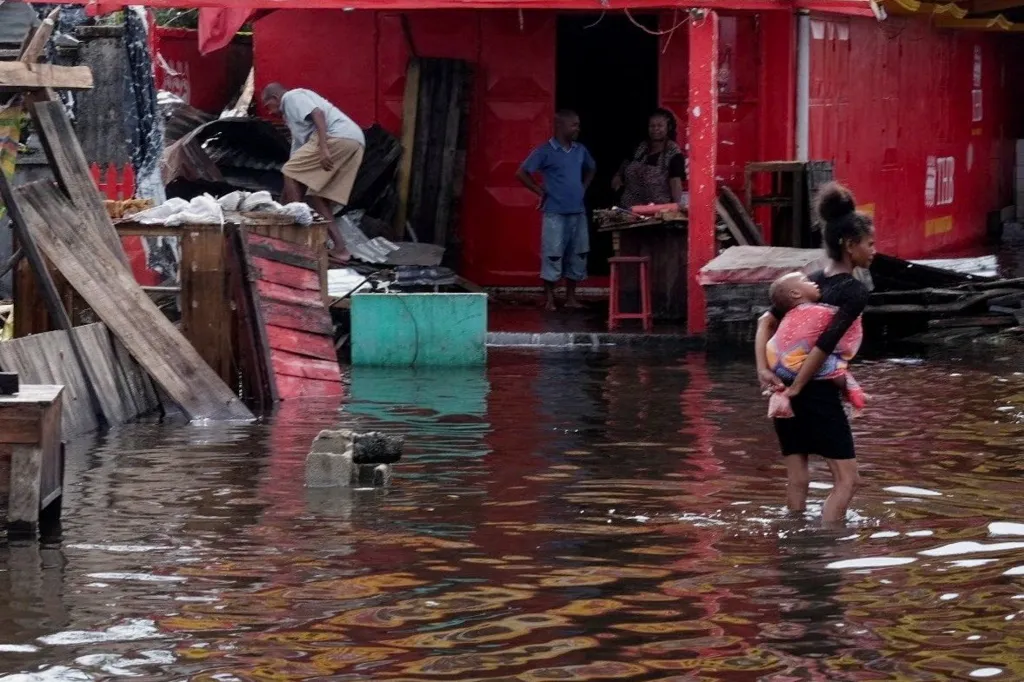
At least 35 people have died after a powerful cyclone struck Madagascar, says the disaster authority in the Indian Ocean island.
Cyclone Gezani made landfall on Tuesday, hitting the island’s main port, Toamasina. Madagascar’s disaster management office said there was “total chaos” – reporting that houses collapsed in the impact zone, where the bodies were found.
Neighbourhoods were plunged into darkness as power lines snapped, while trees were uprooted and roofs ripped off.
As many as 250,000 people are “affected or displaced”, Environment Minister Max Fontaine Andonirina told BBC Newsday on Thursday.
Huge challenges include “disruptions to food-supply chains, to the fuel transport, to the medical access, because most of the major roads are cut”, he added.
One resident described to the BBC how she and her family cowered inside as wind and rain lashed their home for six hours straight, before the windows smashed and water poured in.
“We are trying to do our best… It’s dangerous and I don’t know if there will be enough people to help us, even though the authorities are trying,” the woman, who gave her name as Denise, told BBC Newsday.
“It’s real and its worse” than it looks in videos being shared online, she added.
Gezani is the second cyclone to hit Madagascar this year. It comes 10 days after tropical cyclone Fytia killed 14 and displaced over 31,000 people, according to the UN’s humanitarian office.
The island’s rulers are now pleading for international help.
“What happened is a disaster, nearly 75% of the city of Toamasina was destroyed,” the country’s military leader Colonel Michael Randrianirina, who seized power in October, told the AFP news agency.
“The current situation exceeds Madagascar’s capabilities alone,” he added.
The cyclone’s landfall is likely to have been one of the most intense recorded around the city in the satellite era, according to the CMRS cyclone forecaster on France’s Reunion island, AFP reports.
The National Office for Risk and Disaster Management said many were killed when houses collapsed. Cyclone Gezani hit Toamasina – the country’s second-largest city – with winds reaching 250 km/hour (155 mph).
“It’s total chaos, 90% of house roofs have been blown off, entirely or in part,” the head of disaster management at the Action Against Hunger aid agency, Rija Randrianarisoa, told AFP.
All acknowledge that a huge amount of work needs to be done.
“It takes many, many years” to restore infrastructure and recover, Environment Minister Andonirina told the BBC, adding that parts of Madagascar ravaged by cyclones in the past three years still “have not been rebuilt as it was before”.
Cyclone season in the Indian Ocean around Madagascar normally lasts from November to April and sees around a dozen storms each year, AFP reports.
Madagascar’s disaster management office has evacuated dozens of injured people and hundreds of residents from a district around Toamasina, home to 400,000 people.
Residents in and around Toamasina described scenes of chaos as the cyclone made landfall. “I have never experienced winds this violent… The doors and windows are made of metal, but they are being violently shaken,” Harimanga Ranaivo told the Reuters news agency.
Ahead of the cyclone’s arrival, officials shuttered schools and rushed to prepare emergency shelters.
Later on Wednesday, its status was downgraded from cyclone to tropical storm.
As Gezani moves away from Madagascar and up through the Mozambican Channel, Mozambique’s National Meteorological Institute (INAM) say it does not expect it to make landfall, but that some inland areas may suffer heavy rain and wind.
Mozambique is still reeling from months of severe weather that has forced hundreds of thousands of people from their homes. Aid agencies fear an already desperate situation will become worse, with Oxfam warning that Gezani risks heaping “disaster upon disaster”.