By Andrew Kariuki
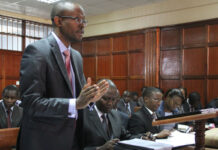
The High Court in Busia has declined to summon senior security officials in a case involving the alleged disappearance of a man, after finding that the identity of the missing person had not been sufficiently established.
In a ruling delivered on February 27, 2026, in Constitutional Petition No. E002 of 2026, Justice W. Musyoka held that it would be premature to compel top security officers to account for the whereabouts of the alleged missing person, Ahmed Mohamed Ibrahim, without clear proof of his identity.
The case was filed by petitioners led by Okiya Omtatah, who had moved the court under a certificate of urgency seeking orders of habeas corpus to compel state agencies to produce the missing individual, either alive or dead or provide a full account of his arrest, detention or whereabouts.
Upon initial consideration of the application, the court granted interim orders requiring the respondents to either produce Ahmed Mohamed Ibrahim or explain his whereabouts through sworn affidavits.
The matter was then set down for inter partes hearing.
However, when the case came up for hearing, the respondents, including the police, the National Intelligence Service, and other state agencies, denied having arrested or detained the individual.
In an affidavit sworn by a senior police officer, the state maintained that the case was not one of unlawful detention but of a missing person.
According to the respondents, a report had been filed at Busia Police Station indicating that the individual, identified as Ahmed Ibrahim, had boarded a bus from Busia to Nairobi but was allegedly abducted by unknown persons at Korinda.
They supported their position with various documents, including police reports, witness statements, call logs and a bus ticket.
Despite these submissions, the court noted that the respondents had not complied with the primary order requiring production of the individual or his body.
While an affidavit had been filed, it did not provide a definitive account of the alleged arrest or current whereabouts of the missing person.
The petitioners, on their part, sought further orders compelling senior officials, including the Inspector-General of Police, the Director of Criminal Investigations, the head of the Anti-Terrorism Police Unit and the Director General of the National Intelligence Service, to personally appear in court and explain the situation.
In declining to grant those orders, Justice Musyoka emphasized that the burden lay with the petitioners to first establish the identity and existence of the missing person.
“One thing that bothers me is that the papers filed by the petitioners have no annextures… They have attached no documents to establish that such a person exists or existed,” the judge observed.
He further noted inconsistencies in the name of the alleged victim, pointing out that the documents presented by the respondents referred to a person identified as Ahmed Ibrahim Ali, raising questions as to whether this was the same individual cited by the petitioners.
“So, who disappeared? Was it Ahmed Mohamed Ibrahim or Ahmed Ibrahim Ali? Are these two the same person?” the court posed, adding that the lack of clarity made it difficult to proceed with the orders sought.
The judge underscored that cases involving alleged disappearance are serious and often involve grave accusations against public officials, and therefore require precise and verifiable identification of the person in question.
“It would be a ‘leap in the dark’ to require accounts for an individual whose identity is not established. The law treasures precision and abhors uncertainty,” the court stated.
As a result, the court declined to summon the senior security officials at this stage, directing the petitioners to provide proper identification documents to substantiate the existence and identity of the alleged missing person.
The matter will be mentioned on March 11, 2026, for further directions.
The court also noted that some parties who had been joined in the proceedings had expressed surprise at their inclusion, indicating that any party against whom no allegations had been made would not be required to participate in the case.