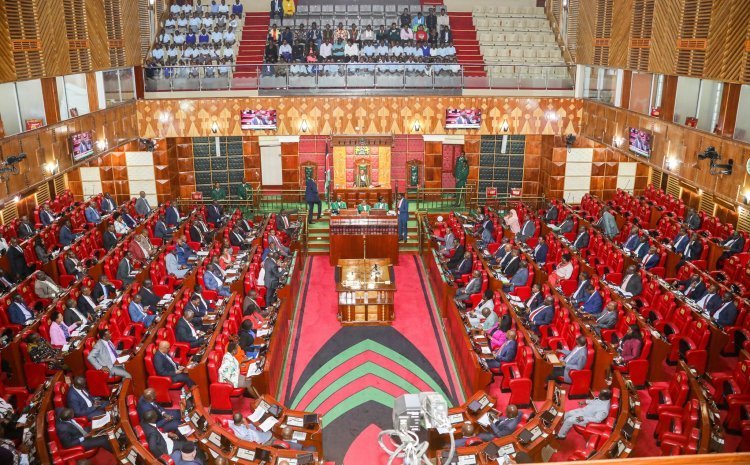
The National Assembly has passed the National Infrastructure Fund Bill (National Assembly Bill No. 1 of 2026), moving the legislation one step closer to becoming law.
The bill, introduced by Majority Leader Kimani Ichung’wah, underwent its third reading in the House before lawmakers voted on Thursday, March 5.
Following deliberations, a large majority of members approved the bill through the traditional “yea or nay” vote called by the Speaker. Effectively, the bill will now move to the President for assent, the final step before it becomes law.
The NIF aims to mobilise almost Ksh5 trillion over the next ten years, whose main objective is to transition infrastructure finance from a debt-led paradigm to an investment-led model.
The bill was subjected to the first reading, where it was introduced in the National Assembly, and at the Committee Stage, it underwent rigorous scrutiny, including stakeholder engagements, public hearings, and submissions from bodies like the Institute of Public Finance and ICPAK (Institute of Certified Public Accountants of Kenya).
It was later subjected to the second reading, which involved report tabling, where the Finance Committee had recommended the Bill.
The Fund seeks to shift infrastructure financing away from heavy public borrowing by mobilising private capital and alternative funding sources such as pension funds, collective investment schemes, sovereign wealth funds, and climate finance.
Legally structured as a body corporate, the Fund can own property, enter contracts, and invest in projects, but is barred from borrowing or taking credit against its balance sheet.
The fund will be overseen by a seven-member Board of Directors, chaired by an independent director, with the National Treasury Cabinet Secretary also sitting on the board.
The board will include four independent directors and two development banking experts, with strict rules barring members from recent government employment or political affiliations to safeguard independence.