The United Opposition has demanded a special National Assembly sitting to, among other things, outlaw the G-2-G fuel deal, accusing President William Ruto of playing a key role in the recent spike in pump prices.
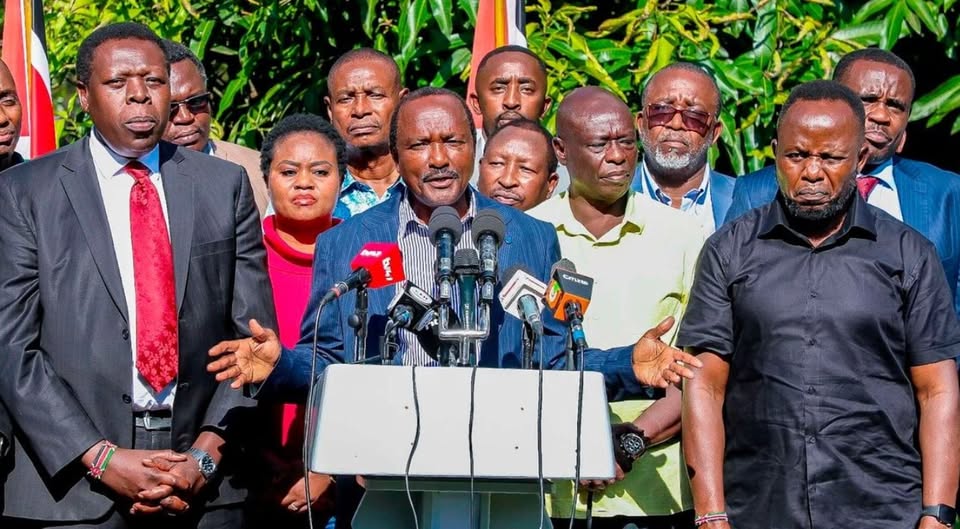
Addressing the press in Karen on Wednesday, opposition leaders also called for the resignation of Energy and Petroleum Cabinet Secretary Opiyo Wandayi and Trade Cabinet Secretary Lee Kinyanjui.
They further revealed what they termed as “intelligence” received from Kenyans regarding the fuel saga that emerged during the Easter holiday. According to Gachagua, President Ruto vetoed a decision by former Kenya Pipeline Company (KPC) Managing Director Joe Sang, former Energy and Petroleum Regulatory Authority (EPRA) officials, and former Petroleum Principal Secretary Liban Mohamed on emergency fuel importation.
“The three international companies in the G2G deal supply and distribute through six local oil marketing companies, but what was hidden from the public was the real culprits of this scandal. The team leaders are William Ruto, Felix Koskei (Head of Public Service), CS Opiyo Wandayi and a local company,” Gachagua claimed.
Gachagua alleged that on the nights of April 5 and 6, President Ruto dispatched a high-powered delegation led by Cabinet Secretary Opiyo Wandayi, Acting EPRA CEO Eng. Joseph Oketje, and other senior government officials, alongside Gulf Energy, to renegotiate new pricing with international oil companies.
He claimed that Gulf Energy, which he described as a “proxy of William Ruto”, acted as the nominated agent in the negotiations.
He further claimed that this meeting explains why CS Wandayi was unavailable when he was summoned by Parliament, alleging that he was in Dubai negotiating the new pricing structure to factor in what he described as President Ruto’s profit margins.
During the same press briefing, Gachagua made further allegations regarding the deal, accusing President Ruto of benefiting directly from the revised fuel prices. He claimed that following the new EPRA fuel review, which saw petrol prices rise by KSh28.69 and diesel by KSh40.30 per litre, President Ruto earns KSh5 per litre.
“Following the April 14, 2026, price adjustment, Mr. William Ruto will earn a profit of KSh5 for every litre consumed by the people of Kenya,” Gachagua stated.
He added, “This is the equivalent of KSh2.5 billion from the 500 million litres to be supplied for the region’s consumption.”
Gachagua further alleged that since the inception of the G-to-G agreement, President Ruto has earned KSh30 billion in profit from the supply of petroleum products to the region.
Based on these claims, he called for the scrapping of the implementation of the Ksh5 trillion National Infrastructure Fund (NIF) and proposed using proceeds from the sale of equity in Safaricom PLC and the Kenya Pipeline Company to cushion Kenyans from the adverse socioeconomic effects of rising fuel prices.
On taxation relief, Gachagua also demanded the suspension of the road maintenance levy, which was increased from KSh18 to KSh25 per litre of fuel, as well as the suspension of the 3 per cent affordable housing levy.
Additionally, the United Opposition called for the suspension of what it termed unwarranted National Social Security Fund (NSSF) deductions, which it described as punitive and allegedly used to finance single-source infrastructure projects.
They also demanded that Parliament remove Value Added Tax (VAT) on fuel products, stating that these demands constitute their irreducible minimum.
The United Opposition warned that if no action is taken by President Ruto, they would announce further measures to compel action.
“If there is no action taken on the part of William Ruto, we shall announce further measures to the people of Kenya to force William Ruto and the National Assembly to act in the best interest of the people of Kenya,” the United Opposition warned.