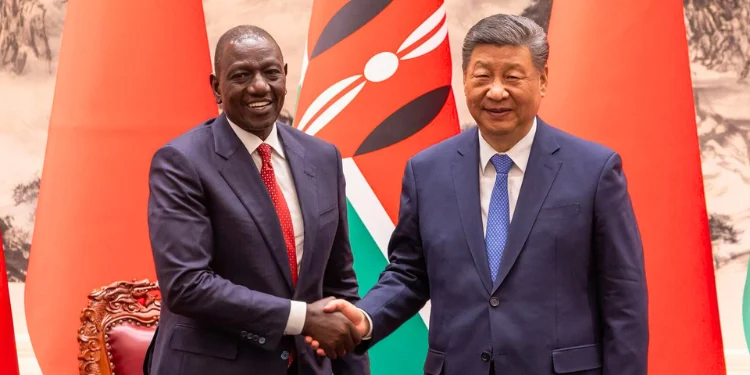
Kenyan exports will now enjoy expanded access to the Chinese market after the government announced a new zero-tariff arrangement.
In a statement on Friday, May 1, the Ministry of Trade said the agreement grants duty-free access to 98.2% of Kenyan exports to China.
The ministry explained that the zero-tariff policy begins immediately and applies to most exports under the Kenya-China Early Harvest Agreement.
“Starting today, May 1, 2026, products from African countries with diplomatic ties with China, including Kenya, will enjoy zero-tariff access to the Chinese market. Approximately 98.2% of Kenyan exports stand to benefit from the Kenya-China Early Harvest Agreement,” the statement read.
The ministry noted that the move signals a major shift in Kenya’s export trajectory and unlocks access to a massive global market.
“This marks a decisive new chapter for Kenya’s export growth and presents an immediate opportunity for Kenyan businesses to expand exports, increase earnings, and penetrate one of the world’s largest consumer markets,” the statement added.
According to the ministry, Kenya continues to face a significant trade imbalance with China despite growing bilateral trade.
In 2025, imports from China stood at USD 5.19 billion, while exports to China were approximately USD 130.68 million, resulting in a deficit of over USD 5.06 billion.
However, the ministry said the agreement is designed to directly address this imbalance by boosting exports and strengthening economic outcomes.
“With the agreement in place, Kenya has a clear pathway to narrow this imbalance, boost foreign exchange inflows, and support job creation across key sectors,” the statement further read.
Following this development, the government identified key export products expected to benefit immediately, including tea, coffee, avocados, macadamia nuts, and fresh horticultural produce.
Others are titanium ores, zirconium, manganese, leather, natural resins, and processed agricultural goods.
Exporters have also been directed to meet strict market requirements such as registration with relevant authorities and China’s customs agency, compliance with sanitary and phytosanitary standards, proper Chinese-language labelling, traceability systems, and complete export documentation.

The ministry assured that government agencies are actively supporting exporters to meet these standards and access the Chinese market efficiently.
“Government institutions are working closely with exporters to ensure they are certified, market-ready, and well-positioned to access the Chinese market,” the statement noted.
The ministry added that reforms are ongoing to ensure that administrative processes do not hinder exporters from benefiting from the zero-tariff framework.
“Efforts are also underway to streamline certification and customs processes to ensure that zero tariffs are matched by seamless market access,” the statement added.
The government also called on businesses to take immediate advantage of the opportunity by scaling operations and strengthening competitiveness.
“Kenyan businesses are called upon to act decisively by scaling production for export markets, investing in value addition and processing, strengthening compliance with international standards, and establishing direct linkages with Chinese buyers,” the statement concluded.