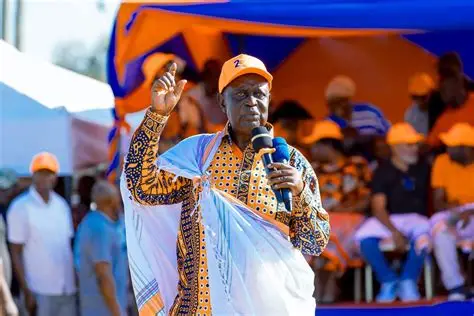
ODM leader Oburu Oginga has confirmed that he will seek re-election as the Senator of Siaya County in the 2027 General Election.
Speaking on Monday, May 25, Oburu made it clear that he intends to retain his current seat in the Senate.
“I will be defending my position as the Senator of Siaya County in 2027,” he stated.
Oburu was elected as the Senator for Siaya County in the 2022 General Election, succeeding James Orengo, who had left the Senate to contest the gubernatorial seat.
His election marked a return to a national parliamentary position after serving at the East African Legislative Assembly (EALA).
Oburu’s political journey began in the 1970s and 1980s when he served as a Councillor for Kisumu Municipality from 1974 to 1979.
He later worked as an economist in the Ministry of Planning and National Development between 1981 and 1994.
Between 1994 and 2013, Oburu served as the Member of Parliament for Bondo Constituency.
During this period, he was appointed Assistant Minister for Finance in the Grand Coalition Government, serving under President Mwai Kibaki and Prime Minister Raila Odinga.

From 2013 to 2017, Oburu served as a Nominated Member of Parliament in the National Assembly, representing the ODM party.
He later moved to regional politics and served as Kenya’s representative to the East African Legislative Assembly (EALA) from 2017 to 2022.
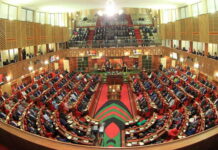
In the Senate, Oburu has served on various committees and taken leadership roles, including chairing the Senate Committee on Energy.
This development comes a week after a TIFA poll showed that Oburu’s Linda Ground faction is less popular among ODM supporters than Linda Mwananchi.
According to a TIFA Research poll released on Thursday, May 14, 73 percent of ODM supporters prefer the faction led by embattled Secretary General Edwin Sifuna.
The Linda Ground faction has only the backing of 24 per cent of ODM members, while 3 per cent remain undecided on which faction to support.
“ODM supporters appear to favour a more independent, people-centred opposition approach rather than closer cooperation with the government.
“The strong backing for the ‘Linda Mwananchi’ faction suggests growing grassroots preference for leaders perceived as defending public interests and holding government accountable,” the report read.
Oburu further faces a new challenge after the poll revealed that ODM’s popularity in the country dropped significantly from the last election cycle.
As of May 2026, ODM enjoyed the support of only 18 percent of Kenyans, a drop from 32 percent in August 2022.
The broad-based government partners, UDA, also saw a decrease in support from 38 percent in August 2022 to 17 percent in May 2026.
Notably, the number of Kenyans who support the broad-based government dropped in the last six months, while those who opposed the arrangement increased.
“TIFA’s last four surveys reveal that while support for the BBG is higher than it was a year ago, the increase in its support seen over the previous two surveys (from 22% to 29% and then 44%) has now dropped, nearly returning to its modest August 2025 level (30% vs. 29%).
“The proportion of those expressing opposition to it has conversely increased since TIFA’s November survey (from 48% to 56%),” the report added.