Amref Health Africa, in partnership with Safaricom Foundation and the county government of Kilifi has launched a digital monitoring system that allows pregnant women in Kilifi County to track their health and access emergency care via their mobile phones.
The innovative system, dubbed “Uzazi Salama” (Safe Delivery), was officially unveiled in Bamba by Amref’s Country Director, Dr. Ndirangu Wanjuki, Safaricom Foundation’s Michael Joseph and Kilifi governor Gideon Mung’aro.
Speaking after the launch, Wanjuki emphasised that the technology will enable continuous remote monitoring of expectant mothers throughout their pregnancies to ensure safer childbirth.
“Through this system, we are following pregnant women to guarantee they deliver safely. It allows them to understand their pregnancy status and seek medical help swiftly whenever they face challenges, all through their phones,” stated Dr Wanjuki.
The initiative is a multi-partner collaboration aimed at strengthening Kilifi’s healthcare sector. Dr. Wanjuki reported that the program has already registered and is actively monitoring 5,000 women.
He also commended the Kilifi County Government under Governor Mung’aro for its collaborative approach with various organisations, which he noted has been instrumental in revitalising the region’s health sector.
Dr. Wanjuki announced a parallel push to register more women into the national Social Health Authority (SHA) insurance scheme. “We will ensure we help many mothers enrol in SHA health insurance so they can access quality treatment,” he affirmed.
This dual strategy, combining real-time digital health tracking with efforts to expand financial protection, is a comprehensive approach to improving maternal and child health outcomes in Kilifi County.
Kilifi County remains one of the 13 high-burden counties for maternal and newborn mortality in Kenya, with a maternal mortality rate of 532 deaths per 100,000 live births, according to the Kenya National Bureau of Statistics (2019). The high mortality rate has been linked to teenage pregnancies, long distances to health facilities, postpartum haemorrhage, poverty and harmful cultural practices such as early marriages.
The Uzazi Salama programme is aligned with the Maternal and Newborn Health Big Bet initiative, established by Amref Health Africa in collaboration with the Ministry of Health, which seeks to drastically reduce maternal and newborn deaths in high-burden counties, including Kilifi.
M-PESA Foundation Chairman Michael Joseph said the foundation has prioritised maternal and child health as a key pillar of its work, noting that the Uzazi Salama programme has already impacted more than 350,000 people in Samburu and Homa Bay counties.
“We hope to reach even more families here in Kilifi by ensuring mothers and children receive quality care from pregnancy through childbirth and the postnatal period,” she said.
Kilifi Governor Gideon Mung’aro expressed optimism that the initiative will significantly reduce maternal and newborn deaths in the county. He noted that the programme will improve access to night-time maternity services, reduce long-distance travel for expectant mothers and ease congestion in referral hospitals by strengthening lower-level health facilities.
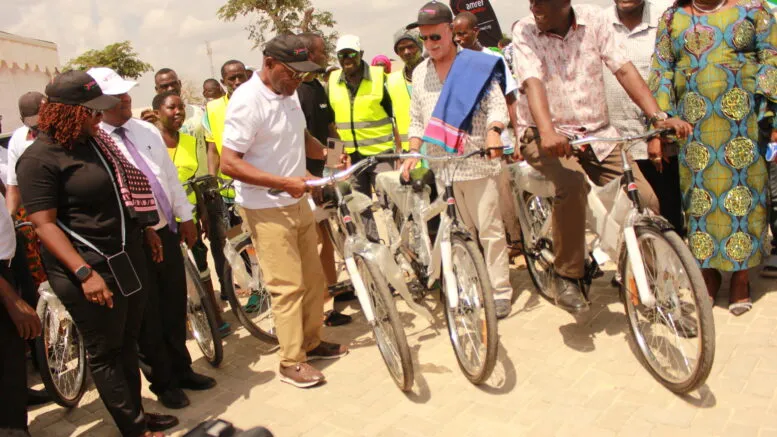
The governor also led a groundbreaking ceremony for a 41-bed capacity maternity wing at the Bamba sub-county hospital. He also distributed 200 bicycles to community health promoters in the area.
Beyond healthcare infrastructure, the Uzazi Salama project will also address social determinants of health by promoting positive gender and social norms, enhancing male involvement, leveraging technology in education, reducing teenage pregnancies and tackling poverty and gender disparities.
Under the Maternal and Newborn Health Big Bet, Amref Health Africa has identified four key game-changers to improve outcomes in 60 referral health facilities across high-burden counties.
These include the establishment of High Response Maternity Units, strengthening neonatal emergency response systems, reinforcing primary healthcare, and enhancing accountability for every mother and newborn.