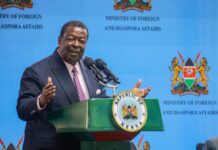
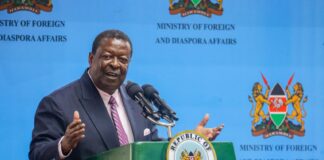
National Assembly Speaker Moses Wetangula is facing fresh ouster bids after Ann Nderitu, the Political Parties Registrar, challenged his leadership status within Ford Kenya.
The scrutiny centers on Wetangula’s dual capacity as Speaker and party leader, igniting a heated debate about the potential conflict of interest and the proper exercise of his duties.
The case, now before the court, raises critical questions about the intersection of political office and party affiliation in the wake of rapidly evolving political dynamics.
During court proceedings, Nderitu revealed that she had reached out to Ford Kenya to clarify Wetang’ula’s status, which provoked public debate regarding the appropriateness of a public officer simultaneously holding a political party leadership position.
In her correspondence, she expressed concerns about the implications of Wetang’ula’s combined roles, stating, “This office has been drawn to the concerns in the public domain, with regard to the Speaker of the National Assembly being the Ford Kenya party leader.”
While the party’s legal representatives responded that there are no existing laws prohibiting the Speaker from retaining his party position, Nderitu accepted their explanation.
Kibe Mungai, representing several concerned parties, argued vehemently that Wetang’ula’s continued association with Ford Kenya and the Kenya Kwanza Alliance undermines the neutrality expected of the Speaker’s office.
Mungai asserted that Wetang’ula lacked the authority to determine the majority or minority status within the National Assembly, claiming that these positions were predetermined during the electoral process.
“The National Assembly had already asked the Registrar of Political Parties who was in which party. It was not within the powers of the National Assembly Speaker to alter the gazetted mandate of the people of Kenya,” he argued.
Mungai characterized Wetang’ula’s simultaneous political engagements as fundamentally partisan, in stark opposition to the objectivity required of parliamentary leadership.
He highlighted that the Independent Electoral and Boundaries Commission had confirmed the majority status of Azimio with 171 members compared to Kenya Kwanza’s 165, refuting Wetang’ula’s claim to the contrary.
Wetang’ula, however, contended that he had been wrongly implicated in the lawsuit and maintained that the matter should be addressed through the Political Parties Disputes Tribunal (PPDT) rather than in civil court. He asserted that the case’s complexities intertwined various issues, including the Finance Act, warranting dismissal.
His defense attorney, Judy Guserwa, reinforced Wetang’ula’s position, declaring that he could not be personally pursued in civil or criminal court regarding this matter.
Conversely, Azimio La Umoja and Jubilee coalitions have openly supported the case, with lawyer Arnold Oginga challenging the notion that the PPDT holds exclusive jurisdiction over parliamentary issues.
“The right forum to decide this case, given the polycentricity of this matter, is here in this court,” Oginga argued, asserting that the Speaker remains subject to judicial oversight.
Justices Ngaah, Chigiti, and Mugambi are poised to deliver their verdict in February next year.