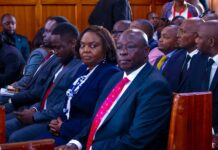
The High Court has ruled that public and state officers are ineligible to run for Speaker of county and national assemblies.
Justice Hellen Ong’udi ruled that civil servants planning to run for Speaker should have resigned on or before February 9 — six months before the General Election — just like their colleagues who resigned to run for political seats.
“It must be borne in mind that the qualifications for a Speaker of the county assembly are similar to those of a member of the county assembly. Similarly, those of the Speaker of the National Assembly and the Senate are similar to those of the MPs and the Senate respectively. One of the disqualifications is if any one of them is a state officer or public officer. This applies to all the houses,” she said.
She stated that Section 43(5) of the Elections Act, which states that a public officer intending to run for office must resign at least six months before the election date, applies equally to a public officer seeking to be elected as speaker of the county assembly or any House of Parliament.
The judge made the decision while dismissing a petition filed by Mr. Phillip Langat, who asked the court to rule that the resignation requirement does not apply to people running for county assembly speaker.
The petitioner contended that the law requiring resignation was unconstitutional, discriminatory, unfair, unreasonable, and disproportionate.
Mr. Langat argued that public officers intending to run for county Speaker’s seat are not bound by the law, claiming that the Speaker of the county assembly is an ex-officio member and thus his/her membership is not through election or nomination.
“Election of the Speaker is presided over by the clerk of the respective county assembly and not the Independent Electoral and Boundaries Commission (IEBC). The election date for the Speaker is neither predetermined nor known and the seat becomes due only after a general election. Hence any public officer intending to contend for that seat needs not to resign as stipulated in the Act,” said Mr. Langat.
He argued that, unlike other elective seats, the Speaker only becomes a member of the assembly after being chosen by elected and nominated members of the county assembly.
As a result, the process of selecting the Speaker is not an election as defined by Article 38(2) of the Constitution, as read with Article 81(d), and, by extension, Section 43(5) of the Elections Act of 2011.