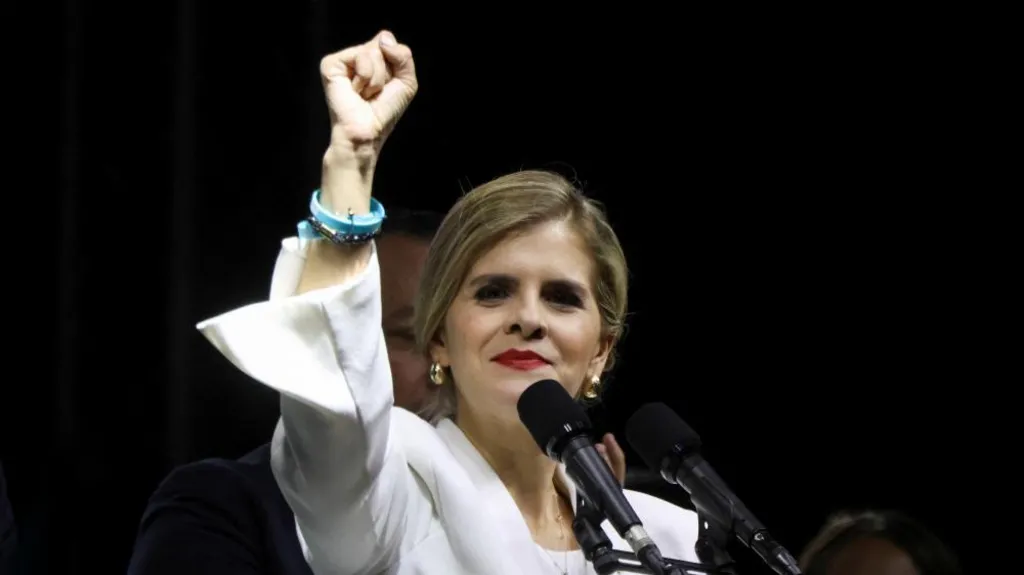
Laura Fernandez, a conservative, populist politician with strong links to outgoing President Rodrigo Chaves, has won nearly half of the votes in Costa Rica‘s general election with 94% of votes counted, meaning she will become the country’s new leader.
Her victory confirms a strong rightward trend in Latin America, where voter anger at corruption and crime has driven recent conservative wins in Chile, Bolivia, Argentina and Honduras.
What were the election results in Costa Rica?
Fernandez had won 48.3% of the vote, the preliminary results from the Supreme Electoral Tribunal (TSE) showed, far in excess of the 40% needed to avoid a run-off.
Fernandez’s party, the Sovereign People’s Party, is also projected to win a majority of 30 seats in the 57-seat Congress, up from its current eight seats.
The other main candidates in the election lagged far behind Fernandez, with economist Alvaro Ramos receiving about one third of the vote, and architect and former first lady Claudia Dobles taking under 5%.
Costa Rica, a country of some 5 million inhabitants, has so far had only one female president in its history, Laura Chinchilla, who served from 2010 to 2014.


Fernandez vows ‘deep and irreversible’ change
Fernandez is a protege and former chief of staff to Chaves, and has vowed to keep on with his tough security policies, while including the widely popular former president in her government.
Under current Costa Rican law, Chaves is barred from seeking re-election until he has been out of power for eight years.
“Change will be deep and irreversible,” Fernandez said during her victory speech, while declaring that under her, Costa Rica would enter a new political era.
“It’s up to us to build the third republic,” she told supporters, with the country’s second republic following a civil war in 1948 “a thing of the past.”
She vowed to “fight tirelessly” to ensure Costa Rica “continues on the path of economic growth, freedom, and above all, the progress of our people.”
She has also promised to uphold the country’s constitution, amid fears in some quarters that she could use her term in power to change rules on presidential mandates.
Promises to fight drug-fueled crime
Foremost among her promises is a vow to crack down on rising violence and crime linked to the cocaine trade.
Although Costa Rica was long considered a model for stability and democracy in Central America, it has now become a central link in the global drug trade.

Its murder rate has climbed 50% in the past six years to 17 per 100,000 inhabitants amid turf wars by Mexican and Colombian cartels.
Fernandez’ victory comes as polls show that the fight against crime topped the concerns of the country’s 3.7 million eligible voters.
She has said she intends to emulate the president of El Salvador, Nayib Bukele, who has pursued a strategy of jailing thousands of suspected gang members without charge in a bid to reduce the crime rate.
Among other things, she has promised to complete construction of a maximum-security prison modelled on Bukele’s Terrorism Confinement Center (CECOT), a facility notorious for the brutal treatment meted out to its inmates.
She has also promised to introduce harsher prison sentences and to impose a Bukele-style state of emergency in those areas with the most crime.