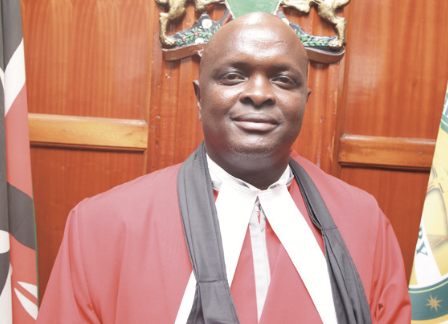
The High Court in Nairobi has ordered the forfeiture of a motor vehicle and bank funds belonging to Ahmed Nur Amin after ruling that the property was linked to drug trafficking and money laundering activities. Delivering judgment, Justice B.M. Musyoki (pictured below) found that the Asset Recovery Agency (ARA) had proved, on a balance of probabilities, that the seized assets were proceeds of crime within the meaning of the Proceeds of Crime and Anti-Money Laundering Act.
The case stemmed from an incident on 24 October 2024, when a vehicle was intercepted along the Garbatulla–Isiolo highway after defying police orders to stop.
Officers fired at its tyres, prompting the occupants to flee and abandon the car.
A search revealed 44 bales of plant material weighing 222.35 kilograms, later confirmed to be cannabis sativa with a street value of over Ksh6.6 million.
The vehicle was traced back to Ahmed Nur Amin, who was subsequently charged in Isiolo with drug trafficking.
ARA sought forfeiture of the car and a cash balance of Ksh198,639.85 held in an account at Absa Bank’s Meru branch.
The Agency told the court that both the vehicle and the money were tied to a laundering network involving the respondent and his associates.
Investigators reported that Amin’s M-Pesa line had received more than Ksh77 million between 2020 and 2024 and that his bank transactions, including deposits made after the seizure of his M-Pesa line, reflected unexplained financial activity.
His sisters, who were also found to be transacting with other suspects previously linked to narcotics cases, were cited as part of the wider network.
In response, Amin claimed he was a miraa and sugar trader and had hired out the vehicle to a man identified as Ali Mohamed Hussein for a burial trip.
He insisted he was at home in Meru when the vehicle was abandoned and maintained that money transferred between him and his sisters was for legitimate business.
He also argued that the ARA had ignored proof that he purchased the vehicle from relatives and had no knowledge of the contraband found in it.
The court rejected his defence, finding significant inconsistencies. Justice Musyoki noted that the hiring agreement relied on by the respondent was drafted after the vehicle had already been impounded, and evidence showed it was prepared in the office of an advocate who was already deceased at the time. The court described the document as an attempt to sanitise the respondent’s actions.
The judge also questioned why the respondent had not contacted the alleged hirer, had not taken basic identification details, and made no effort to follow up on the vehicle once the hire period ended.
The claimed miraa and sugar business was found to have no supporting records, while Nairobi City County confirmed that his sisters did not hold any valid licences for the wholesale business said to justify their financial transfers.
The court held that ARA had established a prima facie case showing that the property was connected to unlawful activity, and the burden had shifted to Amin to demonstrate legitimate sources of income.
He failed to do so.
Justice Musyoki emphasized that civil forfeiture does not depend on the outcome of a criminal case and is instead concerned with whether the property itself is tainted.
Consequently, the court ordered the forfeiture of the vehicle to the Asset Recovery Agency and directed the NTSA Director-General to facilitate its transfer.
It also ordered the transfer of the funds in the Absa account, together with accrued interest, to the Criminals Assets Recovery Fund at KCB’s KICC branch.
Amin was additionally ordered to pay the costs of the suit.
By Peter John