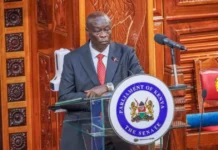
The High Court has upheld the process through which Kithure Kindiki was nominated and approved as Deputy President, finding that the proceedings were conducted in an open, transparent and constitutionally compliant manner.
Delivering the judgement on behalf of a three-judge bench, Justice Freda Mugambi held that the parliamentary process did not violate constitutional requirements on public participation.
The bench noted that the nature of the decision fell within a category of legislative action where openness and accountability, rather than public hearings, are determinative.
“Public participation, the purpose of which is to inform the narrative and policy of citizen-orientated public decision-making, would add nothing of constitutional value to a binary vote of this character,” the court stated.
The bench further observed that even where the concept of public participation is broadly interpreted, the circumstances surrounding the nomination and approval of the Deputy President nominee did not require a structured public engagement process.
The court instead emphasised that the proceedings in the National Assembly met the constitutional threshold through openness, accessibility and institutional transparency.
“We do find that the proceedings of the National Assembly on the nomination of His Excellency Kindiki were conducted in a fully open and transparent manner,” Justice Mugambi said.
According to the court, the debate on the nomination was conducted in public view, with multiple safeguards ensuring accountability.
Members of the public, the judge said, were able to follow the proceedings through live broadcasts, while official parliamentary records captured the full debate.
“The debate was televised, the proceedings were recorded in Hansard, the press was free to report, and members of Parliament were directly accountable to their constituents for the manner in which they exercised their votes,” the judgement noted.
The bench held that such openness satisfied the constitutional expectation that Parliament conducts its business transparently under Article 118(1)(a), which requires legislative bodies to ensure that their proceedings are conducted in an open manner.
“We are therefore satisfied that this openness and transparency, which is the constitutional core of Article 118(1)(a)’s requirement that Parliament conducts its business in an open manner, was amply satisfied,” Justice Mugambi stated.
The court further clarified that not all parliamentary decisions automatically trigger the requirement for direct public participation, particularly where the decision involves a vote within the National Assembly acting within its constitutional mandate.
In this case, the judges found that the approval of the Deputy President nominee was a structured parliamentary vote rather than a policy-formulating process requiring public consultation.
“For the foregoing reasons, we hold that public participation was not constitutionally required for the nomination and approval of His Excellency Kindiki as Deputy President under Article 149(1),” the court ruled.
The decision effectively dismissed arguments challenging the legality of Kindiki’s approval process, with the court affirming that Parliament acted within its constitutional authority.