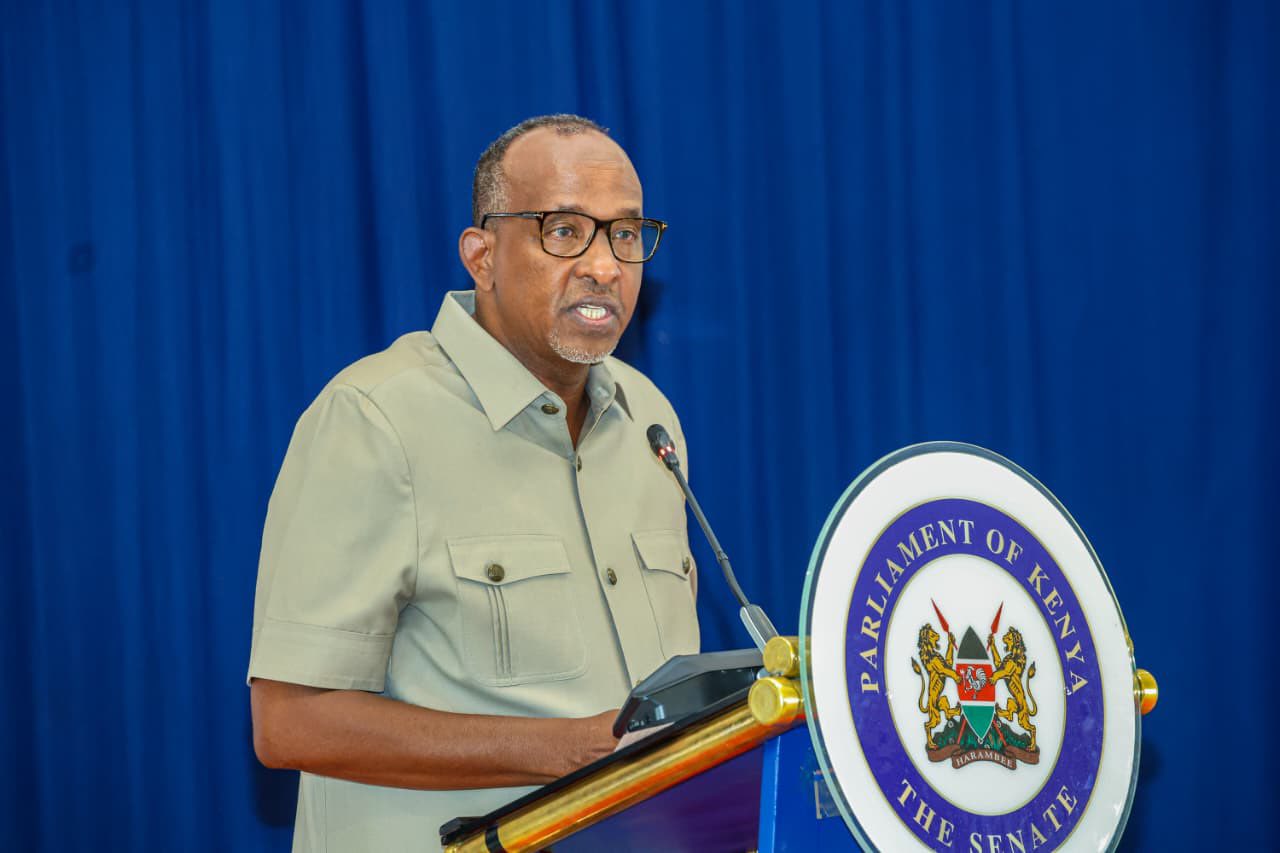
The government has rejected Sh12.7 billion worth of alleged fraudulent claims through the digital system running the Social Health Authority, Health CS Aden Duale has said.
He said this as he insisted that there has been no loss of Sh11 billion from the Social Health Authority.
“This figure—which currently stands at Sh12.7 billion as of today—represents claims that were flagged, rejected and unpaid by our new digital gatekeeper.
Therefore, this represents money saved, not lost,” Duale said.
He was addressing senators during their retreat in Naivasha.
Duale said the fraud detection was enabled by an artificial intelligence-driven claims management system that blocks suspicious billing before payment.
He said 1,188 fraudulent files had been forwarded to the Directorate of Criminal Investigations, with 26 suspects already charged in court and 248 health facilities under probe.
Duale told the Senate that the transition from the defunct NHIF to the Social Health Authority had stabilised health financing and improved accountability.
He said SHA has so far registered 29.7 million Kenyans, collected Sh142.78 billion in contributions and paid Sh105 billion to healthcare providers, achieving a claims settlement rate of 73 per cent.
The CS said the government has sponsored 558,000 vulnerable households under the Social Health Insurance Fund, while counties, NG-CDF and development partners have supported more than 62,000 others.
Murang’a county was singled out for fully paying premiums for 38,000 indigent households.
The CS said free primary healthcare is being rolled out across all counties, with more than 8 million Kenyans already accessing services without paying at Level 2 and 3 facilities.
He cited the “Lipa SHA Pole Pole” initiative, which allows informal sector workers to make small instalment contributions, noting that over 411,000 active payers had raised Sh1.4 billion.
On overseas treatment, Duale announced new strict rules to curb abuse of the scheme.
Only 39 procedures not available locally will qualify for foreign referrals, each capped at Sh500,000 and subject to peer review.
Hospitals abroad must also be pre-approved and linked to local facilities to ensure continuity of care.
Duale defended devolution in health, saying it had expanded access through functional Level 4 and 5 hospitals in all 47 counties.
He urged senators, led by Amason Kingi, to support legislation and funding to sustain the reforms.
He called for urgent exchequer releases of Sh5.9 billion to clear pending primary healthcare claims, a supplementary budget of Sh11.9 billion to cover projected deficits and Sh2.04 billion to support the maternity package.
The CS also warned counties against replacing their health allocations with facility improvement funds, saying the practice undermines the intent of the law that allows hospitals to retain revenue for service upgrades.
On digitisation, he said 10,277 health facilities have been linked to the Taifa Care system, with more than 30,000 digital devices deployed and health data now hosted locally under a new Kenya–US partnership to safeguard sovereignty.
Duale said the ministry had also regularised the status of medical interns, formalised and equipped 107,000 community health promoters and invested Sh6.18 billion in diagnostic equipment under the National Equipment Support Programme.
He added that Kenya is expanding laboratory networks and emergency operations centres through the Kenya National Public Health Institute to strengthen pandemic preparedness, while Kenyatta National Hospital has established a tissue-matching laboratory to support organ transplants locally.
Despite the progress, Duale acknowledged challenges in harmonising health laws and pushing through the Quality Healthcare and Patient Safety Bill, which he said is critical to standardising care.
“The state of our healthcare is transforming. We have moved from a deficit-ridden NHIF to a surplus-generating SHA, stopped the haemorrhage of public funds and redirected resources to the mwananchi,” he said.
The CS urged senators to provide legislative backing and oversight to anchor the gains and ensure universal health coverage becomes a reality.