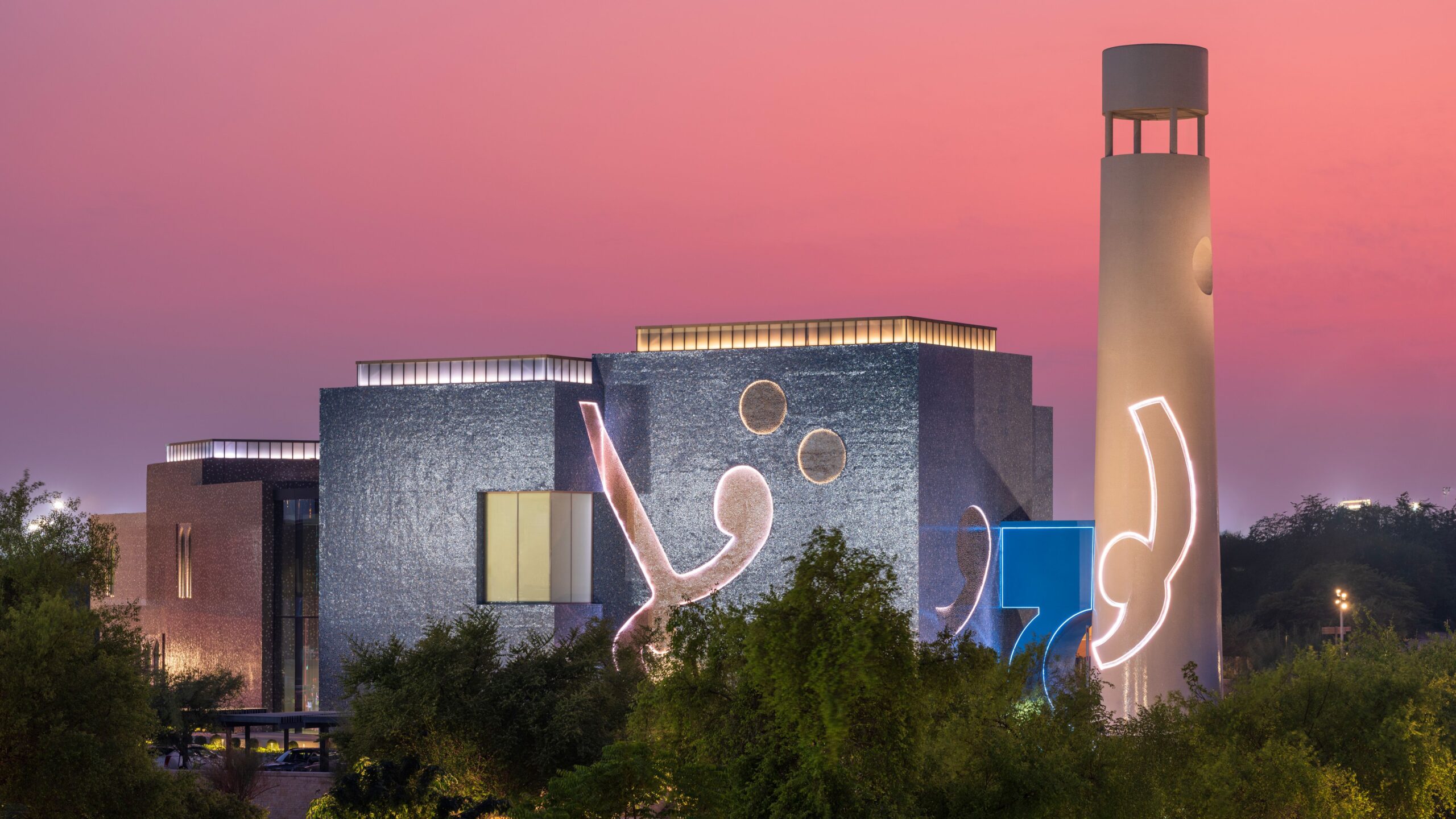
On the edge of Doha, a new grey-blue building rises like a sketch against the sky. Its shimmering tiles shift with the sun, casting geometric shadows, and the structure itself seems to lean forward, as if eager to tell a story.
This is Lawh Wa Qalam (The Pen and the Tablet), the world’s first museum dedicated to the legendary Indian artist MF Husain. Opened last week in Qatar Foundation’s Education City, the 3,000-square-meter space honors the prolific and provocative painter who spent his final years in Qatar and was granted citizenship in 2010.
Inside, more than 150 works—paintings, sculptures, films, tapestries, and photographs—map the astonishing breadth of Husain’s seven-decade career. The collection offers a rare window into the artist’s late-life reflections, curated to fulfill his own wish for the space to feel like a home.
“We want visitors to experience the world as he did, in an intimate, playful, and reflective manner,” says curator Noof Mohammed.
Few artists traveled as widely, or as imaginatively, as Husain. His dynamic, muscular horses remain among the most prized and recognizable images in contemporary Indian art, commanding millions at auction. With a nomadic and bohemian spirit, he moved seamlessly between Cubist-inspired modernism and traditional Indian themes, creating bold, vibrant canvases drawn from history and mythology. His distinctive style earned him the moniker “the Picasso of India,” though his forays into Bollywood filmmaking proved less successful.
Yet Husain’s career was never without controversy. His paintings of nude Hindu goddesses ignited fury among hardline groups, who accused him of obscenity. The resulting legal battles and threats eventually forced him into a self-imposed exile—a poignant chapter that adds a layer of complexity to the celebratory narrative now housed within Doha’s serene, sun-dappled walls.
The museum stands not just as a tribute to an artist, but as a sanctuary for a legacy that was often contested, inviting visitors to wander through the mind of a man who painted, dreamed, and lived in relentless, vivid color.
By James Kisoo