By Andrew Kariuki
Residents across parts of the Middle East have reported hearing explosions and air defence activity as regional tensions sharply escalate following joint United States and Israeli air strikes on Iran.
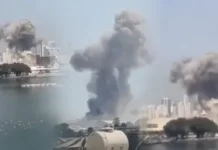
In Qatar’s capital, Doha, multiple explosions were heard as the country’s defence ministry confirmed it had intercepted several missiles believed to be targeting the Al Udeid Air Base, the largest American military installation in the region.
Authorities stated that the attempted strikes caused no reported damage.
Emergency alerts were issued to residents, urging them to remain indoors as a precaution.
While some traffic remained on the roads, movement was noticeably reduced compared to normal conditions, reflecting heightened concern among the public.
Similar incidents were reported across neighbouring countries, including the United Arab Emirates, Bahrain and Kuwait, where air defence systems were also activated.
In the UAE, state media reported that one person was killed after missiles were intercepted, marking one of the few confirmed casualties linked to the unfolding situation.
In Bahrain, officials confirmed that missiles struck near a United States naval installation, which hosts the US Fifth Fleet. However, the extent of any damage has not yet been made clear.
The developments come amid rising hostilities between Iran and its regional adversaries.
Iran had previously warned that it would target US military installations across the region if it came under attack, and the recent incidents appear to be in line with those threats.
Iran’s Supreme National Security Council has since issued a strongly worded statement promising what it described as a “crushing response” to the strikes, noting that the attacks occurred during ongoing diplomatic engagements with Washington.
According to the council, Iran’s armed forces have already begun retaliatory measures, while accusing its adversaries of attempting to force concessions through military pressure.
The statement warned that further operations could take place in Tehran and other cities, advising civilians to remain calm while taking necessary precautions.
Authorities in Iran have also introduced a series of internal measures, including keeping schools and universities closed, reducing government operations to half capacity, and urging citizens to avoid crowded areas.
Officials further assured the public that essential supplies remain available and there is no immediate risk to basic needs.
Iran’s Foreign Ministry acknowledged that it had been aware of the possibility of strikes by the United States and Israel but stated that diplomatic engagement had continued regardless.
The latest escalation follows a series of stalled negotiations, including recent talks in Geneva that failed to produce a breakthrough.
Meanwhile, international actors have expressed concern over the rapidly deteriorating situation. The United Kingdom has indicated that it was not involved in the strikes, while also warning against further escalation. Officials emphasized that their immediate priority is the safety of their nationals in the region.
Monitoring groups have also reported a near-total internet blackout in Iran, raising concerns over access to information and communication within the country as the situation unfolds.
As missile interceptions, air defence responses and retaliatory threats continue to emerge across multiple countries, fears are growing that the crisis could expand into a broader regional conflict, with significant implications for global security.