Scientists at the University of Cambridge have developed a new way to alter complex drug molecules using light rather than toxic chemicals—a discovery that could accelerate and improve how medicines are designed and made. Published in Nature Synthesis, the study introduces what the team calls an “anti-Friedel–Crafts” reaction.
A classic Friedel–Crafts reaction uses strong chemicals or metal catalysts under harsh experimental conditions. This means the reaction can only happen in the early stages of drug manufacturing, and is followed by many additional chemical steps to produce the final drug.
The new Cambridge approach reverses that pattern, allowing scientists to modify drug molecules at the final stages of production.
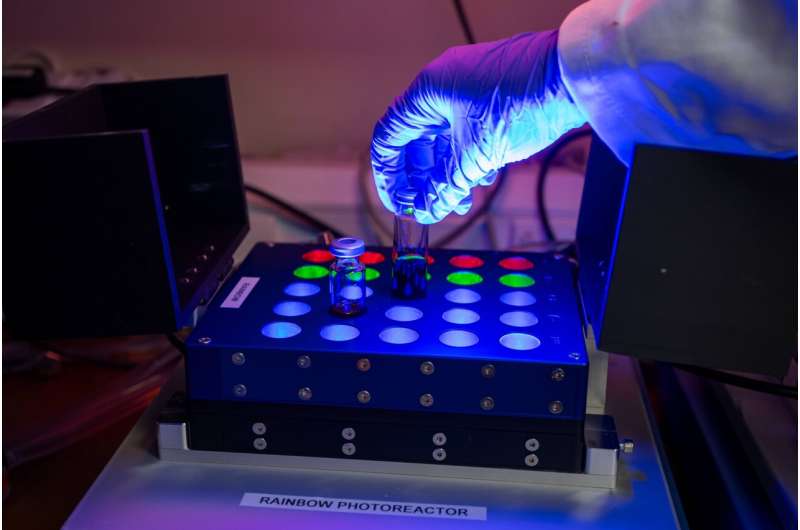
Rather than relying on heavy metal catalysts, the chemistry is powered by an LED lamp at ambient temperature. When activated, it triggers a self-sustaining chain process that forges new carbon–carbon bonds under mild conditions and without toxic or expensive chemicals.
In practical terms, this means chemists can make targeted changes late in the development of a new or existing drug rather than dismantling and rebuilding complex molecules from scratch—a process that can otherwise take months.
“We’ve found a new way to make precise changes to complex drug molecules, particularly ones that have been exceptionally difficult to modify in the past,” said David Vahey, first author and a Ph.D. researcher at St John’s College, Cambridge.
“Scientists can spend months rebuilding large parts of a molecule just to test one small change. Now, instead of doing a multistep process for hundreds of molecules, scientists can start with their hit and make small modifications later on.”
Vahey is a member of Professor Erwin Reisner’s research group at Cambridge. Reisner’s group is known for developing systems inspired by photosynthesis, using sunlight to convert certain types of waste, water, and the greenhouse gas carbon dioxide into useful chemicals and fuels.
Reisner, Professor of Energy and Sustainability in the Yusuf Hamied Department of Chemistry, lead author of the paper, said the importance of the latest work lies in expanding what chemists can do under practical conditions while developing greener manufacturing methods.
“This is a new way to make a fundamental carbon–carbon bond and that’s why the potential impact is so great. It also means chemists can avoid an undesirable and inefficient drug modification process.”
The team demonstrated the reaction across a wide range of drug-like molecules and showed it could be adapted to continuous-flow systems increasingly used in industry. Collaboration with AstraZeneca helped test whether the method could meet the practical and environmental demands of large-scale pharmaceutical development.
“Transitioning the chemical industry to a sustainable industry is arguably one of the most difficult parts of the whole energy transition,” explained Reisner.
The breakthrough came from a laboratory setback, like some of science’s most famous discoveries, from X-rays and penicillin to Viagra and modern weight-loss drugs.
“Failure after failure, then we found something we weren’t expecting in the mess—a real diamond in the rough. And it is all thanks to a failed control experiment,” Vahey said.
He had been testing a photocatalyst when he removed it as part of a control test and found the reaction worked just as well, and in some cases better, without it.
At first, the unusual product appeared to be a mistake. Instead of discarding it, the team decided to understand what it meant. Reisner said the breakthrough depended not just on chemistry, but on judgment.
“Recognizing the value in the unexpected is probably one of the key characteristics of a successful scientist,” he said.