The Energy & Petroleum Regulatory Authority (EPRA) has announced that maximum retail prices for petroleum products in Kenya will remain unchanged for the period March 15 to April 14, 2026.
In Nairobi, Super Petrol, Diesel and Kerosene now retail at Sh178.28, Sh166.54 and Sh152.78, respectively, effective midnight for the next 30 days.
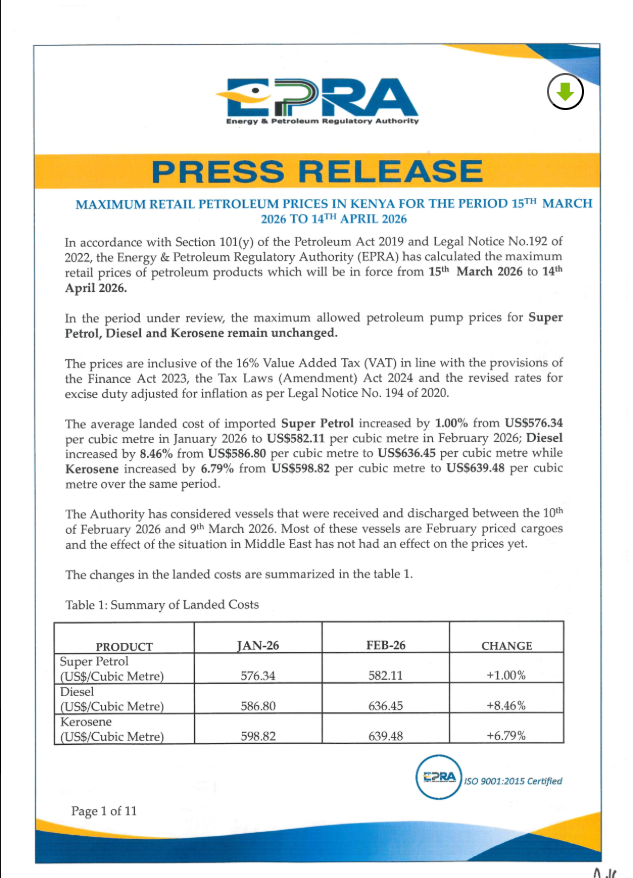
The prices are inclusive of the 16 per cent Value Added Tax (VAT), in accordance with the Finance Act 2023, the Tax Laws (Amendment) Act 2024, and revised excise duty rates as per Legal Notice No. 194 of 2020.
Daniel Kiptoo Bargoria, EPRA’s Director General, explained that the decision follows a careful review of imported petroleum costs.
“The average landed cost of imported Super Petrol increased by 1.00 per cent from US$576.34 per cubic metre in January 2026 to US$582.11 per cubic metre in February 2026. Diesel increased by 8.46 per cent from US$586.80 per cubic metre to US$636.45 per cubic metre, while Kerosene rose by 6.79 per cent from US$598.82 per cubic metre to US$639.48 per cubic metre over the same period,” he said.
EPRA noted that the calculations were based on vessels received and discharged between February 10 and March 9, 2026.
“Most of these vessels are February-priced cargoes and the effect of the situation in the Middle East has not had an effect on the prices yet,” Bargoria added.
Kenya relies entirely on imported refined petroleum products, which are traded on international markets using standard pricing benchmarks.
Local pump prices are determined by applying the prevailing exchange rate to the US Dollar-denominated trade prices. EPRA tracks trends in both global petroleum markets and the USD-KShs exchange rate to ensure prices remain fair and reflective of market conditions.
“The purpose of the Petroleum Pricing Regulations is to cap the retail prices of petroleum products already in the country so that importation and other prudently incurred costs are recovered while ensuring reasonable prices to consumers,” said Bargoria.
EPRA assured the public of its continued commitment to fair competition and the protection of both consumers and investors in the energy and petroleum sectors.
“We remain committed to observing fair competition and protecting the interests of both consumers and investors in the energy and petroleum sectors,” he said.
The regulator’s decision provides temporary relief to motorists and businesses, as fuel prices have been a key concern for households and transport operators amid fluctuations in global oil markets. Kenyans will continue paying the same rates at pumps until the next review, covering the period up to April 14, 2026.