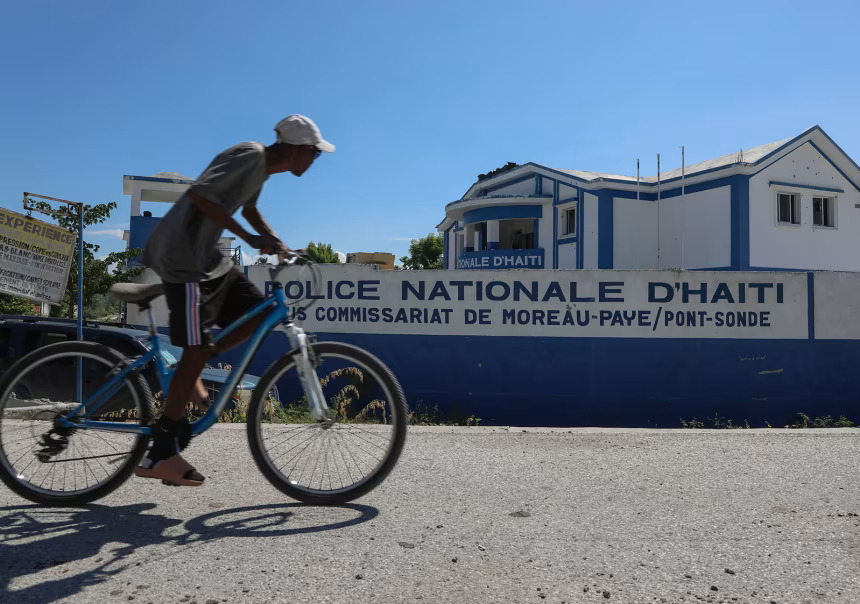
Heavily armed gangs launched sweeping attacks across Haiti’s Artibonite region over the weekend, killing civilians, torching homes and triggering a mass exodus toward the coast.
Local police, overwhelmed and undersupplied, warned that half of the country’s largest agricultural region has now fallen under gang control.
Authorities say the assaults, which targeted towns including Bercy and Pont-Sondé, began late Friday and continued into early Sunday. Haiti’s police union SPNH-17 described the situation as a national catastrophe, saying the loss of control of both the West and Artibonite departments marks “the greatest security failure in modern Haitian history.”
With most of Haiti’s police forces and the Kenyan-led multinational security mission concentrated in gang-dominated Port-au-Prince, communities in the central region were left largely defenseless.
Guerby Simeus, a local official in Pont-Sondé, said he had confirmed nearly a dozen deaths so far — among them a mother and child and a municipal employee, and warned that no reinforcements had arrived.
As the attacks intensified, hundreds of residents fled to Saint-Marc, a coastal city now overwhelmed by displaced families. Tensions boiled over on Monday as crowds attempted to force their way into the mayor’s office, demanding weapons and vowing to fight the gangs themselves.
“Give me the guns! I’m going to fight the gangs!” shouted survivor Réné Charles. Others declared they would no longer rely on the government, accusing authorities of ignoring warnings that a gang invasion was imminent.
Political activist Charlesma Jean Marcos urged survivors sleeping outdoors to take refuge inside government buildings until the state regains control. He warned that hunger will deepen as emergency support runs thin.
More than half of Haiti’s population already faces acute food insecurity, and gang roadblocks have helped drive displacement to a record 1.4 million people.
The attacks were attributed to the Gran Grif gang, blamed for one of Haiti’s deadliest massacres in October 2024, when more than 100 people were killed in Pont-Sondé. Residents said gang members brazenly livestreamed the latest assault as sustained gunfire echoed across the region.
One man, trapped inside his home for two days, questioned why security assistance, including surveillance drones used regularly in Port-au-Prince, had not been deployed. “I feel this gang is special,” he said. “They don’t want to destroy this gang.”
Gran Grif’s leader, Luckson Elan, and former legislator Prophane Victor, accused by the UN of supplying weapons to young men in Artibonite, were recently sanctioned by the United Nations and the United States.
UN figures show killings in the Artibonite and Centre departments have surged dramatically this year: more than 1,300 people were killed from January through August, compared with 419 in the same period last year.
“These assaults underscore the capacity of gangs to consolidate control across a corridor from the Centre to Artibonite amid limited law enforcement presence and logistical constraints,” the UN warned in a recent report.
Fritz Alphonse Jean, a member of Haiti’s transitional presidential council who was himself sanctioned by the U.S. last month and is now seeking to unseat the prime minister, condemned the government’s inability to stem the violence.
“Blood continues to flow,” he wrote on X. “Lives and property continue to be lost in front of a government incapable of addressing the population’s problems for more than a year. Stability???!”
As survivors await protection and the government struggles to regain control, the humanitarian crisis across central Haiti continues to deepen, with no clear sign of when, or if, the state will be able to push the gangs back.
Source: CNN
Written By Rodney Mbua