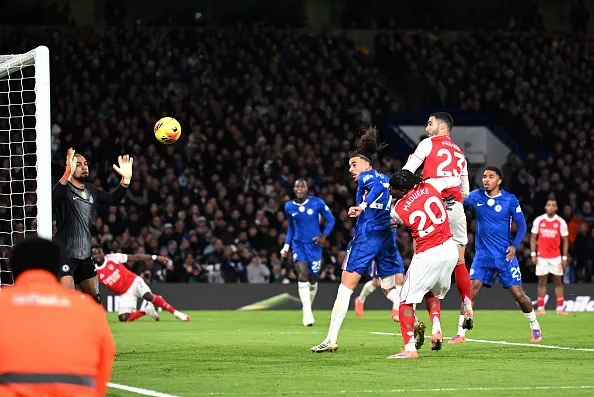
Gianfranco Zola blasted Wesley Fofana’s defending that led to Arsenal’s equaliser against Chelsea at Stamford Bridge.
The London rivals shared the points after a feisty affair at Stamford Bridge on Sunday evening.
Moises Caicedo was shown a straight red card for a wild challenge on Mikel Merino in the first-half but it was the Blues who took the lead three minutes into the second period through Trevoh Chalobah.
Arsenal responded just 11 minutes later with Merino, again filling in up front, in the right place to head home Bukayo Saka’s cross.
The Arsenal winger beat Marc Cucurella to lift the ball into the box to find Merino unmarked with Fofana failing to track his run into the six yard area.
Reviewing the goal post-match, Arsenal legend Ian Wright identified Fofana as at fault for the goal.
‘Fofana as the central defender, he leaves him,’ Wright told Premier League Productions.
‘He’s now ball watching and he’s hoping the ball doesn’t get put in a good position instead of making sure he’s back another yard. Because with another yard, Fofana is maybe able to flick it away.
‘But great movement from Merino arriving in the box, that’s what he does so well.’
Chelsea legend Zola was alongside Wright in the studio, also fearing Fofana was guilty of ‘ball watching’ and losing his man – something the Italian described as ‘not acceptable’.
‘I agree, it is the mistake so many defenders make, they get attracted to the ball, they start ball watching and they lose the opposition who is going in behind them,’ Zola said.
‘It happens, it is so common. A defender who loses his man in the box, it is not acceptable.
‘It is one thing Italian coaches are very strict on. You have to have your body open and watching the ball but above all else, watching the opposition.
‘It is the opposition that is going to score, not the ball.
‘Your man cannot get the ball, whether the ball is delivered to the first post, the second post or the middle your man doesn’t have to touch the ball.’