Two senior military officials taken hostage during Sunday’s attempted coup in Benin have been freed, a government source has told the BBC.
It remains unclear how they were released or if other hostages are still being held.
Security forces are continuing a manhunt for those involved in the plot, who remain at large.
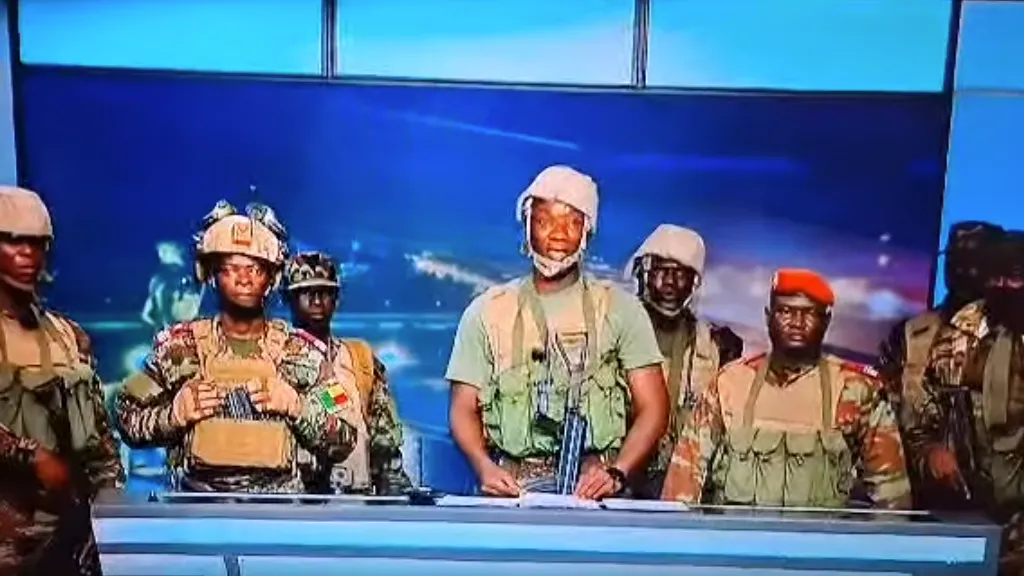
A group of soldiers appeared on state TV early in the morning to announce they had taken over in the West African country, and gunfire was heard near the presidential residence.
However, President Patrice Talon later announced that the situation was “totally under control” in the West African country.
Regional power Nigeria assisted in thwarting the mutiny, saying its fighter jets had helped “dislodge the coup plotters from the National TV and a military camp” following a request from Benin’s government.
On Sunday afternoon, huge explosions were heard in Cotonou, Benin’s largest city and seat of government. They were thought to have been the result of an air strike.
Prior to the explosions, flight-tracking data showed that three aircraft had entered Benin’s airspace from neighbouring Nigeria before returning home.
The extent of the damage is not clear.
Earlier on Sunday, Benin government spokesperson Wilfried Leandre Houngbedji told the Reuters news agency that 14 people had been arrested in connection with the attempted coup.
A journalist in Benin also told the BBC that of those reportedly arrested 12 are believed to have stormed the offices of the national TV station – including a soldier who had previously been sacked.
The coup plotters said they were led by Lt Col Pascal Tigri, whose whereabouts are unknown.
In Sunday evening’s national address, the 67-year-old president said that loyalist forces had “cleared the last pockets of resistance held by the mutineers”.
“This commitment and mobilisation enabled us to defeat these opportunists and avert disaster for our country. This treachery will not go unpunished,” he added.
“I would like to reassure you that the situation is completely under control and therefore invite you to go about your business peacefully.”
It is not clear if there have been any casualties, but the president expressed his condolences “to the victims of this senseless adventure, as well as to those still being held by fleeing mutineers”.
There had been a series of coups in West Africa before Sunday’s thwarted attempt in Benin, heightening fears that the security of the region could worsen.
Benin, a former French colony, has been regarded as one of Africa’s more stable democracies.
The nation is one of the continent’s largest cotton producers, but ranks among the world’s poorest countries.
Nigeria, Benin’s large neighbour to the east, has described the coup attempt as a “direct assault on democracy”.
The rebel soldiers justified their actions by criticising Talon’s management of the country, complaining first about his handling of the “continuing deterioration of the security situation in northern Benin”.
Benin’s army has suffered losses near its northern border with insurgency-hit Niger and Burkina Faso in recent years, as jihadist militants linked to Islamic State and al-Qaeda spread southwards.
The soldiers’ statement cited “the ignorance and neglect of the situation of our brothers in arms who have fallen at the front and, above all, that of their families, abandoned to their sad fate by Mr Patrice Talon’s policies”.
The rebels also hit out at cuts in health care, including the cancellation of state-funded kidney dialysis, and taxes rises, as well as curbs on political activities.
Talon, who is regarded as a close ally of the West, is due to step down next year after completing his second term in office, with elections scheduled for April.
A businessman known as the “king of cotton”, he first came to power in 2016. He has endorsed Finance Minister Romuald Wadagni as his successor.
Talon has been praised by his supporters for overseeing economic development, but his government has also been criticised for suppressing dissenting voices.
In October, Benin’s electoral commission barred the main opposition candidate from standing on the grounds that he did not have enough sponsors.
Last month, constitutional amendments were passed by MPs, including the creation of a second parliamentary chamber, the Senate.
Terms for elected officials were extended from five to seven years, but the presidential two-term limit remained in place.
Sunday’s attempted coup comes just over a week after Guinea-Bissau’s President Umaro Sissoco Embaló was overthrown – though some regional figures have questioned whether this was staged.
In recent years, West Africa has also seen coups in Burkina Faso, Guinea, Mali and Niger, prompting concerns about the region’s stability.
Russia has strengthened its ties with these Sahel countries over recent years – and Burkina Faso, Mali and Niger have left the West African regional bloc Ecowas to form their own group, the Alliance of Sahel States.
News of the attempted takeover in Benin was hailed by several pro-Russian social media accounts, according to BBC Monitoring.
Ecowas and the African Union (AU) both condemned the coup attempt.