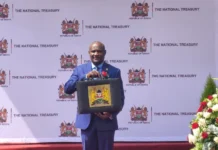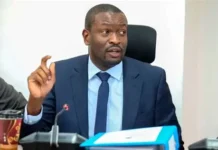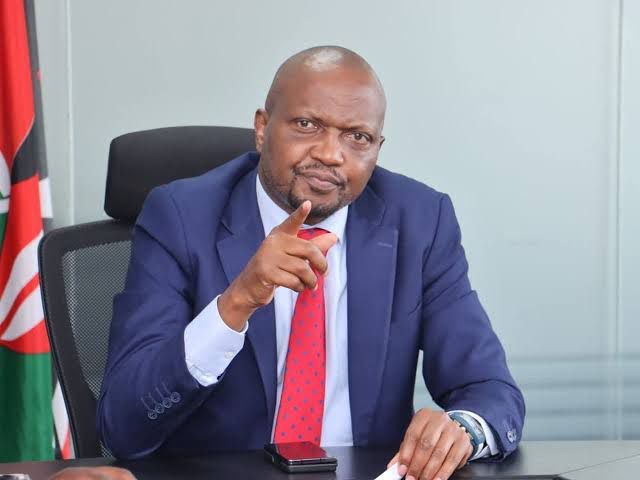
Former Public Service Cabinet Secretary Moses Kuria has stepped up signals of a possible bid for the Nairobi governorship in the 2027 General Election, framing his interest as a response to what he described as deep-seated structural failures in the capital rather than personal political ambition.
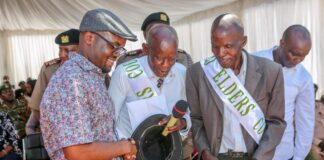
Speaking during an interview with digital media platforms at the home of Morris Ogeta, a former personal bodyguard to the late ex-Prime Minister Raila Odinga, in Uyoma, Siaya County, Kuria said he does not consider the governorship essential to his political survival, arguing instead that Nairobi is in urgent need of radical leadership.
“I don’t need Nairobi; Nairobi needs me. I can survive without being governor or something,” Kuria said, positioning himself as a reform-oriented technocrat motivated by governance outcomes rather than electoral titles.
Reflecting on his unsuccessful bid for the Kiambu governorship, Kuria sought to distance himself from the loss, suggesting the county’s struggles since then underscored his broader argument about leadership deficits.
“I tried to be the Governor of Kiambu, I didn’t make it. I am not worse; Kiambu County is worse,” he remarked, shifting the focus from personal defeat to what he implied were missed opportunities for reform.
Kuria painted a bleak picture of Nairobi’s current condition, describing the city as suffering from systemic decay that cannot be addressed through incremental fixes.
“Nairobi is in a terrible mess,” he said. “Nairobi is a big slum sprinkled with a few green places.”
According to Kuria, the capital’s challenges — ranging from urban planning failures and congestion to service delivery gaps — demand comprehensive restructuring rather than short-term interventions.
In one of his most striking proposals, Kuria suggested the creation of a new city to decongest and modernise Nairobi, drawing parallels with Nigeria’s decision to establish Abuja rather than attempting to overhaul Lagos.
“If I was governor of Nairobi, I would create a new city just like Nigeria did. Nigeria could have fixed Lagos, but they created Abuja,” he said. “Nairobi requires re-engineering, not repairing.”
Kuria anchored his pitch on what he described as extensive international exposure, saying his experience advising governments and multinational corporations abroad has given him insight into how functional global cities are built and managed.
“I am a widely travelled person. I still do it; I advise big companies and governments abroad. I know what is possible and what is not possible,” he said.
He argued that Nairobi’s complexity requires leadership that combines vision with technical competence, asserting that only leaders with broad exposure and experience can drive meaningful transformation.
“Only someone like me who is widely travelled with relevant experience can fix it,” Kuria said, while acknowledging that the final decision rests with voters.
Despite the bold rhetoric, Kuria struck a conciliatory tone, saying he would respect the will of Nairobi residents should they opt for alternative leadership.
“If Nairobi wants, I’m available; if they don’t want, the village is waiting for me,” he said, adding, “I wish Nairobi nothing but the very best.”
Kuria’s remarks come amid early manoeuvring by several political figures eyeing the Nairobi governorship, a seat widely viewed as one of the most influential sub-national offices in the country due to the capital’s economic weight and symbolic significance.