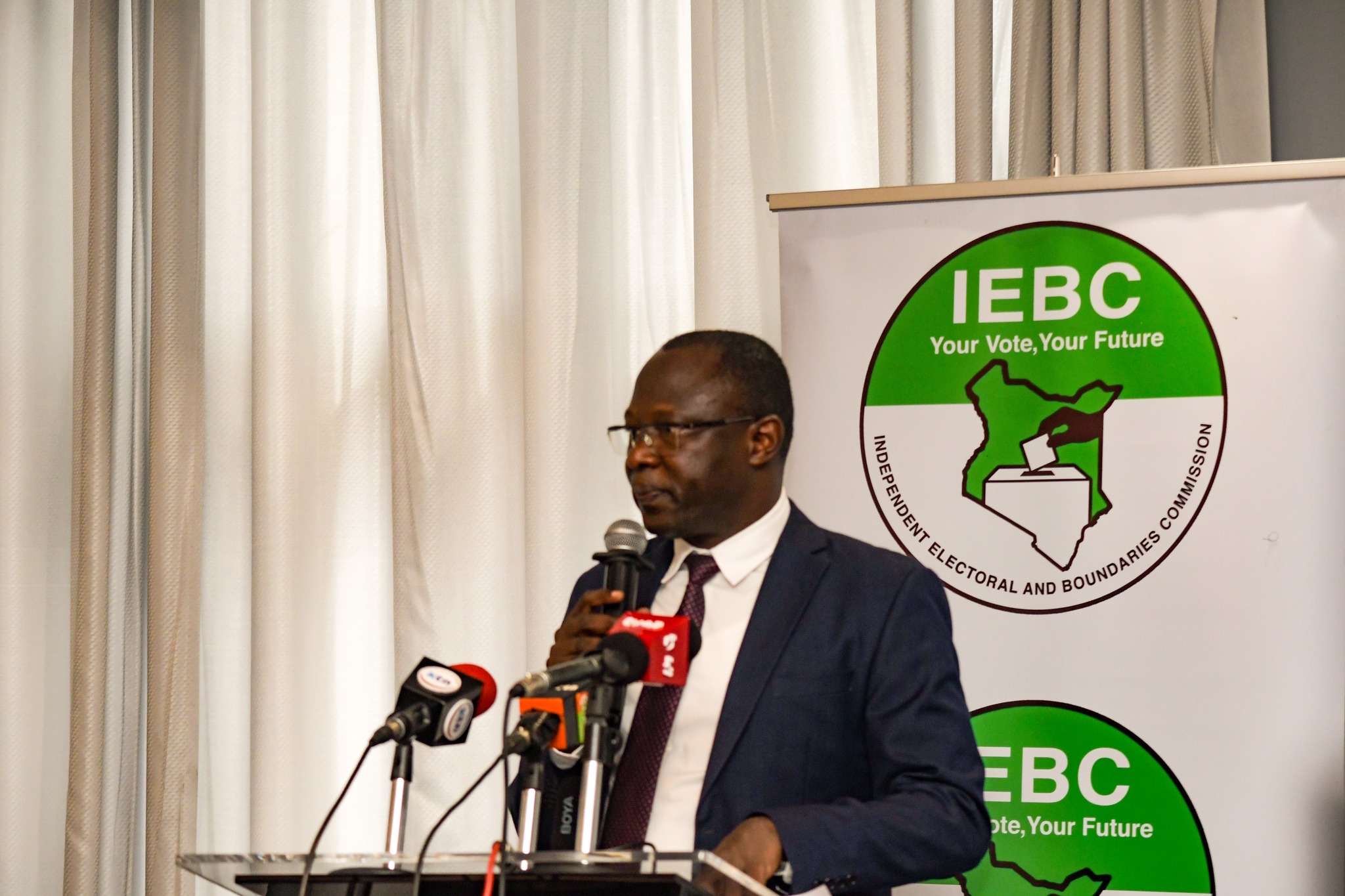
By Andrew Kariuki
The Independent Electoral and Boundaries Commission (IEBC) has raised concern over the current political environment, warning that rising cases of goonism, deepening mistrust and growing anxiety among stakeholders could negatively impact the conduct of upcoming elections.
The concerns were highlighted during an IEBC–Kenya Private Sector Alliance (KEPSA) breakfast meeting held on Wednesday, where stakeholders pointed to increasing fears of political violence and the influence of money in electoral processes.
Participants at the meeting cited what they described as a growing culture of “goonism,” alleging that some politicians are using organized groups to intimidate opponents and influence political outcomes. There were also concerns over voter manipulation through financial inducements.
KEPSA representative Vimal Shah noted that the country is facing a significant trust deficit, warning that uncertainty surrounding elections is creating fear among citizens and the business community.
“We are seeing a fear psychosis that is causing widespread concern about the future. There is a need for clarity of rules and a coordinated approach to conflict resolution,” Shah said.
He further proposed the establishment of a multi-agency taskforce to address electoral tensions, pointing to lack of coordination among institutions as a major challenge.
“The mistrust is too high, and the cost of elections in Kenya remains significantly elevated,” he added.
IEBC Chairperson Erastus Edung Ethekon acknowledged the concerns but clarified that the commission has limited authority in dealing with issues such as political violence outside the official election period.
“We have the electoral code of conduct, but it only becomes enforceable once the election period is gazetted and candidates are registered,” he said.
While affirming that the commission is technically prepared to conduct elections, Ethekon expressed concern about the broader environment in which the polls will take place.
“Operationally, we are fine. What we are worried about is the environment in which we will hold the election. Will it be peaceful?” he posed.
He also disclosed that some IEBC offices had previously been attacked during the Continuous Voter Registration (CVR) exercise, stressing the need for public cooperation.
“We are offering a service to facilitate Kenyans in exercising their democratic right. It should not be made difficult,” he said.
On voter registration, Ethekon noted that the commission has fully transitioned to a biometric system, making earlier manual registers obsolete.
“When IEBC began in 2012, only fingerprints were captured. The law now requires a comprehensive biometric register, including iris and other identifiers. The previous manual register is no longer valid,” he explained.
He urged Kenyans who registered before the new system, especially those who participated in the 2007 elections, to update their details.
“If you have not joined the new biometric register, you need to come forward and register afresh. We want everyone included,” he said.
On emerging technologies such as artificial intelligence, the IEBC chair emphasized that any adoption must strictly comply with the law.
“Even if we are innovative, we cannot implement systems outside what the law provides,” he stated.
He also cautioned against premature declaration of election results by third parties, maintaining that while results are publicly accessible, only the IEBC has the constitutional mandate to officially declare the president-elect.
“Results are public and Kenyans can collate them, but the declaration of the president remains the mandate of the commission,” he said.