A few days ago, Sarvesh Kumar, a school teacher in Uttar Pradesh, was found dead in his home. In a video recorded before his death, he is seen weeping, describing the relentless pressure of election work. “I have not been able to sleep for 20 days,” he says. “If I had time, I would have finished this work.”
Kumar was one of thousands of government employees—primarily teachers, junior staff, and contract workers—deployed since November 4 for a massive voter roll update across 12 Indian states and territories. Known as the Special Intensive Revision (SIR), the exercise aims to register every eligible voter ahead of national elections, compressing into one month a task that once took six.
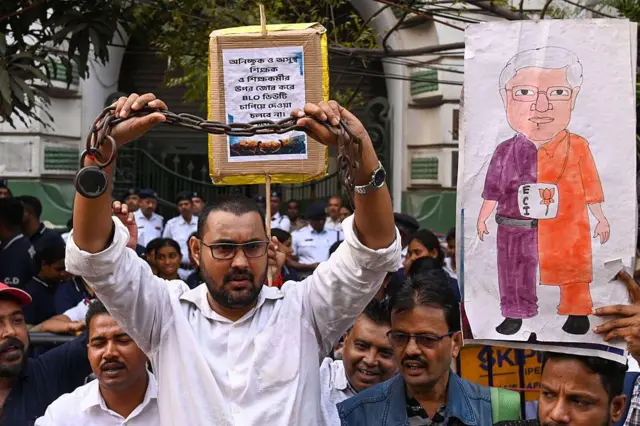
These Booth-Level Officers (BLOs) are the backbone of the effort, going door-to-door to verify documents, answer queries, and upload data, all while juggling their regular jobs. But many say the conditions are unbearable.
The BBC spoke to 10 BLOs in Uttar Pradesh and West Bengal, who described working 14–15 hours a day with little rest, minimal sleep, and meager pay. The punishing schedule has sparked outrage following more than a dozen deaths—including alleged suicides and heart attacks—that families attribute to election-related stress.
In Gujarat, primary teacher Arvindbhai Vadher allegedly died by suicide last month due to the “torturous nature of BLO work,” his family told BBC Gujarati. In a note seen by the BBC, Vadher wrote of “constant fatigue and mental stress.” Another teacher, Rameshbhai Parmar, died in his sleep after a day of SIR duties; his daughter said he had worked late into the night and gone to bed without eating.
The Election Commission has not responded to BBC questions about working conditions or the deaths. Opposition leaders have criticized the rushed timeline of the SIR drive, contrasting it with a similar exercise two decades ago that spanned half a year.
As India prepares for the world’s largest democratic exercise, the toll on those tasked with enabling it is coming into stark relief—raising urgent questions about the human cost of electoral logistics.
By James Kisoo