Stacy Boit,
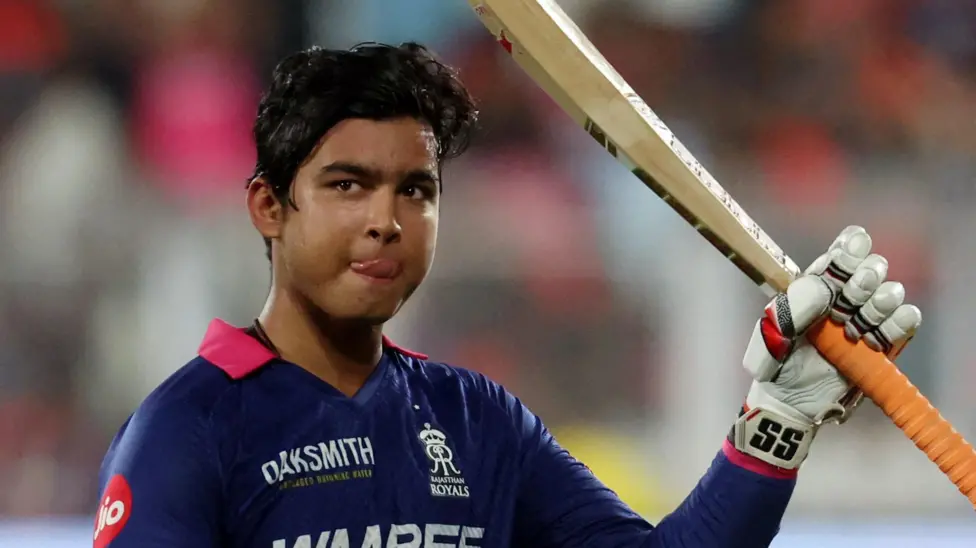
Few have had a better view of the development of cricket’s 15-year-old sensation Vaibhav Sooryavanshi than former England all-rounder Mike Yardy.
Yardy was in the opposing dugout when Sooryavanshi, then aged 12, played for India against England in an under-19 series.
He was coach once more when the precocious left-hander toured England last summer – Sooryavanshi scored 143 in the fourth 50-over match in Worcester – and again when the teenager hammered an incredible 175 from 80 balls against England in the Under-19 World Cup final in February.
So, has he spotted a weakness?
“Not really, no,” Yardy tells BBC Sport.
Yardy’s tongue is slightly in his cheek – but that is a question now facing the world game.
A batter not old enough to leave school in many corners of the globe, who used to travel three hours to the nearest major city for coaching at the age of eight, is currently taking down the very best bowlers around.
“The talent he has got, I don’t know what to predict because I have never seen anything quite like it,” Yardy says.
Any suggestion the 12 months of white-ball success leading to the Under-19 World Cup final knock were some sort of fluke for Sooryavanshi has been banished at this year’s Indian Premier League.
Rajasthan Royals’ opener followed his 35-ball century as a 14-year-old in last year’s tournament – one which made him the youngest centurion in men’s T20s – with a 36-ball century against Pat Cummins’ Sunrisers Hyderabad two weeks ago.
The speed of those two tons has only been beaten by West Indies’ T20 legend Chris Gayle in the IPL.
Like Gayle, Sooryavanshi’s innings are built on brutal boundary hitting, though he gets there in a different way.
With a high yet unusual and whippy bat swing, his hands move away from his body as the bowler releases. He generates his power as the bat swishes back through the line to make contact.
It led former England captain Michael Vaughan to muse this week whether Sooryavanshi could become the “greatest striker of a cricket ball of all time”.
“His bat swing is quite unique,” says former India international Deep Dasgupta, another who has had a front row seat for the teenager’s rise, through his commentary at the IPL.
“It is not a taught bat swing. Batters go straight up and straight down – a linear path. This is more circular and wristy.”
Any suggestion the 12 months of white-ball success leading to the Under-19 World Cup final knock were some sort of fluke for Sooryavanshi has been banished at this year’s Indian Premier League.
Rajasthan Royals’ opener followed his 35-ball century as a 14-year-old in last year’s tournament – one which made him the youngest centurion in men’s T20s – with a 36-ball century against Pat Cummins’ Sunrisers Hyderabad two weeks ago.
The speed of those two tons has only been beaten by West Indies’ T20 legend Chris Gayle in the IPL.
Like Gayle, Sooryavanshi’s innings are built on brutal boundary hitting, though he gets there in a different way.
With a high yet unusual and whippy bat swing, his hands move away from his body as the bowler releases. He generates his power as the bat swishes back through the line to make contact.
It led former England captain Michael Vaughan to muse this week whether Sooryavanshi could become the “greatest striker of a cricket ball of all time”.
“His bat swing is quite unique,” says former India international Deep Dasgupta, another who has had a front row seat for the teenager’s rise, through his commentary at the IPL.
“It is not a taught bat swing. Batters go straight up and straight down – a linear path. This is more circular and wristy.”
The 61 sixes Sooryavanshi has managed in 17 IPL innings are only three fewer than former England captain Eoin Morgan managed in 75 knocks in the tournament.
India great Jasprit Bumrah, Australia metronome Josh Hazlewood and New Zealand swinger Trent Boult have all been smacked over the ropes in this year’s tournament.
There is often little culture – his most profitable shot is categorised by CricViz as a ‘slog’ – but the striking is remarkable for its regularity, its uncommon cleanness and its length.
“He gets a full flow and gets everything out of his bat swing but is then able to hold a really consistent base with his feet into the ground, with balance and keeping his head still,” Yardy says.
“I think there is a unique talent to it. You have got to have an extraordinary gift to do that.”