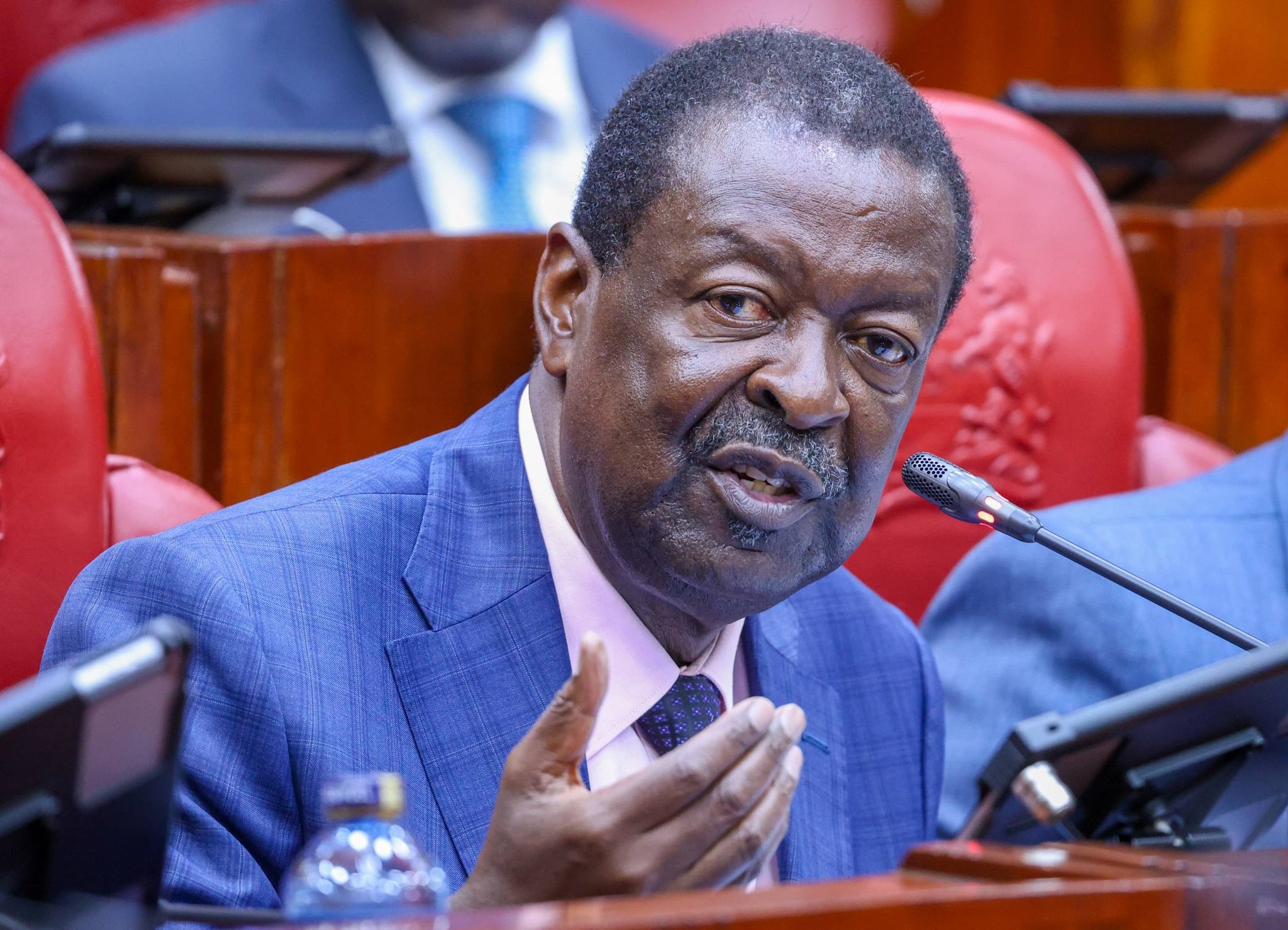
Prime Cabinet Secretary (PCS) Musalia Mudavadi has dismissed proposals to relocate Kenya’s capital from Nairobi, saying the idea is impossible due to legal and practical constraints.
Appearing before the Senate Committee on Devolution and Intergovernmental Relations on Monday, March 30, Mudavadi stated that relocating Kenya’s capital from Nairobi is likely to clash with Kenya’s land tenure system.
The PCS acknowledged that capital cities have been changed in other countries, citing Nigeria and Tanzania, which changed their capitals from Lagos to Abuja and Dar es Salaam to Dodoma, respectively. He, however, noted that the situation in Kenya was different.
“We cannot relocate the capital to another city. In Tanzania they were able to do that with Dodoma and in Nigeria they moved away from Lagos. our land tenure system cannot provide a solution like the one in Tanzania and Nigeria,” Mudavadi stated.
According to Mudavadi, much of the urban land is privately owned, and that is one of the reasons why the idea cannot be achieved.
“A lot of the land in urban areas belongs to Kenyan citizens. Even if you move beyond that, you would be looking at compromising people’s land to create a new city,” he added.
Mudavadi also highlighted the financial implications of such a move, pointing to the high costs of relocating major infrastructure like the Standard Gauge Railway (SGR).
Questions from the Senate committee had focused on whether relocating or expanding the capital might be more practical, especially given issues such as flooding and houses built on riparian land.
Instead of moving the capital from Nairobi, however, Mudavadi emphasised the need to look at alternative interventions to improve the city’s infrastructure and urban management.
For this reason, Mudavadi defended the corporation agreement between Nairobi County Government and the national government aimed at strengthening the performance of the capital in four key areas, including water and sewerage.
The Cooperation also focuses on construction and rehabilitation of roads, bridges and drainage, housing and related infrastructure development and finally, solid waste management and Nairobi river regeneration.
Mudavadi reaffirmed that expanding or relocating Nairobi is not a feasible option under Kenya’s current circumstances, and instead pointed to ongoing initiatives under the Ksh80 billion cooperation agreement between the two levels of government.
“The joint steering committee which I chair is not the implementing committee. Implementation is led by Governor Sakaja through a hands-on committee that works closely with technical teams from both the national government and City Hall,” he explained.