William Li has lived in the same Hong Kong public housing block since he was born. But since a deadly fire tore through Wang Fuk Court one week ago, he has struggled with a label he never wanted: hero.
“My heart breaks every time someone calls me a hero,” the 40-year-old says, his voice breaking. “Some people weren’t saved.”
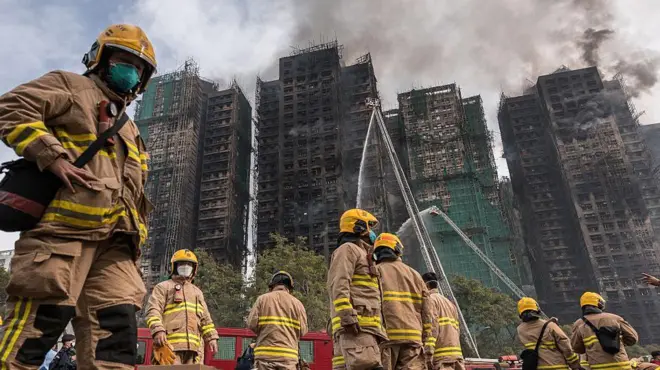
The fire, which killed at least 159 people, left Li haunted not by pride, but by guilt—convinced he could have done more. As firefighters continue searching for the remains of 30 missing residents, an independent investigation has been launched to determine the cause of the blaze and why so many were unable to escape.
Early findings suggest the building’s fire alarms malfunctioned and non-fire-resistant netting was installed around the complex. For Li, the silent alarms meant he did not grasp the danger when his wife first called. He spent nearly ten minutes gathering belongings before opening his door to a corridor choked with smoke.
After retreating and sealing his flat with wet towels, he heard cries outside. Groping blindly through the haze, he pulled a middle-aged couple, the Chows, to safety. They told him they had also heard a domestic worker calling for an elderly woman—but that voice had gone quiet. Li did not venture out again.
“I feel very guilty,” he admits. “I didn’t open my door again and try to find them.”
Others displayed similar courage with tragic ends. Sixty-six-year-old Bai Shui Lin is believed to have saved several families by pounding on doors to warn them. She did not survive. “If I’d asked her to leave a minute earlier, I think she would have,” her son told CBS. “But we know her. She wouldn’t have left without warning others.”
Trapped for hours, Li and the Chows faced impossible choices: one fire exit was blocked by flames, and they believed another was locked. They ruled out jumping from their second-floor window due to the inferno and constant explosions. A property management subsidiary of Danish firm ISS, responsible for Wang Fuk Court, has not responded to BBC inquiries about the locked exit reports.
“It was the first time I felt death had something to do with me,” Li recalls. He began sending farewell messages on WhatsApp: “I can’t escape. If something happens to me, take care of my children.”
After two and a half hours, firefighters reached them via an aerial ladder. Li insisted the Chows be rescued first. “We are older and told him he should leave first,” Mrs. Chow told local outlet HK01. “He refused and said he was young and could handle this.”
When it was finally his turn, Li hesitated, reluctant to leave a home filled with memories, photography equipment, and toys. “The fire was telling me that I couldn’t take anything away,” he says.
Reunited with his family at a nearby fast-food restaurant and later hospitalized, the weight of the ordeal finally overwhelmed him. “When I got to the emergency room, my knees gave in,” he says. “A burning smell lingered in my nose. I really wanted to wash it away.”
Admitted to a ward in the early hours, he broke down. “This time, when the nurse asked me if I wanted to go home, I wasn’t willing to leave,” he confesses. “I felt like I was avoiding what I would have to face.”
Now, he is facing it head-on—by telling his story to anyone who will listen. “I hope many people will come forward to help find the truth,” Li says. “I hope Wang Fuk Court residents will be given answers and justice.”
By James Kisoo