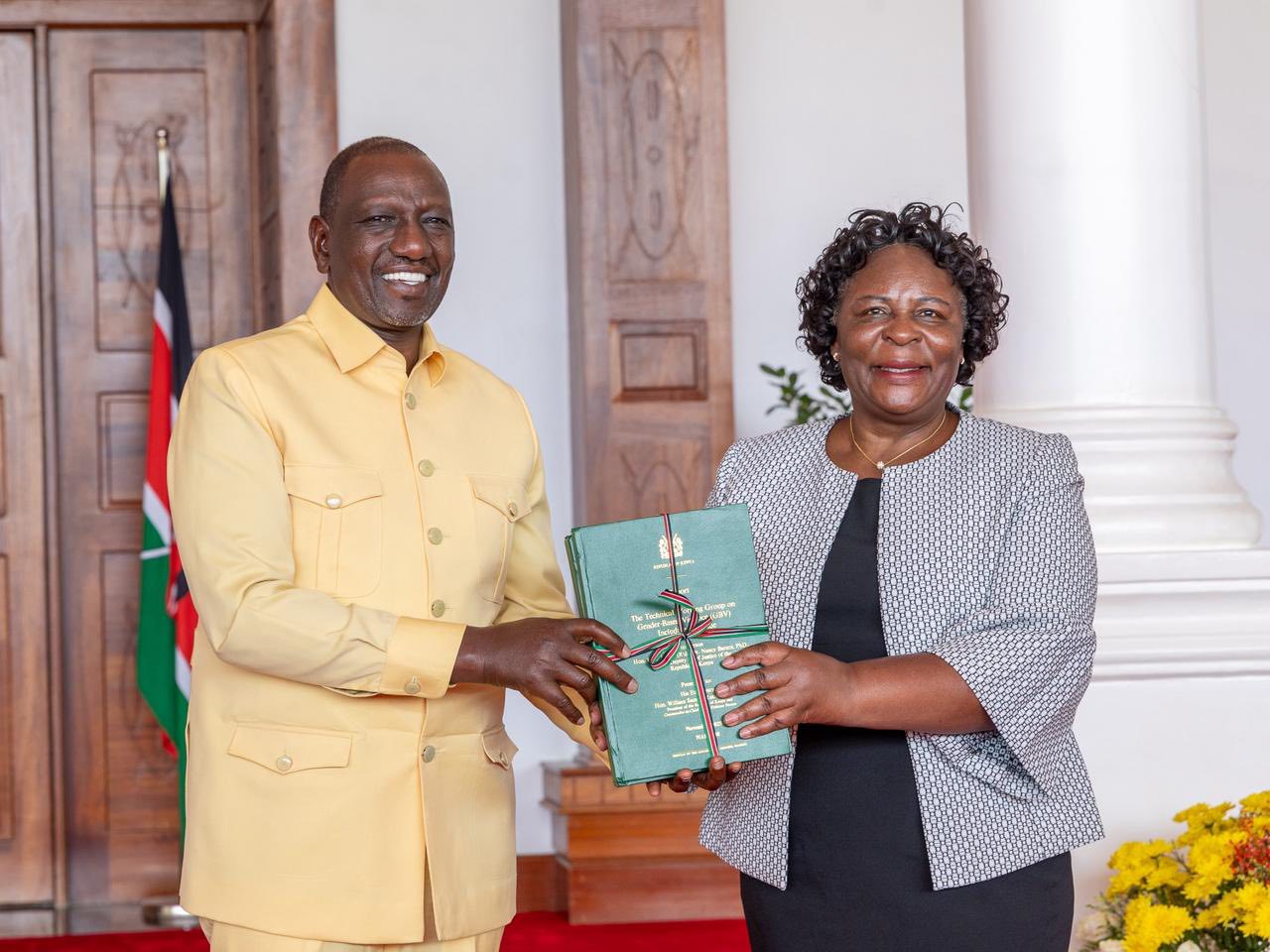
The Gender-Based Violence (GBV) technical working group, chaired by Nancy Baraza, has recommended the installation of CCTV cameras in Airbnb accommodations and bed-and-breakfast establishments, as part of urgent measures to curb rising cases of femicide in the country.
Presenting its report to President William Ruto, the taskforce chairperson, Nancy Baraza said many femicide cases occur in temporary private accommodation where there is little accountability and no proper record of occupants, making investigations difficult and enabling perpetrators to evade justice.
“We are recommending immediate installation of CCTV services in premises, especially Airbnbs and BnBs, because we found this is where most of the femicides are taking place. There is no accountability and there are no records,” Baraza said.
The proposal is likely to spark outrage, as it borders on violation of privacy. Most Airbnbs already have CCTV at entrances and other shared or public areas, but not inside the units.
However, the task force’s recommendation, which would require cameras inside the units, is expected to draw the backlash.
The committee, which kicked off nationwide public hearings on May 12, was tasked with assessing the effectiveness of existing responses to GBV and femicide and proposing legal, institutional and policy reforms aimed at strengthening protections for victims.


According to the report, mandatory CCTV surveillance in short-term rental facilities, including Airbnbs, is intended to enhance accountability and deter crimes in spaces that have increasingly featured in reported cases of violence, particularly in urban centres such as Nairobi.
The taskforce described GBV and femicide as a national crisis requiring the highest level of government response, calling for urgent, coordinated and survivor-centred action led from the Presidency.
Recent investigations by the Presidential Taskforce on Gender-Based Violence and Femicide found a troubling pattern of femicides occurring in short-term accommodation facilities such as Airbnbs and bed-and-breakfasts, where perpetrators exploit weak registration systems, lack of oversight and minimal accountability.
Many victims are lured or taken to these premises under false pretences or during intimate encounters, only to be attacked, assaulted, or killed with limited evidence left behind and scant records to aid in tracking suspects.
The taskforce noted that these locations have become hotspots for gender-based violence, prompting recommendations for mandatory installation of CCTV cameras and stronger monitoring, to deter offenders and support swift investigation in the wake of such tragic incidents.
Among the key proposals is the establishment of a dedicated GBV and Femicide Police Unit to handle prevention, investigations and prosecutions.
The taskforce said GBV and femicide should be treated as distinct, high-risk offences requiring specialised skills and survivor-centred approaches, rather than being handled under general criminal investigations.

The taskforce also urged the President to personally champion a nationwide awareness campaign to define what constitutes GBV and femicide and to drive behavioural change through engagement of men, women, boys and communities, while challenging harmful cultural and patriarchal norms.
“This must be a cultural evolution that promotes gender equality, human rights and respect for all genders,” Barasa noted.
To address gaps in financing and coordination, the taskforce recommended the creation of a National GBV and Femicide Response Fund, supported by the government, private sector and development partners.
It proposed that the National Treasury ring-fence at least Sh50 Billion starting in the 2026/2027 financial year, with additional contributions from donors and private sector players.
The fund would support emergency medical care, psycho-social counseling, legal aid, court support, witness protection, shelters, rescue centres, temporary housing and economic reintegration of survivors.
It would also finance long-term community education and prevention programmes, including school-based training on human rights and gender equality.
The taskforce warned that uncoordinated spending by government and donors had weakened the impact of GBV interventions, arguing that a single fund would improve efficiency and accountability.
Coordination from the Presidency to ensure implementation, the taskforce proposed the formation of a multi-sectoral implementation committee based in the Presidency, led by a chief coordinator to oversee execution of the recommendations and manage the response fund, including fundraising.
It suggested that members of the existing 43-member taskforce could be considered for the implementation team, citing their technical expertise and familiarity with the report.
Legal Reforms on legislative reforms, the taskforce urged the Attorney General to initiate amendments to the Penal Code to recognise femicide as a distinct criminal offence, separate from murder or general homicide.
It also proposed a new Citizen Obligation Act, which would make it mandatory for members of the public to report GBV cases, including domestic violence, with failure to report treated as complicity in the crime.
The taskforce said many domestic violence cases escalate to murder because neighbours and relatives treat abuse as a private matter and fail to alert authorities in time.
The report further recommends establishing one-stop GBV recovery centres in all 47 counties, offering integrated services including medical care, counselling, legal aid and shelter.
To address weak data systems, the taskforce called for the creation of a National GBV and Femicide Observatory to centralise reporting, track trends and guide policy responses.
Citing figures from the National Commission on Gender and Equality, the taskforce said the country loses an estimated Sh46 billion annually due to GBV, through healthcare costs, lost productivity and social services, warning that continued normalisation of violence threatens constitutional rights to life and dignity, as well as national economic growth.
The report now awaits government action, with expectations high that its recommendations including tighter regulation of short-stay accommodation could significantly reshape how the country confronts the growing crisis of gender-based violence and femicide.