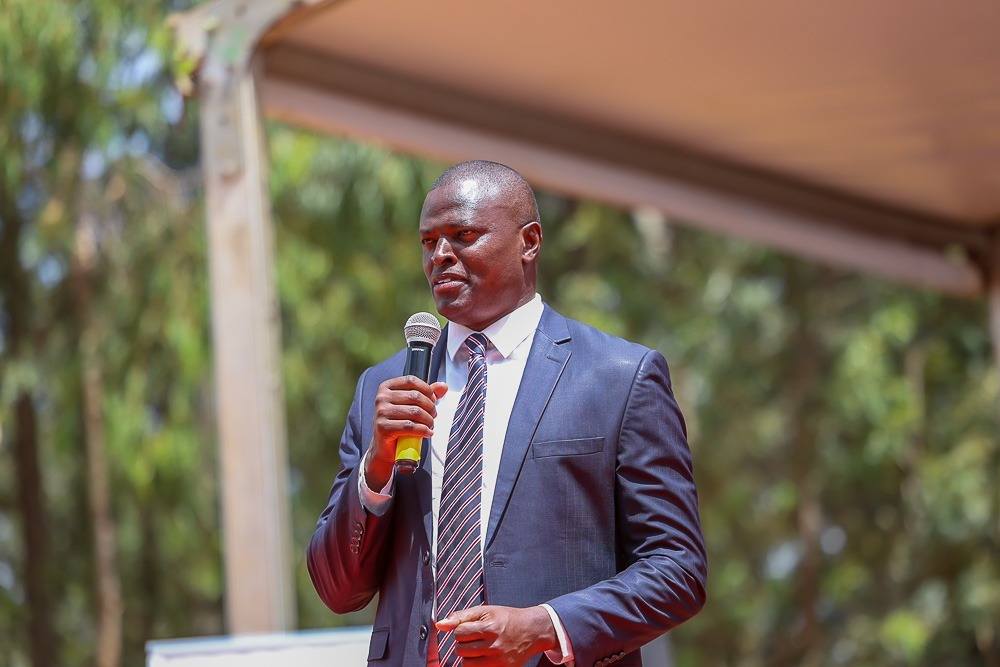
Kiharu MP Ndindi Nyoro has criticised the government’s proposed sale of part of its stake in Safaricom Plc, saying the process could short-change Kenyans.
He warned that history may judge Parliament harshly if it goes ahead under the current terms.
Nyoro raised his concerns during a sitting of the National Assembly’s joint committee on Finance, National Planning, Public Debt and Privatisation, which is scrutinising the deal.
The government plans to sell 15 per cent of its holding in Safaricom to South Africa’s Vodacom Group at Ksh 34 per share, generating about Ksh 204 billion.
He argued that selling without open competition is unfair and could harm public wealth. Nyoro cited examples from developed markets, where competitive bidding ensures sellers get the best price.
“Take a bank with 100 billion shillings in shareholders’ funds or co‑capital. If you buy the share today in the market, it is trading at 32 % of that value. Would you go to the bank to tell them to sell you the share at the market price? Would they agree? It has never happened in the market and elsewhere,” he said.
He compared the sale with an ongoing corporate bid in the United States for Warner Brothers Discovery, where companies like Paramount and Netflix are competing to buy the company.
“Currently in the US, there is an ongoing bid by a company called Warner Brothers Discovery, the owner of CNN. But they are not selling in the market. There is a bid, and the final bid is two companies, one called Paramount and Netflix,” Nyoro said.
“Then this jargon about the market, a sophisticated market like the US, is seeing the value of non-competitive bidding in a private company. But here in Kenya, we have been cornered by our buyers, and we are now talking the language of market price. It will be wrong, and history will not judge us very well if we continue this transaction with this kind of consideration,” he added.
Transparent transaction
Nyoro stressed that the shares belong to all Kenyans and that the transaction should be transparent. He questioned how the buyer was selected and whether a fair process was followed.
“Chair, 6 billion shillings we are selling with our population, it means the government is selling my 100 shillings as a share. If you divide the shares we are selling, Chair, and you give Kenyans their share, everyone in this hall, because we are all Kenyans, today will be allocated 100 shares,” he said.
“So, my 100 shares, what is the process that has been taken for the buyer to be identified? What was the process? How did you one day wake up and decide we are going to sell to the current buyer?” he asked.
He also raised concerns about information asymmetry, saying the prospective buyer has an advantage because of its existing presence on Safaricom’s board.
“There is something in the market for any transaction to work, for any information, for any transaction to work efficiently, Chair. There is something called information symmetry. Now, we are selling our stake of 15 per cent to a company who is already inside Safaricom, which already has board members,” he said.
“So definitely, they already have a step ahead of any other person who would think of buying our stake because of the information asymmetry. That is something else that we have to look at,” he added.
This comes after Safaricom CEO Peter Ndegwa moved to allay fears that the partial sale will change the company’s Kenyan character. He told Parliament that the share sale will not affect Safaricom’s governance, operations, or regulatory oversight, and that the company will continue to operate under Kenyan law and regulation.
Safaricom remains licensed and accountable to Kenyan regulators, and its board and management structures will stay intact despite the transaction. There is no transfer of operational control or weakening of Kenyan oversight.
Treasury Cabinet Secretary John Mbadi has also stressed that the government will remain a strategic shareholder and that the sale will not affect national security or data protection, as such matters are governed by Kenyan laws and regulations, not shareholding composition.