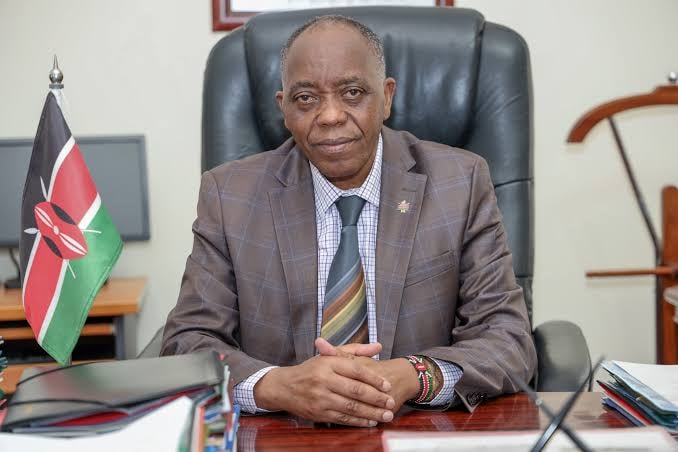
The National Security Advisory Committee (NSAC) has denied allegations made by Independent Electoral and Boundaries Commission (IEBC) chairman Wafula Chebukati that it offered to moderate presidential election results in order to favor Azimio candidate Raila Odinga.
According to affidavits signed by Kennedy Kihara, Principal Administrative Secretary at the Office of the President, and Joseph Kinyua, Head of Public Service, the NSAC went there solely for security reasons.
Kihara claims that on August 15, acting on NSAC orders, he led a delegation that included Kennedy Ogeto, Police Inspector General Hillary Mutyambai, and Francis Ogolla to a meeting with Chebukati and IEBC commissioners at the National Tallying Centre in Bomas.
“The meeting was necessitated by the fact that the NSAC in the discharge of its mandate had become ceased of information to the effect that the delays in declaring the results of the presidential elections and the manner in which results were being transmitted including the stoppage of the public display of results had generated considerable public anxiety and tension and risked creating the opportunity for chaos, violence and insecurity in parts of the country,” Kihara says in his affidavit.
The NSAC noted that at the time of requesting the meeting, it was unclear whether Chebukati would be able to meet the stated timelines or whether they faced any challenges, given that the public display of results had been abruptly halted and there had been no public communication on the same or on the process of tallying and verifying the results.
“I am aware that the law requires the result to be declared within 7 days which in the present case was to lapse on 16 August. The delay in declaring the results of presidential elections while lawful but particularly long,” Kihara said.
Kinyua claims in his affidavit that he called Chebukati to inform him of the NSAC’s decision to send a team to meet with him and members of the commission to discuss security implications surrounding the transmission tallying, verification, and declaration of presidential election results.
Kinyua claims that efforts had been made previously to meet with Chebukati, but all had been in vain. He was deafeningly silent.
“It is due to the urgency and sensitivity of the matter at hand that NSAC considered it necessary to have a physical meeting as opposed to engaging in correspondents,” Kinyua says.
He also claims that the subject meeting was not unusual because the NSAC and IEBC have previously engaged in matters relating to security in election cases in a context of interdependence between both parties.
“As the chairperson of the NSAC, I’m not aware of any resolution to contact or meet Chebukati with a view to affecting the results of the presidential elections,” Kinyua affirmed.
The Head of Public Service goes on to say that the NSAC played no role in the election process other than providing advice on security issues surrounding the elections and developing strategies to keep the country safe and secure during the election period.
According to Kinyua, the meeting’s feedback indicated that the IEBC was committed to its constitutional mandate of managing election results, particularly presidential election results.
The commission assured the NSAC team that their security concerns had been considered and that they would deliberate.
Following the feedback, the NSAC team recommended that adequate security be deployed in all potentially affected areas in order to persuade potential losing candidates to engage their supporters in order to allow for a peaceful redress mechanism and that the IG enhance security for the IEBC commissioners.
“I therefore categorically deny Chebukati’s insinuation that I arranged a meeting between him and members of the NSAC with a view to influencing the outcome of the presidential elections held on August 9 in favour of a particular candidate,” Kinyua states in his affidavit.
Chebukati listed Kinyua among other top government officials who wanted to subvert the will of the people at the Bomas of Kenya during the announcement of the Presidential results in his replying affidavit.
According to the IEBC chairman, NSAC members went to see him at the national tallying center with other commissioners and asked him to ensure a runoff if he couldn’t declare Raila Odinga the outright winner of the 2022 presidential election.
In the affidavit, he also stated that the meeting was attended by Principal Administrative Secretary at the President’s Office Kennedy Kihara, Solicitor General Kennedy Ogeto, Inspector General of Police Hillary Mutyambai, and LT. General Francis Omondi Ogolla, Vice Chief of Defences.
Chebukati stated in his narration that prior to the arrival of the team, he received a call from Kinyua informing him that he had sent a team to discuss the “assumption of office.”
Raila has petitioned the Supreme Court to overturn William Ruto’s victory, claiming that the entire election process was a sham.
However, Chebukati and Ruto maintain that the process was credible and that Raila’s and the other surrogates’ petitions should be dismissed, describing them as comedies.
The IEBC Chairman noted that Kihara relayed the message, warning that if he declared William Ruto as President-Elect, “the country will burn.”
He went on to say that clashes between the Kikuyu and Luo communities had already begun “in several slums including Kibera and Mathare” due to alleged “Kikuyu betrayal.”
“The second part of the message from the NSAC delegation was that if we cannot announce Raila Odinga as the outright winner, then we must ensure that there is a runoff,” Chebukati submitted.
Chebukati went on to say that following Kihara’s remarks, he invited all commissioners to share their thoughts, which commissioners Nyang’aya, Masit, Wanderi, and Vice Chairperson Cherera all supported.
According to Chebukati, Commissioner Abdi Guliye believes the commission has a constitutional mandate and will be guided by the same constitution and applicable law in declaring the results.
In his replying affidavit, Commissioner Boya Molu expressed a similar perspective.