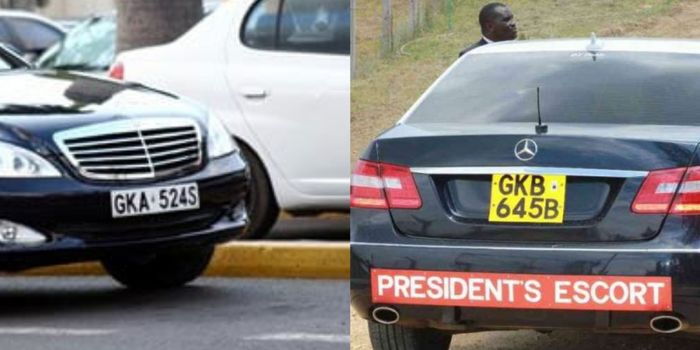
The National Transport and Safety Authority (NTSA) has issued a notice to Kenyans who have purchased vehicles previously owned by the national government, parastatals, or county governments.
In an update on Monday, January 26, the authority warned that a purchase alone does not confer full legal ownership.
As such, NTSA urged all buyers of ex-GK vehicles to take immediate steps to regularise ownership through its official systems.
“Purchased an Ex-GK, parastatal or county vehicle? Don’t stop at purchase. Re-register the vehicle to enjoy full ownership and avoid future complications,” the notice read.
NTSA explained that re-registration of ex-GK vehicles, including those from parastatals, national government departments and county governments, must be supported by an authorization letter from the relevant Principal Secretary or, in the case of military vehicles, the Department of Defence.
Applicants are required to submit a duly completed and signed Form A, the GK number plates or a retention letter from the disposing institution, and the original GK registration certificate.
Where a logbook is unavailable, the buyer must formally notify the authority in writing.
NTSA further stated that a completed Form C must be signed and stamped by both the disposing institution and the buyer.
For vehicles acquired through auction, buyers must provide supporting documents such as a valid auctioneer’s licence, the auctioneer’s KRA PIN, and a certificate of incorporation.
Additional requirements include copies of the buyer’s KRA PIN certificate and national ID, a tape lift of the chassis and engine numbers from the Directorate of Criminal Investigations (DCI), and a new entry form for vehicles whose duty had not been paid.
The authority noted that number plates and registration certificates are not applicable to ex-military vehicles.
On the application process, NTSA said all re-registration requests must be initiated online through the NTSA service portal.
Applicants are required to log into serviceportal.ntsa.go.ke, select motor vehicle services, choose the re-registration option, and fill in all required details.
They must then look up the vehicle entry and KRA PIN, select a preferred number plate type, attach all required documents, and submit the application after making a declaration.
NTSA added that buyers must pay the re-registration and inspection fees, log into their accounts to accept or decline consent notifications, and select their preferred number plate and logbook collection point.
Buyers must also enter details of the authorised person who will collect the documents.

NTSA said the seller will receive a notification prompting them to book a re-registration inspection.
The seller is required to select a preferred inspection centre and date, submit the application, and present all original physical documents for verification after inspection.
Once the process is complete, applicants are required to wait for approval and allocation of new number plates.
This comes a week after NTSA clarified the process for transferring ownership of vehicles belonging to deceased persons.
In a public notice on Monday, January 19, the authority explained that vehicles forming part of an estate cannot be transferred through the standard process.
According to NTSA, the transfer must instead follow an alternative procedure anchored in succession law and administrative verification.
“Vehicles inherited or managed under an estate must be transferred through an alternative transfer process. This protects families and owners from ownership disputes,” the notice read.
NTSA explained that vehicles that form part of a deceased person’s estate fall under succession cases and require specific documentation to prove lawful authority and prevent conflicts.
Applicants must present a certified copy of the Certificate of Grant together with the schedule of properties, a letter appointing the administrators of the estate, and the original registration certificate (logbook) or a police abstract.
According to NTSA, additional requirements include a certified copy of the death certificate issued by the Civil Registration Services, a tape lift from the Directorate of Criminal Investigations (DCI), a duly completed transfer form (Form C), a sworn affidavit from the successor, and copies of the KRA PIN and national ID of the new owner.
NTSA further explained that the transfer is processed through an application for an alternative or forced transfer, which must be submitted online via the authority’s service portal.
Applicants are required to access the NTSA service portal, navigate to the services section, and select the alternative or forced transfer option.
All the required original documents must be clearly scanned and uploaded as a single PDF file.
The applicant must also indicate the preferred collection centre and provide the identification details of the authorised person who will collect the logbook before submitting the application.
Once the application is submitted, the client is required to make payments for the forced transfer and vehicle inspection.
After a mandatory waiting period of seven days, the system prompts the applicant to book an inspection. The vehicle must then be presented for inspection at the selected centre on the booked date, and the physical versions of the uploaded documents must be submitted at the preferred NTSA office.
NTSA noted that upon approval, an SMS notification will be sent to the new owner.