Sponsored Ad

Ad 1
Ad 2
Ad 3
Ad 4
Ad 5
Ad 6
27.3 C
Kenya
Sunday, May 24, 2026
Home Blog Page 1380

Kenya Proposes Raising Tax-Free Income Threshold to Ease Wage Earner Burden

By Ian Maleve

The government of Kenya is considering raising the tax-free threshold on personal income above the current Sh24,000 per month as part of measures to provide relief to low- and middle-income earners.

If implemented, this move could bring much-needed fiscal breathing space to workers and spur consumer spending at a time of rising living costs.

Under the current law, residents earning up to Sh24,000 per month pay no income tax a threshold many stakeholders argue has become outdated amid inflation and economic pressures.

The proposed increase would be aimed at adjusting to these realities and ensuring that marginal employees retain more of their gross income.

Tax experts have welcomed the measure, noting that it would effectively raise disposable income across a wide swathe of the workforce.

“Adjusting the threshold is a practical way to ease the burden on lower-income groups without slashing government revenue significantly,” said a fiscal analyst.

However, raising the threshold comes with downsides. The Kenya Revenue Authority (KRA) and Treasury must evaluate the potential revenue shortfall.

Current budget projections already account for tight fiscal policy, with authorities targeting additional revenue of Ksh25 to Ksh30 billion through administrative reforms and tightening tax incentives rather than increasing taxes.

Indeed, the government is pursuing a new revenue-raising strategy focused on enhancing tax compliance and rationalizing exemptions. This suggests that any additional cost from raising the threshold must be offset elsewhere.

Policymakers face the challenge of balancing relief for wage earners with the fiscal constraints arising from a growing budget deficit and high debt levels.

Public sentiment is also a critical consideration. In 2024, aggressive tax proposals sparked deadly protests, prompting the government to abandon controversial tax hikes. Any new fiscal reform including raising the tax-free threshold will need to be communicated carefully to avoid reigniting unrest.

As discussions continue, parliament will likely scrutinize the proposal within the broader framework of the Finance Bill 2025. Key questions for lawmakers include: how much revenue would be forgone? Will the measure primarily benefit the intended demographic? And what compensatory measures will the Treasury deploy to uphold budget stability?

For now, workers and employers alike are watching closely, hopeful that an increase in the tax-free threshold will deliver tangible relief and signal responsiveness from a government mindful of socio-economic pressures.

Mixed Fortunes for Banks and Traders as Shilling Holds at 129 for 12 Months.

By Ian Maleve

Kenya’s shilling has remained largely unchanged at around 129 units to the US dollar for the past year, presenting a mixed bag of outcomes for traders, commercial banks, and import-driven businesses.

After a sharp depreciation in early 2023 that pushed the local currency to record lows of over 160 per dollar, the Central Bank of Kenya (CBK) adopted a series of monetary tightening policies, including aggressive interest rate hikes and increased forex market supervision.

These measures helped to stabilise the shilling and anchor inflation expectations. However, the currency has now settled at a new plateau of 129 to the dollar, staying within a narrow trading range for the last twelve months.

This stability has come as a relief for importers, many of whom were battered by the earlier volatility that inflated the cost of essential goods, raw materials, and petroleum products.

The predictability in exchange rates has allowed businesses to plan better, reduce forex hedging costs, and avoid pricing shocks. Traders dealing in machinery, electronics, and consumer goods have particularly benefited from the steady rate.

On the other hand, commercial banks and currency dealers have seen a decline in forex trading income. With the shilling locked in a narrow band, the opportunities for arbitrage and speculative gains have diminished.

Several banks, which previously posted sharp increases in forex trading income during periods of volatility, have now reported a cooling in their non-interest revenue streams.

Exporters, too, are feeling the pinch. A relatively stronger shilling has eroded the earnings of firms selling goods abroad, particularly those in the horticulture, tea, and coffee sectors.

The lower forex conversion gains have led some to call for a more flexible exchange rate policy to help cushion them against external shocks.

Analysts argue that while the current rate stability is welcome, it also masks underlying vulnerabilities, including high external debt repayments and a narrowing current account deficit.

With the CBK expected to maintain a tight monetary stance and investor inflows remaining steady, the shilling is likely to remain in its current range in the near term unless global shocks or domestic political risks shift the balance.

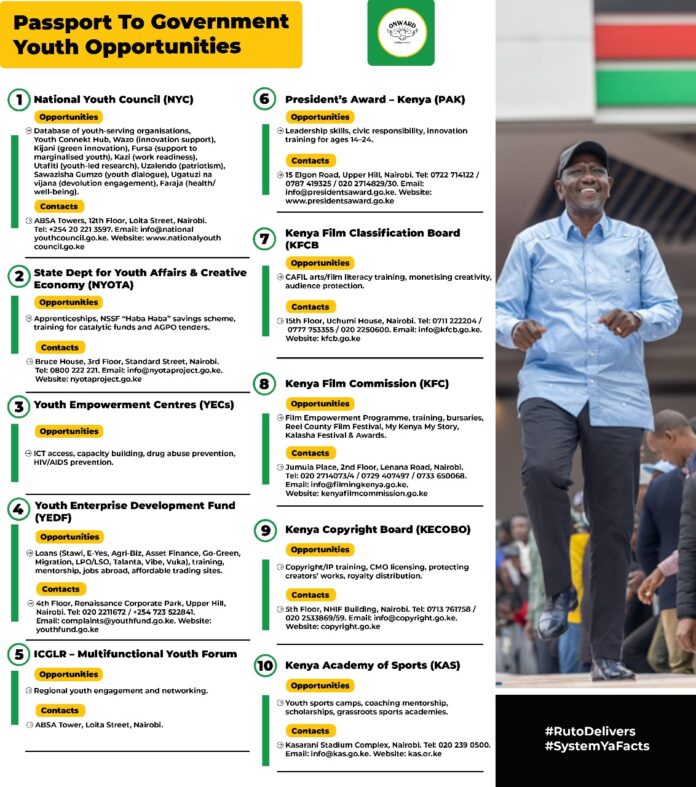
Kenya Rolls Out “Passport to Government Youth Opportunities” to Boost Access to Jobs and Training

By Michelle Ndaga.

The government has unveiled a new consolidated guide — the Passport to Government Youth Opportunities — aimed at helping young Kenyans access employment, training, and entrepreneurship programmes more easily.

‎The initiative, published by the National Youth Council (NYC) and now circulating widely on social media, compiles key government-led youth empowerment programmes into one accessible document. It brings together opportunities from multiple ministries and agencies, eliminating the need for young people to search across scattered platforms.

Among the featured programmes are:

NYOTA Project (National Youth Opportunities Towards Advancement) — offering apprenticeships, entrepreneurship training, and savings schemes.

‎Access to Government Procurement Opportunities (AGPO) — reserving 30% of public tenders for youth, women, and persons with disabilities. Youth Enterprise Development Fund (YEDF) — providing financing and business development support for youth-led enterprises.

‎Ajira Digital Program — training young people in digital skills and connecting them to online jobs.

‎National Employment Authority (NEA) — facilitating job matching, career guidance, internships, and overseas placements.

‎‎Other agencies represented include the Kenya National Innovation Agency (KENIA), the Micro and Small Enterprises Authority (MSEA), the Kenya Film Commission (KFC), and the National Industrial Training Authority (NITA).

‎According to the NYC, the “passport” will soon be integrated into a digital platform, allowing young people to register, check eligibility, and apply for multiple programmes in one place. The move follows the launch of the NYOTA initiative earlier this year, which aims to unlock at least 200,000 job and training opportunities for Kenyan youth. Officials say the project is part of President William Ruto’s broader youth empowerment agenda, intended to reduce unemployment, promote innovation, and ensure young people can benefit from public resources.

‎The Passport to Government Youth Opportunities PDF is available for download via the National Youth Council’s website.

Manchester United Unveil Third Kit In Tribute to 1993–94 Winning Seasons

Manchester United have launched their new third kit for the coming season, a design that honours the club’s celebrated 1993–94 double-winning side.

The strip marks the return of the adidas Trefoil logo for a second year running, set against a black base enlivened with yellow trim and hints of blue, a nod to the away kit worn between 1993 and 1995. Subtle details include a tonal devil motif embedded across the shirt and a shield-shaped frame around the club crest.

The 1993–94 campaign remains one of United’s most revered. Sir Alex Ferguson’s team, powered by the influence of Eric Cantona, Roy Keane and Ryan Giggs, secured both the Premier League and FA Cup.

They fell just short of a domestic treble after losing to Aston Villa in the League Cup final, but their achievement marked them out as only the fourth side in the 20th century to complete the double in England.

With the new third kit’s release, United’s full wardrobe for the season is now complete following the unveiling of their home and away strips earlier in the summer.

Attention now shifts to the pitch, where hopes are high for Ruben Amorim’s side after a transfer window of heavy investment.

Matheus Cunha, Bryan Mbeumo and Benjamin Šeško have joined for a combined outlay exceeding £200m, and United are not finished yet. Brighton midfielder Carlos Baleba is a priority target, though further signings may hinge on player sales.

Alejandro Garnacho, Antony and Jadon Sancho are all available for transfer, while striker Rasmus Højlund could also face an uncertain future with Šeško’s arrival reducing his chances of regular minutes. The shake-up under Amorim signals United’s determination to re-establish themselves among the Premier League elite — a goal the new kit symbolically roots in their historic past.

Tottenham Target Savinho and Eze in £100m Transfer Shocker

Tottenham Hotspur have stepped up efforts to land both Savinho and Eberechi Eze, with the club narrowing its shortlist as it looks to inject high-impact quality into Thomas Frank’s first season in charge.

Sources indicate Spurs made contact for both players late last week, with the twin pursuits designed to offset the loss of Son Heung-min and cover for James Maddison’s absence through injury.

While Eze has been on the radar for much of the summer, the move for Savinho, currently at Manchester City, has caught many by surprise.

The 20-year-old winger’s name emerged as Spurs weighed alternatives including Jack Grealish and James McAtee. Uncertainty over Savinho’s role in Pep Guardiola’s plans has encouraged Tottenham to explore the possibility of making him a central figure in their project.

Savinho is said to be open to a move to north London, with the prospect of regular minutes proving attractive. The situation bears some resemblance to Julian Alvarez’s unexpected switch to Atlético Madrid last year, where limited game time at City prompted a high-profile exit.

Guardiola reportedly wants to keep Savinho but has a history of allowing departures for players keen on a fresh start.

Eze’s case is more straightforward. Arsenal have kept tabs on the Crystal Palace forward but have hesitated over his fit in their starting XI. Tottenham believe there is room for both Eze and Savinho, and are advancing discussions for each in parallel before deciding on whether to commit to the combined outlay, which is expected to exceed £100m.

Frank has been assured of strong backing in the market, with the aim of pushing Spurs towards the Premier League’s top end and re-establishing themselves as a Champions League force. This week could prove decisive in turning intent into concrete deals.

Billionaire Elon Musk Accuses Apple of Bias Over OpenAI

Elon Musk has accused Apple of anti-competitive conduct, claiming the iPhone maker is unfairly favouring OpenAI’s ChatGPT over rival artificial intelligence apps in its App Store rankings.

The billionaire said on Monday that his AI startup, xAI, would take “immediate legal action” against Apple, alleging the company’s practices amounted to “an unequivocal antitrust violation”.

“Apple is behaving in a manner that makes it impossible for any AI company besides OpenAI to reach No 1 in the App Store,” Musk wrote on X, his social media platform. He also criticised Apple for not featuring either X or xAI’s chatbot Grok in its “Must Have” section, despite their popularity.

Musk offered no evidence to support the claims, and neither Apple, OpenAI nor xAI responded to Reuters’ requests for comment. ChatGPT is currently the top free app on Apple’s US App Store, with Grok ranked fifth and Google’s Gemini chatbot far lower at 57th, according to market intelligence firm Sensor Tower.

Apple has a partnership with OpenAI that integrates ChatGPT into iPhones, iPads and Macs, a move announced in June. The arrangement has fuelled questions from rivals about whether Apple’s commercial interests influence its app store recommendations.

The fresh dispute comes as Apple faces heightened regulatory scrutiny over its control of the App Store. In April, a US judge found the company had breached a court order designed to promote competition, referring it to federal prosecutors for a potential criminal contempt probe. That same month, the EU fined Apple €500m (£421m) for restricting developers from steering users to cheaper deals outside the App Store, in violation of the bloc’s Digital Markets Act.

Musk’s legal threat adds to the mounting pressure on Apple as global regulators test the limits of its tightly controlled digital marketplace.

Shakahola Murder Trial Delayed as Prosecutors Uncover Fresh Evidence

The High Court in Mombasa has put on hold the murder trial of controversial preacher
Paul Nthenge McKenzie and his 28 co-accused after prosecutors revealed the
discovery of crucial new evidence.

Appearing before Lady Justice Diana Kavedza on Monday, Prosecutors Alex Ndiema
and Victor Simbi said investigators had uncovered fresh leads that could rope in
additional suspects and expand the list of witnesses.

“The investigators have gathered new evidence, which will lead to the inclusion of
additional suspects and more witnesses to testify against the accused,” Mr Ndiema told
the court.

The prosecution requested more time to complete investigations, assuring the court that
the adjournment was not intended to stall proceedings.

“This application is purely aimed at ensuring thorough investigations are conducted,” Mr
Simbi added.

According to the State, DNA collection and analysis are still underway, and the charge
sheet may need to be reviewed or substituted; changes that would be addressed during
pre-trial hearings.

Justice Kavedza adjourned the matter to Wednesday, when the prosecution is expected
to call four witnesses. The court will issue further directions after the fresh evidence is
formally presented and pre-trial matters are concluded.

Alex Nzine ‘Kalimba’–Hydrologist and Former MCA Aspirant Killed in Road Accident

Mutonguni Ward has been left in shock following the tragic death of prominent hydrologist and former MCA aspirant Alex Nzine Kalimba, popularly known as Hon. Kalimba, in a hit-and-run accident.

Kalimba, a respected community leader from Kyamutimba area in Mutonguni Location, was killed early Tuesday morning when a speeding bus struck him along the Matuu–Mwingi road near Miami area, Machakos County.

Police said the driver fled the scene and efforts are underway to trace and arrest the suspect.

Hon. Kalimba first came to political prominence as a frontrunner for the Mutonguni MCA seat during the 2019 by-election, eventually losing to Eng. Mati.

Tributes have been pouring in since the news broke. Mutonguni MCA Hon. Kiluma described Kalimba as “down to earth, hardworking, selfless and a strong pillar to the community,” adding that his contributions would be remembered for generations.

Kiluma recalled the warmth and hospitality Kalimba extended to friends and political allies, noting his generosity during the 2022 campaigns.

“He gave the 100-shilling notes to his villagers on my behalf and told me to keep the smaller denominations I had carried,” Kiluma said. “He urged his kinsmen to vote for me without hesitation.”

His body is preserved at Mbaku Mortuary pending a post-mortem. Funeral arrangements will be announced in due course as the community continues to come to terms with the loss.

China’s aland Health Seeks Buyers at Valuation Exceeding $1.5 Billion

By Ian Maleve

China-based nutraceutical firm aland Health Holding is actively seeking potential buyers for its controlling stake, targeting a valuation above $1.5 billion, according to insider sources.

The company’s founder and chairman, Chang Liang, holds approximately 60 percent of the company, while major investment firms such as Affinity Equity Partners, Goldman Sachs Growth Equity, and Henderson Investment Corp make up the remaining ownership.

The company, which this year is forecasted to generate around $150 million in EBITDA, has drawn early interest from both strategic buyers and private equity firms.

Analysts see aland’s U.S.-based subsidiary, International Vitamin Corporation (IVC), as a key asset enhancing the firm’s attractiveness. IVC’s U.S.-based production capabilities are well-positioned to cater to reshoring efforts and rising global demand for wellness and nutritional products.

With eleven manufacturing facilities and four international research and development centers across Asia, North America, and Europe, aland employs over 5,000 staff and maintains robust production scale including more than 30 billion tablets, 9 billion softgels, 6 billion capsules, and 16,000 metric tons of powder annually.

The company serves both branded consumers and notable retailers through private-label arrangements with companies such as Walmart and Costco.

While discussions are still in preliminary stages, insiders confirm that there is no fixed timeline yet for soliciting non-binding offers.

The move underscores broader market dynamics, including a push toward localization of supply chains particularly in sectors like health and wellness, which are experiencing rising demand.

The global nutritional supplements market, valued at approximately $485.6 billion in 2024, is expected to expand significantly to an estimated $704.3 billion by 2030 at a compound annual growth rate of 6.4 percent, reflecting strong long-term prospects for potential buyers.

The intended sale marks a strategic turning point for aland. As the company navigates this early-stage process, stakeholders are closely watching to see whether a final deal will reflect the company’s growing footprint, diversified products, and international reach, or whether valuation expectations will adjust in line with market trends and competitive pressures.

Overall, aland Health’s bid to tap into significant sale value reflects both its current scale and the heightened investor appetite for companies capable of bridging consumer health demand with supply chain resilience.

Court Postpones Bail Hearing for Fraud Accused Brian Kiprotich Kiprono to August 19

The bail hearing for Brian Kiprotich Kiprono, the man at the center of a high-profile computer fraud and identity theft case, has been adjourned to August 19 to allow more time for a pre-bail report and legal responses.

Kiprono, who is accused of using the phone of former Nairobi Central Police Station OCS Samson Talaam to extort money from Talaam’s family and legal team, appeared before Principal Magistrate Carolyne Mugo at the Milimani Law Courts today.

In his latest appearance, Kiprono made four applications: seeking medical attention for his asthma condition, requesting to be released on bail and bond, asking for the return of his confiscated phone, and requesting to be served with relevant court statements.

However, the probation officer requested an extension of three more days to compile a pre-bail report from Sotik. 

Counsel Danstan Omari, representing Talaam, also asked for more time to file a replying affidavit. Magistrate Mugo granted the requests and scheduled the next hearing for August 19, 2025.

Background of the Case

Brian Kiprotich Kiprono , is facing eight serious charges of computer fraud and unlawful possession of identity documents. He denied all the charges.

According to the charge sheet, Kiprono, between June 16 and June 19, 2025, fraudulently replaced a SIM card belonging to OCS Talaam then under the custody of the Independent Policing Oversight Authority (IPOA) for investigation and used it to solicit money from Talaam’s family and legal team.

The phone had been seized from Talaam on June 15 following his arrest over the murder of blogger and teacher Albert Omondi Ojwang while in police custody at the Central Police Station.

Kiprono was later arrested on July 20 at his residence in Nairobi’s Pipeline area. During the arrest, police allegedly found him in possession of seven national identity cards belonging to different individuals.

He claimed one of the IDs that of Geoffrey Kipkoech belonged to his brother, with whom he lived.

The Director of Public Prosecutions (DPP) has strongly opposed bail, citing fears that the accused may interfere with ongoing investigations. 

Talaam’s lawyer, Stanley Kinyanjui, supported the State’s opposition, pointing out the suspicious circumstances under which the seized phone and SIM card ended up in Kiprono’s possession. 

“The Directorate of Criminal Investigations (DCI) still cannot explain how the phone and SIM card, which were seized and held by IPOA, came into the hands of the accused,” Kinyanjui told the court.

Earlier, Milimani Chief Magistrate Lucas Onyina had ordered Kiprono to be remanded at Industrial Area Remand Prison until September 12, 2025, pending further directions.

As the case continues to unfold, questions remain about possible lapses in the chain of custody involving sensitive evidence and whether more individuals may be implicated. The court will revisit the matter on August 19.

Create a free account, or log in.

Gain access to read this content, plus limited free content.

Yes! I would like to receive new content and updates.

Sponsored Ad

Ad 1
Ad 2
Ad 3
Ad 4
Ad 5
Ad 6