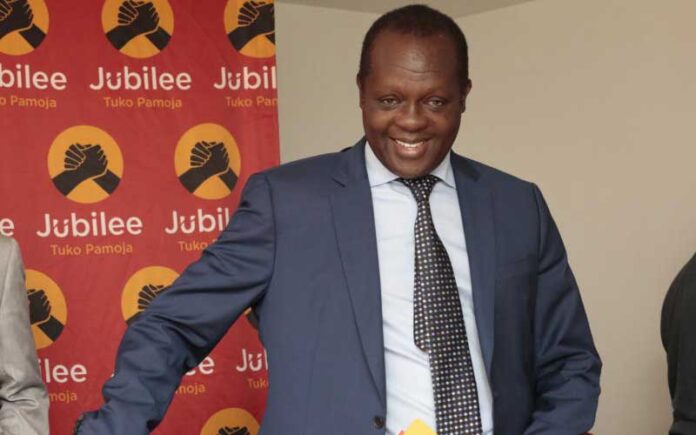
The former Kibaki, Uhuru Kenyatta Cabinet Minister and CS respectively has reportedly disappeared into thin air after a raft of activities surrounding his ownership of the high-end Dari hotel and park in Karen.
Tuju, a former broadcaster and owner of Ace Communications served as the Information, Tourism and Cabinet minister in Kibaki’s first cabinet primarily due to his personal links with the then NARC president Kibaki.
It was during his tenure that KANU was kicked out of KICC following an executive order signed by Tuju on instructions of then Mt. Kenya maffia viz Materere Keriri, Kiraitu Murungi, Chris Murungaru, Martha Karua and Daudi Mwiraria.
Tuju was ostensibly nominated to the Kibaki cabinet to slight Raila who was then a sworn political enemy of the then Rarieda Constituency MP.
In 2007, Tuju lost the seat owing to his close links with Kibaki’s PNU and remained in political boardrooms until President Kenyatta secured his second term in 2017.
He was appointed the first CS in Kenya’s history to represent a political party but effectively to fight the then DP William Ruto who had then fallen out with his boss Kenyatta.
Tuju was among three high-profile Uhuru men who stormed the BOMAS of Kenya in August 2022 to demand that Raila Odinga be declared the winner of the hotly contested presidential ballot.
Others were Major General Francis Ogola (now deceased) and the then head of civil service Joseph Kinyua.
When Raila and his Nyanza troops joined the broad-based government, Tuju become one of the key brokers completing another entry into the Kenya Kwanza government.
Trouble however did not stay away from him as EADB had already sanctioned the auction of his property over a commercial dispute that had stuck in court for over a decade.
By the time of his disappearance, the supreme court had sealed his fate.
Tuju’s personal life has also been in turmoil. His former bodyguard reportedly died under unclear circumstances following allegations of illicit affair with his wife. The wife has also since died.
Tuju runs the 100-acre ultra-modern hotel and conservancy in Karen from where he hosts high-profile international guests.
As a former CS, minister and high net worth person, the politician is entitled two bodyguards and VIP security.
Before his demise, former IEBC Chair Wafula Chebukati had accused Tuju of coaxing him to declare Raila the winner of the 2022 elections
TikTok has banned 20 accounts after the BBC highlighted the use of AI-generated black female influencers to drive users to sites promoting sexually explicit content.
They are part of a growing trend of accounts on Instagram and TikTok that has been criticised as racist, exploitative and misleading because of racial tropes and language used.
The BBC and researchers from the independent AI publication Riddance found dozens of accounts on the two platforms featuring highly sexualised black female digital characters or avatars.
The images and videos were generated by AI but not labelled as such, in apparent breach of the platforms’ guidelines.
Nearly all the accounts were on Instagram and about a third also had versions on TikTok. Instagram’s parent company Meta told the BBC it was investigating, but did not say it had taken any action.
The avatars are often shown dressed in skimpy swimwear or other revealing clothing and portrayed with exaggerated body shapes.
Some have exceptionally dark skin tones that have been digitally manipulated, giving them an artificial appearance.
Account names include terms such as “black”, “noir”, “dark” and “ebony”. Several include comments about white males in their posts, such as “loves white men” and “why I need a white guy in my life”. Many of the accounts follow or like each other.
The BBC, working in collaboration with analysts Jeremy Carrasco and Angel Nulani from Riddance, has identified 60 such accounts, mainly on Instagram, that have carried links, or chains of links, to paid-for sexually explicit content on third-party sites. The sites labelled the imagery as AI-generated, but the Instagram accounts did not.
The research also identified many more accounts on both Instagram and TikTok with similar AI-generated avatars that did not link to paid content.
‘I was angry’
One of the accounts shut down by TikTok – though still operating on Instagram at the time of publication – has caused further anger by stealing videos from real people.
It is presented as the account of a striking AI-generated character and had amassed three million followers within a few weeks of its creation in December.
But it has modified and posted videos from a genuine content creator, Riya Ulan, a model based in Malaysia.
The avatar’s face, which has an exceptionally dark, artificially created skin tone, is overlaid on to Riya’s body, and Riya’s movements, clothing and backdrop are replicated.
“I was angry,” Riya told the BBC. “Of course my videos are all out there… It doesn’t mean that you can just take it and steal it and post it as your own.”
Some accounts – including the one that stole Riya’s content – reject suggestions they are AI-generated
One of the manipulated videos reached over 35 millions views on TikTok and 173 million on Instagram, about 47 times the views on Riya’s original post.
While the three videos that clearly match Riya’s content are not sexual, other videos on the AI account using the same digitally created character show it in revealing clothing or performing provocative actions. A chain of links from the account leads to paid-for adult content.
“I’m not sure if I’m more concerned about them taking my video to promote their explicit content or [that] people actually believe in that,” she says.
It is becoming harder for users to tell whether content is real and “people keep on falling for these AI models”, she adds.
Many viewers appear to treat the avatars as real, despite their unrealistic features. In posts or Instagram stories, some of the accounts deny using AI, including the one that took Riya’s content.
Riya says she reported the account to both platforms multiple times but, at the time, the content was not removed. TikTok banned it after the BBC approached it for comment.
‘Unrealistic depictions’
“I believe these accounts are racist because their existence perpetuates a long history of the exploitation of black people,” says Nulani, one of the researchers.
“Their use of caricatures, race-play terminology and unrealistic depictions of black women prove they’re not concerned with our safety or wellbeing, but our ability to be capitalised as part of the online porn machine,” she adds.
Carrasco, who critiques AI trends and techniques on his social media accounts, says “the new thing is the quantity of shameless, racist depictions of extremely black people”.
While “that fetish” may have existed in the past, AI “gives it new purchase”, he says. He explains that AI makes it easier to remove undertones in images and videos in order to create dark skin tones that are not natural, and to create effects that would previously have required animation or skin painting.
Also, he says, there are no social consequences for an avatar: “There’s no shame… that’s something AI uniquely exploits.”
Content creator Houda Fonone says she fears online reflections of lived experience are being replaced by artificial images
Houda Fonone, a Moroccan model and content creator who advocates for more authentic representations of black women, says the trend is about “erasure”.
“Silky hair, extremely thin bodies and impossibly flawless skin… it’s as if black beauty can only be accepted when ‘refined’.”
She says this risks reinforcing stereotypes while “our stories and real-life experiences are replaced by an artificial image”.
The BBC sent Meta and TikTok examples of the accounts we identified, and asked for their responses.
Two days later, a TikTok spokesperson told the BBC the company had “removed content and banned accounts which breach our rules”.
Within a few days, 20 accounts had been labelled “banned” on the app.
“TikTok prohibits AI generated content of individuals used without their permission, we have zero tolerance for content which promotes off-platform sexual services,” the spokesperson said.
The company says it prohibits and removes AI-generated content that is harmful or misleading, and requires users to label realistic AI-generated content. It said it had also applied correct labelling to a number of videos.
Meta said it was investigating the content brought to its attention.
It says it wants users to know when they are looking at posts that have been made with AI, and that it has policies in place for the labelling of AI-generated content. Nine Instagram accounts the BBC has tracked appear to no longer exist.
Neither platform gave details about its response to Riya’s initial reports.
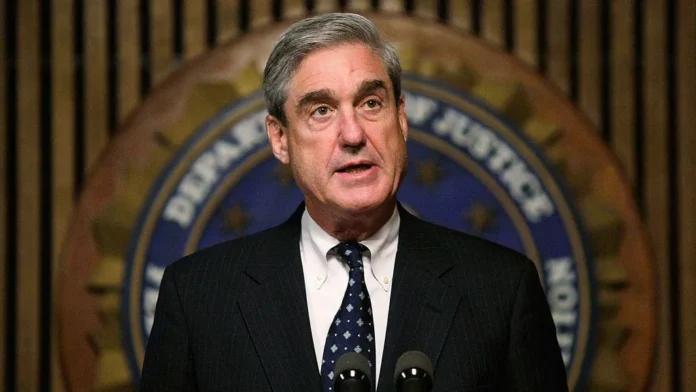
Robert Mueller, the former special counsel whose investigation into alleged Russian interference in the 2016 US election defined much of Donald Trump’s first term in office, has died aged 81.
The cause of his death was not immediately clear. CBS News, the BBC US partner, confirmed his death.
“With deep sadness, we are sharing the news that Bob passed away” on Friday night, his family told the AP in a statement. “His family asks that their privacy be respected.”
Mueller previously led the Federal Bureau of Investigation (FBI) from 2001 to 2013, taking the office just days before the 11 September 2001 terror attacks. He is credited with reshaping it into a modern counterterrorism agency.
Mueller is survived by his wife of nearly 60 years, Ann Cabell Standish, their two daughters, and three grandchildren.
Mueller’s special counsel inquiry put Donald Trump’s 2016 campaign under a microscope, drawing harsh criticism from the US president.
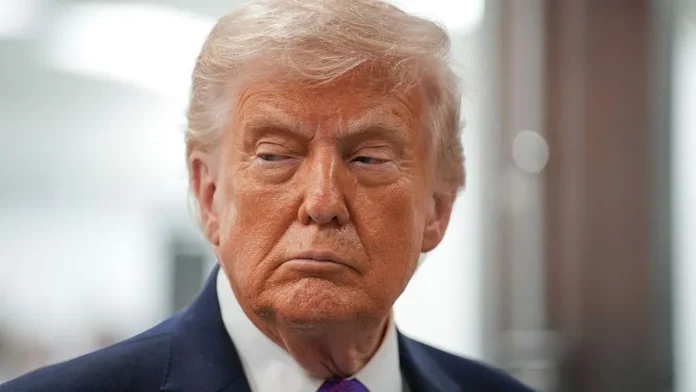
The president wrote on Truth Social on Saturday: “I’m glad he’s dead. He can no longer hurt innocent people!”
Mueller’s former employers and colleagues praised him as a longtime public servant. Both of the presidents he served under as FBI director – George W Bush and Barack Obama – paid tribute.
Bush, who appointed Mueller to lead the FBI, said he was “deeply saddened” by his death.
“In 2001, only one week into the job as the sixth director of the FBI, Bob transitioned the agency mission to protecting the homeland after September 11,” he said. “He led the agency effectively, helping prevent another terrorist attack on US soil.”
Obama called him “one of the finest directors in the history of the FBI” and commended his “relentless commitment to the rule of law and his unwavering belief in our bedrock values”.
Former FBI director James Comey, who succeeded Mueller at the agency and whose abrupt firing by Trump led to the Mueller investigation said: “A great American died today, one I was lucky enough to learn from and stand beside.”
A spokesman for Mueller’s former law firm, WilmerHale, called him an “extraordinary leader and public servant and a person of the greatest integrity” in a statement.
Mueller was born in 1944. After studying politics at Princeton University, he joined the Marines and deployed to Vietnam in 1968.
As a lieutenant, Mueller led a platoon of troops, was wounded twice in battle and was awarded numerous commendations, including the Bronze Star for valour and a Purple Heart.
After returning from the war, he went to the University of Virginia, where he studied law and graduated in 1973.
In August 2001, Mueller was unanimously confirmed as FBI director by the US Senate and he served at the agency for more than a decade.
He retired from the FBI in 2013.
But four years later, Mueller found himself at the centre of a political maelstrom that consumed Washington and would later define his legacy.
His investigation into Russian attempts to influence the 2016 presidential election – and the potential involvement of Trump and his campaign – were a near daily source of intrigue and speculation for nearly two years, from May 2017 to March 2019.
The court filings of his special counsel’s office were meticulously picked apart, with each new revelation a potential bombshell that could, depending on one’s perspective, bring down a president or destroy a nation.
Trump condemned Mueller’s inquiry as a “witch hunt” and a “hoax”, viewing the special counsel as one of his greatest political adversaries. Trump frequently said there had been “no collusion” between his campaign and Russia.
During the investigation, Mueller’s team scrutinised Russia’s actions as well as several of Trump’s top campaign staff and allies. Despite his work frequently making headlines, Mueller himself rarely spoke publicly.
“I did not always agree with everything that Robert Mueller did,” Andrew Weissmann, a member of Mueller’s team, told the BBC. “I think it’s really important for people to know how much integrity and how much thoughtfulness went into his decision-making and how much faith he had – maybe more than I did – in the American people, in citizens and in Congress.”
The investigation resulted in multiple indictments and plea deals with former Trump campaign manager Paul Manafort, as well as national security adviser Michael Flynn.
In the end, the 448-page “Mueller report” was thorough but ultimately inconclusive. It found that Russia interfered in the 2016 election in a “sweeping and systemic fashion”, but did not establish that members of the Trump campaign conspired or co-ordinated in these activities.
His findings noted that “while this report does not conclude that the president committed a crime, it also does not exonerate him”.
In February 2021, Mueller sat for a rare interview with MSNBC to recount key moments in his decades-long career.
Asked why he agreed to oversee something as politically daunting as his Russia investigation, he said: “I found that I’ve gotten tremendous enjoyment out of public service. And I find it hard to turn down a challenging assignment.”
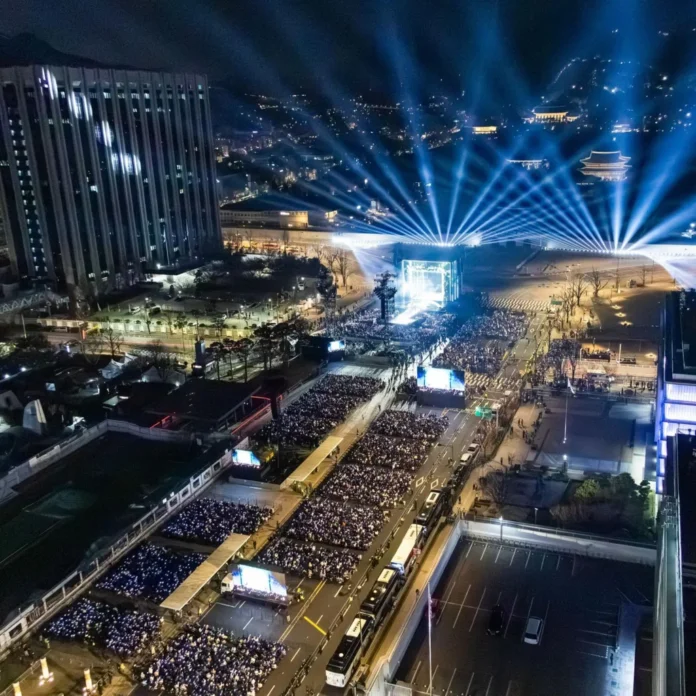
On Saturday, the heart of Seoul turned into a sea of purple.
It was splashed across landmarks, towering billboards, giant screens on high-rises, posters, masks and t-shirts. It was in the display of drone lights on the Han River.
The reason for it was impossible to miss.
“Welcome back BTS,” a banner on a 7-Eleven declared, surrounded by the K-pop act’s signature colour. The world’s biggest band was returning to the stage – after a break of more than three years because of mandatory military service.
“BTS is everything for us,” says Veronica, who along with her friend Amanda flew in from the US to catch Saturday’s show.
The concert was yet to begin. Members RM, Jin, Suga, J-Hope, Jimin, V and Jung Kook had not made an appearance, but already, BTS was everywhere.
The megastars of pop were back.
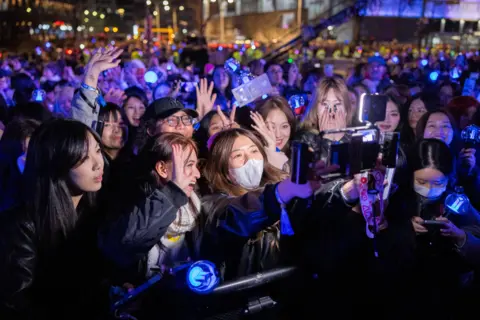
And their “Army”, as their legions of fans call themselves, was ready – happy, singing, screaming, light-sticks in hand. These props can be seen at every K-pop concert but the big bands have their own.
Amanda and Veronica had them too. They wore wide grins and matching purple hanbok, the traditional Korean dress.
The band’s break is what made them seek out other members of the Army. “That’s how we met,” Amanda says.
But it had been a difficult three years, they added, spent yearning for the band to come back.
BTS fans on meaning of comeback show
Finally, the wait was over.
As the sun faded, the square thumped with screams of the crowd. Fans erupted into chants of the seven members’ names.
Then the noise fell away as a deep, resonant toll of the Divine Bell of King Seongdeok rose – a part of “Number 29”, a track in BTS’s new album Arirang.
It rolled across Gwanghwamun Square, lingering – heavy and deliberate – grounding the spectacle in something that felt far older.
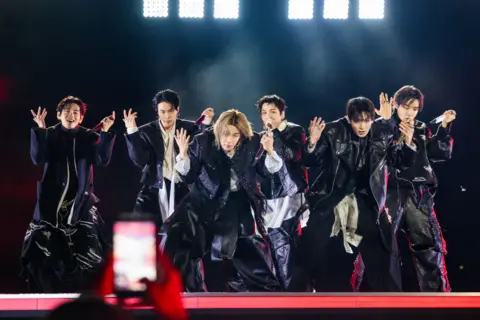
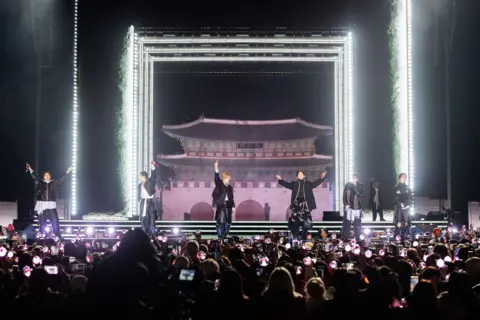
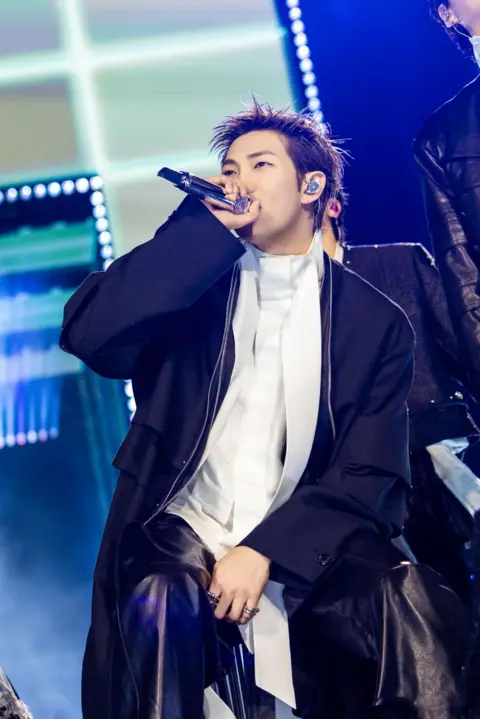
And then the seven K-pop stars appeared in front of the medieval gateway to the palace. “Annyeonghaseyo (hello),” the band’s leader RM greeted fans in Korean, before switching to English: “We are back.”
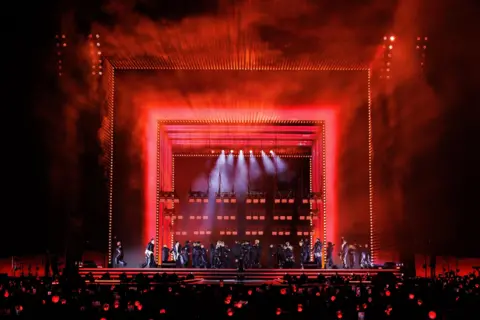
They walked to an impromptu stadium the city had set up in the middle of the square and climbed onto the stage, which resembled a triumphal arch.
It was a striking prelude to “Body to Body”, the album’s first full track, interwoven with Korea’s most iconic folk song and the album’s namesake, Arirang.
As the music swelled, the stage was washed in deep red. The comeback was under way.
And it seemed to win over an uncertain Kim Young-hee: “When I first listened to the album, I thought it was a bit harder to digest than their previous releases, but after seeing them perform live, I realised that BTS never disappoints us.”
There had been growing curiosity about the setlist. While the focus was expected to be on new material, many wondered whether the group would revisit the hits that defined their global rise.
And they did – with “Butter”, “MIC Drop”, “Dynamite” and “Mikrokosmos” igniting instant recognition, lifting the crowd into a shared, euphoric chorus.
Thousands of light-sticks shifted colour in the dark, moving in rhythm and revealing the size of the crowd, which had filled the square.
It was far below the 250,000 authorities had said they were expecting. But it was certainly in the tens of thousands.
Seoul had gone big for this moment, turning its centre into a giant K-pop stage for the first time ever.
Inspired by the South Korean flag, the stage stood with the Gwanghwamun gate as its backdrop, framed by the mountains – a strikingly Seoul scene.
“I’m deeply honoured to perform at Gwanghwamun, the most historic place in South Korea,” Suga said. “We named the album Arirang and chose Gwanghwamun as the venue to reflect our identity.”
It was a rare honour. And the band knew it, taking turns to thank the city and its officials.
But the decision had also drawn criticism. People questioned the need to direct so many resources – the public space, the thousands of police for crowd and safety management – for a show streamed live exclusively on Netflix.
“They’ve pulled in police and fire personnel en masse. If something happens elsewhere, there may be no staff left to respond, and access could be blocked because of the controls,” one user wrote on X.
In another post, pop music critic Jung Min-jae said: “If a comeback concert of this scale, one that effectively paralyses parts of the city centre, is allowed, then other artists or agencies may well request to use the same space in the future.
“At that point, on what criteria will the Seoul Metropolitan Government approve or reject such requests?”
But the government argued this was BTS, returning to reclaim their spot at the top of an industry that has shaped them as much as they have shaped it.
The stage was in front of Seoul’s historic Gwanghwamun gate
The band exploded after its debut in 2013. Their albums – a mix of pop, hip hop and R&B – have hit the number one spot in the Billboard charts multiple times, while their choreographed performances have packed stadiums around the world.
They were the first K-pop group to headline at Wembley – they “broke the wall”, as RM himself put it.
BTS, which has addressed the UN and been invited to the White House, has become the face of South Korea’s soft power.
So this remarkable, slightly contentious, comeback party is a reflection of the band’s place in South Korean minds, according to music critic Lim Hee-yun.
Although South Korea was now one of the world’s wealthiest nations, the country at times had felt culturally inferior to the West, Lim said.
“Then we saw blue-eyed Westerners, tens of thousands of them gathered in a stadium. Crying and singing along to BTS. It’s the ultimate kookbbong,” he said, referring to a Korean saying comparing intense national pride to drugs.
Be it hiatus or retirement, they would remain legendary, according to Lim: “Like the Beatles.”
On Saturday, it was clear how the high the stakes were – for the band, which was returning to so much expectation and hype, but also the government, which had provided a stage it hoped would boost South Korea’s global brand.
Tens of thousands of excited fans flooded the historic centre of Seoul
There were 22,000 free seats available inside the concert venue, in front of the stage. The other spectators watched the show on a dozen screens installed further down the road, all the way to the main thoroughfare blocks away.
Many were foreigners. Some told the BBC they had flown thousands of miles just to watch BTS on screen, if not on stage. Some had begun learning Korean, and even moved here, after joining the fandom.
K-pop fandom is unlike any other, and BTS is perhaps the biggest example of that.
“This comeback, after so many years, means a lot to me,” said Golnar Taheri, who has been a fan since the debut of BTS thirteen years ago. “I feel like I can live my life with more energy.”
Throughout the show, the seven K-pop stars thanked the “Army” again and again.
“Thank you for waiting, Army,” Jin declared, slipping into English.
The fans had their own message: screams, cheers, tears. Many of those who turned up today couldn’t wait for more. “It was a crazy experience…It was just like a dream, and I can’t still believe it [happened],” Azadeh Zamani said.
A grand world tour follows: 34 stops and 88 shows, which is expected to rake in billions of dollars in revenue.
The band’s leader RM told the audience: “We are back.”
For others, the band’s break proved worth the wait.
“Listening to their latest music, I see the same inspiration that touched me before is still there and even more mature now. Like I’m getting older, they are becoming more mature,” Song Soo-yeon says.
“They aren’t just dancing and singing beautifully. They sing about life, and I learn a lot from them.”
Crowds thought record-breaking global hit “Dynamite” would close the night – but it didn’t. Instead, they got an unexpected finale, Mikrokosmos, from 2019 – a tender rumination on self-worth and hope.
“I want our songs to offer a little strength and comfort,” V had said earlier.
And that’s how the night seemed to end, with a shimmering sea of light sticks spreading across the square, like a galaxy.
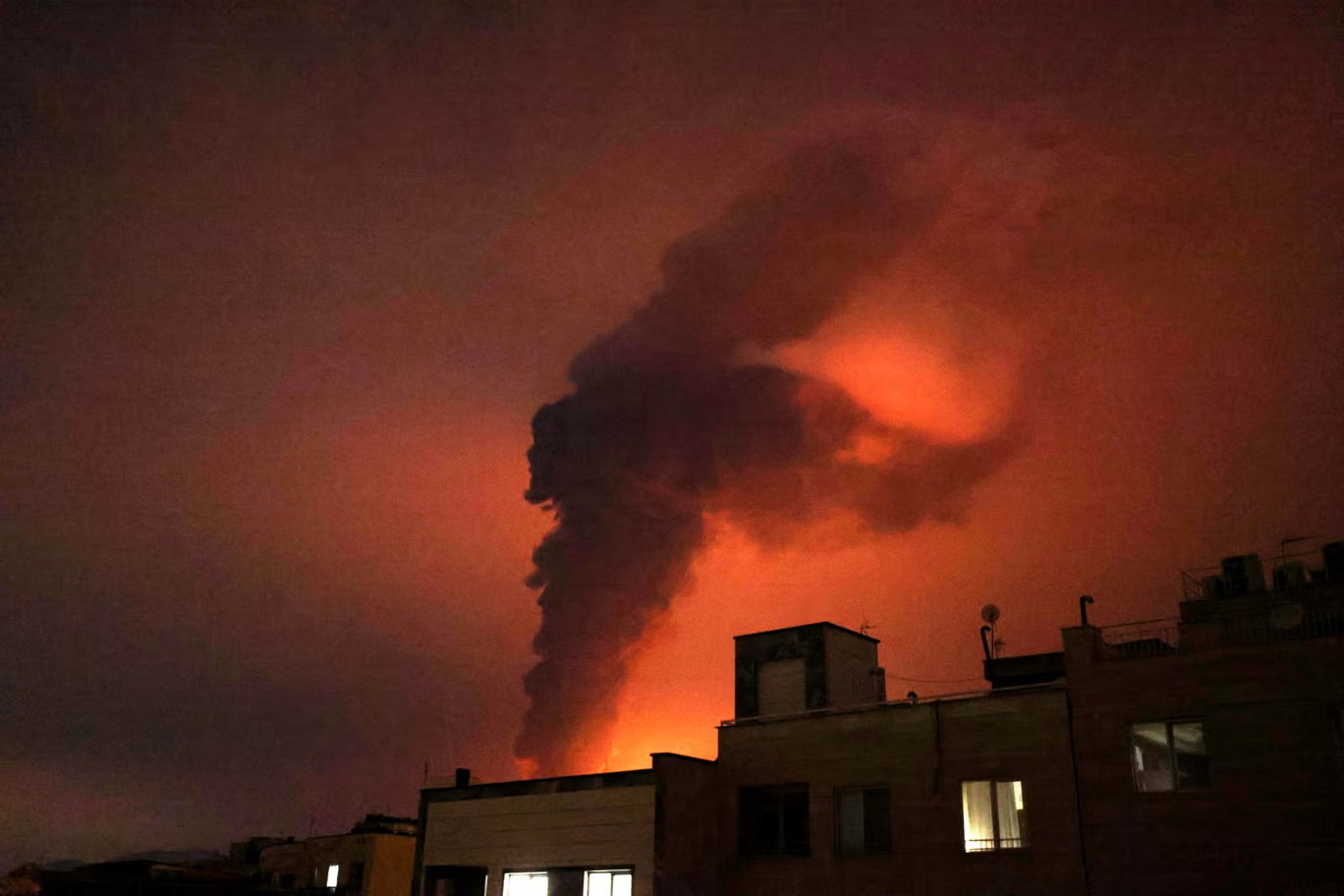
Three weeks after the joint US-Israeli war against Iran began, the conflict has reached a fuzzy state of mixed messages and uncertainty, with Donald Trump’s public comments often seemingly contradicted by realities on the ground.
The war is “very complete, pretty much”, the US president has said, but new American ground forces – including a Marine expeditionary unit – are moving into the region. It is “winding down”, but US and Israeli bombing and missile strikes on Iranian targets continue unabated.
Opening the Strait of Hormuz, the geographic choke point through which 20% of the world’s oil export travels, is a “simple military manoeuvre”, but for now only Iranian-approved ships are transiting the waters. The Iranian military is “gone”, but drones and missiles are still striking targets in the region and targets have extended as far as the joint US-UK base in Diego Garcia.
In a Saturday evening post on Truth Social, Trump threatened an escalation, warning that if Iran didn’t “fully open, without threat” Hormuz in 48 hours, the US military would begin targeting Iranian power plants, “starting with the biggest”.
The day before, however, he had used his social media website to provide a numbered list of American military objectives for the Iran war, which he said the US was “getting really close” to fulfilling.
The items, comprising his most detailed statement on the subject since the war began, included degrading or destroying Iran’s military, its defence infrastructure and its nuclear weapons programme, as well as protecting American allies in the region.
Not included was the goal of securing the Strait of Hormuz, which Trump said should be the responsibility of other nations that are more dependent on oil exports from the Gulf. The president has frequently noted that the US is a net exporter of energy and does not rely on oil from the Middle East – although such a view glosses over the global nature of the fossil fuel market, where price fluctuations directly impact the price at American petrol pumps.
Trump’s Truth Social post also made no call for Iranian regime change. Gone are any references to approving the nation’s next leader or “unconditional surrender”, which Trump had insisted on in the early days of the war.
In Trump’s latest outline of his objectives, it is possible that the US could end its operation with Iran’s current anti-American leadership in power, its oil exports still flowing and its ability to assert some measure of control over the Strait of Hormuzintact.
If that is an unappealing resolution to a war that the president and his aides have said began with the 1979 Iran Revolution and that they would finish, there is an alternative route that involves the US ground forcespresently on the way to the Middle East region.
Just over a week ago, US media reported that a Marine expeditionary unit, with about 2,500 combat soldiers and supporting ships and aircraft, had been dispatched from Japan to the Middle East, which it should reach in the coming days. Another Marine force of similar size recently departed its base in California with its arrival expected in mid-April.
Military analysts have suggested that the US could be planning to capture Kharg Island, a slice of land about 21 sq km (8 sq miles) in size that contains Iran’s primary oil export terminal. Doing so could, in theory, cut off the nation’s oil shipments, depriving the nation of much-needed revenue and forcing it to make greater concessions to the Americans in exchange for an end to hostilities.
Trump on Friday said that he wasn’t sending ground troops to Iran, but added: “If I were, I certainly wouldn’t tell you”. Clarity, it seems, is not his intention.
The threat of such a move prompted Iran’s state media to report on Saturday that any attack on Kharg Island would lead Iran to cause “insecurity” in the Red Sea, another key global shipping transit point, and “set fire” to energy facilities throughout the region.
Iran’s warning underscores the dangers that would accompany a US escalation that further exposes American military forces to Iranian reprisals.
Earlier this week, US media reported that the Trump administration was preparing to ask Congress for $200bn (£150bn) in emergency funding for the ongoing Iranian military operation. Such a request would suggest that, far from winding down, the White House is preparing for a long, expensive fight.
The initial reaction from Congress, including from Trump’s Republican allies, was cautious at best.
“We’re talking about boots on the ground. We’re talking about that kind of extended activity,” said Republican Congressman Chip Roy of Texas.
“They have got a whole lot more briefing and a whole lot more explaining to do on how we’re going to pay for it, and what’s the mission here.”
The so-called “fog of war” doesn’t just cloud the thinking of military planners, it also affects the perception of politicians and the public.
The Iran war, it seems, is at a pivot. But which direction it takes from here is a puzzle.
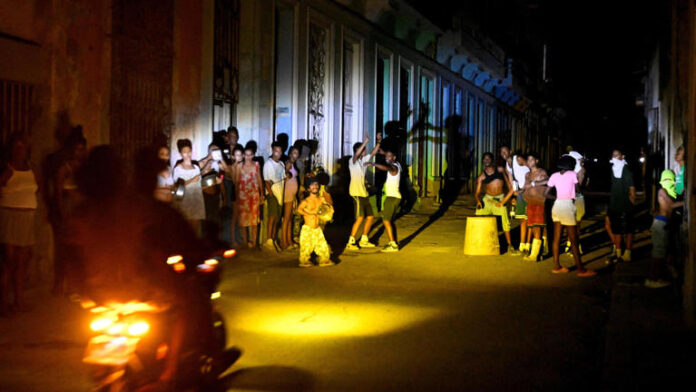
More than 10 million people have had power cut to their homes and businesses across Cuba after the country’s national electrical grid collapsed for the second time in a week.
Cuba’s energy ministry said “a total disconnection of the National Electrical System has occurred”, in a statement posted on social media. “Protocols for restoration are already beginning to be implemented.”
Cuba’s grid operator UNE said it was gradually recovering electricity, prioritising “vital” centres including hospitals and water systems.
The Caribbean country has suffered three major blackouts this month as a US fuel blockade cuts off foreign oil imports, required to keep power stations running.
The Communist-run country has an ageing electricity infrastructure and chronic fuel shortages.
A coalition of international socialist groups arrived in Havana over the weekend to show their support for the Cuban government, bringing with them aid donations of solar panels, basic food kits and medicines.
The “Nuestra America” convoy, a flotilla of aid leaving Mexico, was delayed because of rough sea conditions but is expected to arrive in Havana’s port on Monday.
Rare public dissent sparked by the recent crisis and national power cuts saw locals banging pots and pans in central Havana on Monday. Protesters in central Cuba’s town of Morón also attacked and set fire to the Communist Party headquarters on the same day.
Unauthorised demonstrations are illegal in Cuba and those who defy the ban risk being jailed.
Since US soldiers seized former Venezuelan President Nicolás Maduro on 3 January, Donald Trump has been repeatedly asked about similar mooted plans for Cuba.
President Trump is reported to want the removal of Cuba’s President Miguel Díaz-Canel, a regional ally of Venezuela, as a condition of lifting the fuel embargo.
Last week, Trump suggested there could be a “friendly takeover” of Cuba, later remarking it would be an “honour”.
Speaking to campaigners delivering humanitarian supplies this weekend, the Cuban president said the island has a “preparation plan to raise our people’s readiness for defence” against any US military aggression.
The American and Cuban governments have held initial phases of bilateral talks aimed at ending the crisis, Díaz-Canel has confirmed, although it is unclear how they are progressing.
On Friday Cuban Deputy Foreign Minister Carlos Fernandez de Cossio insisted that “the political system of Cuba is not up for negotiation, and of course neither the president nor the position of any official in Cuba is subject to negotiation with the United States”, Reuters reported.
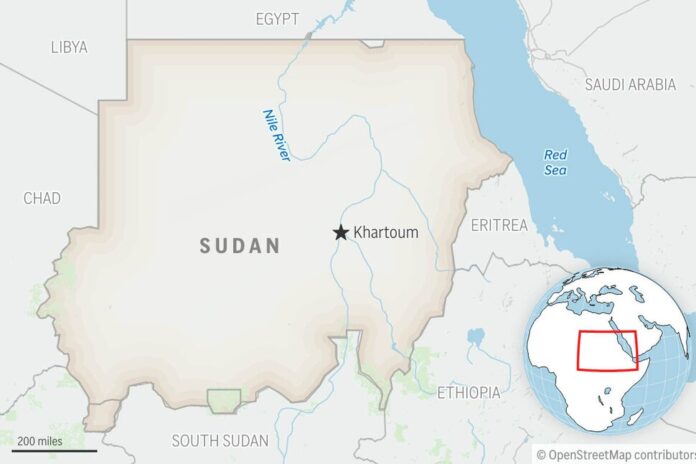
(Reuters) – The World Health Organization said on Saturday that a strike on a hospital in East Darfur, Sudan, killed at least 64 people, including children, medical staff and patients, Director-General Tedros Adhanom Ghebreyesus said in a post on X.
WHO said the Friday attack on Al Deain Teaching Hospital has rendered the facility non-functional, cutting off essential medical services in the city.
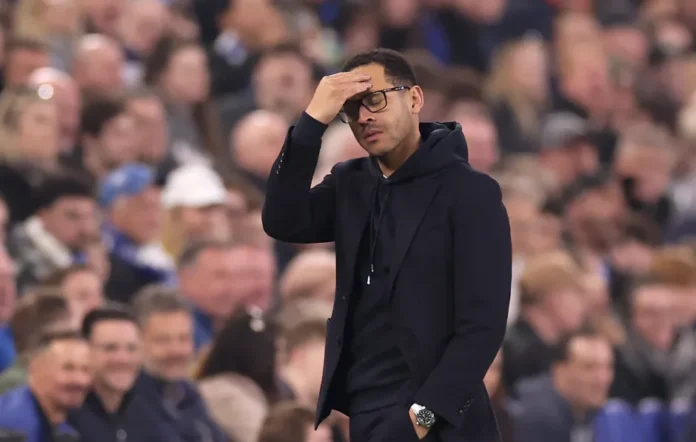
Chelsea have to sack Liam Rosenior and bring in Cesc Fabregas to save their season.
That’s the view of talkSPORT co-host Rory Jennings after the Blues were well-beaten 3-0 by Everton on Saturday night, with the club at serious risk of missing out on Champions League qualification.
Chelsea shipped three goals in a dreadful defeat at EvertonCredit: Getty
Goals from Beto and Iliman Ndiaye inflicted a ninth top-flight defeat of the season on Chelsea, with 3-0 being their biggest losing margin away at Everton.
They had previously lost 3-1 on three separate occasions [in January 1998, September 2015 and December 2019] against the Toffees in Merseyside, while they were also beaten 4-2 in February 1994.
Rosenior, who joined in January as the successor to Enzo Maresca, is now under increased pressure at Stamford Bridge.
Saturday’s result comes just days after they were knocked out of the Champions League by Paris Saint-Germain – and a week after they lost 1-0 at home to Newcastle.
And he once again called for the decision to be made after the third Everton goal live on the GameDay Phone-In on talkSPORT.
He raged: “Disgrace, they are a disgrace, they are an absolute disgrace. Everyone out there is a disgrace to the badge.
“Liam Rosenior should be sacked now. What are we… 77 minutes into the game, he should be sacked now. It’s a travesty if he is the manager…”
Co-host Jamie O’Hara then pointed out that Rosenior is on a five-year deal with the option of an extra year, but Jennings insisted: “It’s irrelevant.
“We gave Lewis Hall a deal and then sold him to Newcastle. We’ve given Liam Rosenior a deal, it’s time to sell him.
“He is gone, he is out the club, he cannot be the Chelsea manager!
Beto and Ndiaye proved to be Everton’s heroes on Saturday against the BluesCredit: Getty
“He has proven to us that he’s not up to the job, look, if you don’t want to make this a personal thing, people get annoyed when I call him ‘talentless’ or say that he’s mediocre, or say that he’s undeserving of the job.
“I don’t care if people get annoyed, it’s completely true. For one second, I won’t be emotional about it.
“Let’s just call this an experiment, and let’s even pretend that it’s a noble experiment, something that you could say was progressive and exciting, giving a young, English manager an opportunity.
“OK, great, you tried it, it hasn’t worked, it’s been a distinct failure, a proven failure, now get him out the club and get a proper manager in!
“There are so many obvious, proper managers, managers who have a proven track record, managers who know what it takes to win games of football.
“This Chelsea team are still capable of getting into the Champions League spots this year, with this manager, that is not going to happen.”
Jennings wants to see Fabregas in the dugout at Stamford BridgeCredit: Getty
Get on the phone to Cesc
Jennings then called for Chelsea to bring former star and current Como boss Cesc Fabregas in as their new boss.
He remarked: “Genuinely if the club’s standards are anything close to what they should be, I do know what the answer is.
“The answer is sack Rosenior now… just get him out of the club now, get on the phone immediately to Cesc Fabregas.
“Somebody who understands Chelsea, somebody who won the league with us, somebody who knows what the standards should be, somebody who has an affinity with the fans, somebody who was an elite player themselves.
“What we need is somebody like that, the club will never do that because Fabregas has too much pride, he would never exist and work within these parameters.
“But if we were a club that were serious, that’s what we would do.”
Jennings concluded by saying: “Battered by Newcastle, battered by Paris Saint-Germain, battered by Everton.
“He’s got to go tonight hasn’t he? He’s actually got to be sacked tonight.”
The defeat for Chelsea leaves the club in sixth spot, as they failed to leapfrog above Liverpool and Aston Villa into fourth place.
As for Everton, they are up into seventh and sit just two points behind the west Londoners.
(Reuters) – British cabinet minister Steve Reed said on Sunday that there was no assessment that backed claims Iran is planning to strike Europe with ballistic missiles, or that it even has the capacity to do so.
On Saturday, the Israel Defence Forces posted on social media that Iran has missiles “that can reach London, Paris or Berlin”.
“There is no assessment to substantiate what’s being said,” British Housing Secretary Reed told the BBC.
“I’m not aware of any assessment at all that they are even trying to target Europe, let alone that they could if they tried.”
In a separate interview with Sky News, Reed said that U.S. President Trump spoke for himself when he threatened to “obliterate” Iran’s power plants if Tehran did not fully reopen the Strait of Hormuz within 48 hours.
Asked to define Britain’s position on Trump’s deadline, Reed said: “The U.S. president is perfectly capable of speaking for himself and defending what it is that he’s saying.”
“We’re not going to be dragged into the war, but we will protect our own interests in the region. We will work with our allies to de-escalate the situation.”
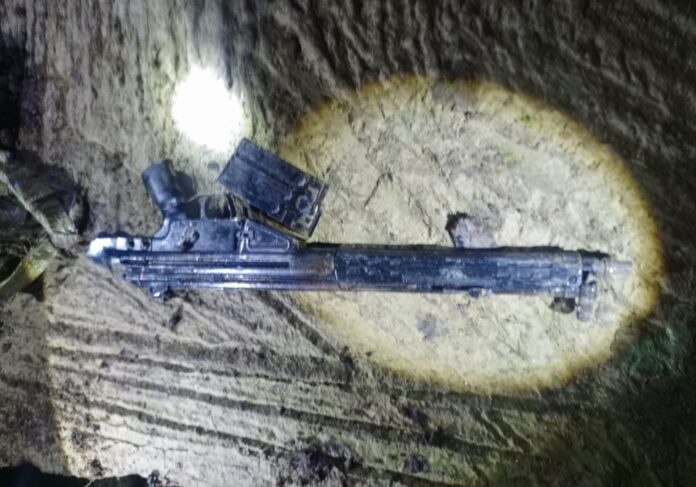
Detectives have recovered a dangerous firearm believed to have been used in a series of violent robberies within and beyond Kisumu County.
According to the Directorate of Criminal Investigation (DCI), the officers acting on credible information from a wary and responsible citizen in Kisumu City, the Officer Commanding Station (OCS) at Kondele Police Station swiftly mobilized undercover officers and launched a targeted operation.
The tip-off pointed to a possible breakthrough in tracing a missing G3 FMP rifle, a weapon linked to criminal activity in the region.
“The operation led officers to Kawese Village, Mahenya Sub-location, within Kolwa East Location, at the residence of one Wilson Ojowi. In a remarkable turn of events, a close family member of the wanted and dangerous suspect—cooperated with police and guided officers to a suspicious site within the compound,” the DCI said.
“What followed was a painstaking search that culminated in the shocking discovery: buried inside an unfinished latrine, officers unearthed the sought-after G3 rifle. The weapon had been concealed in a sack alongside an empty magazine, hidden beneath freshly dug soil. Notably, the rifle had been crudely modified—its butt stock and muzzle had been cut off—raising concerns about its use in close-range, high-risk criminal operations,” thev statement added.
The DCI said that the scene was professionally processed and documented, with the recovered firearm and magazine securely transported and booked at Kondele Police Station as key exhibits.
Preliminary investigations have linked the weapon to a recent robbery with violence incident where one of the suspects was seen wielding a G3 rifle missing a butt stock, matching the recovered firearm’s description.
The prime suspect, identified as 20-year-old Fortune Benedict Migot, remains at large alongside three accomplices. Authorities believe he is behind a string of violent robberies, and forensic analysis of the recovered rifle is expected to further solidify his connection to multiple crime scenes.
Fortune is also reportedly facing an active case at the Winam Law Courts, currently under investigation by DCI Kisumu East. He had previously sustained gunshot injuries during a robbery incident, an indication of his continued involvement in high-risk criminal activities.
Police have intensified the manhunt and are urging members of the public to continue sharing information that could aid in the arrest of the suspect and his accomplices.
This operation underscores the critical role of community-police collaboration in combating crime and ensuring public safety.










![Instagram Screen shot taken from a Q&A on the Instagram account, which the BBC is not naming, that stole Riya Ulan's content. A comment reads: "I HOPE YOU AREN'T AI [three crying emojis] YOU ARE SOOOOOOOOO GORGEOUS [two red heart emojis]". A response is displaced saying: "LoL ofc not Thank you [three face emojis]. The head of a woman with black skin and hair is partially visible. The face and the backdrop have been blurred.](https://ichef.bbci.co.uk/news/480/cpsprodpb/9e3e/live/decce3f0-2161-11f1-a79a-77e93010d956.jpg.webp)