Sponsored Ad

Ad 1
Ad 2
Ad 3
Ad 4
Ad 5
Ad 6
27.4 C
Kenya
Thursday, May 7, 2026
Home Blog Page 308

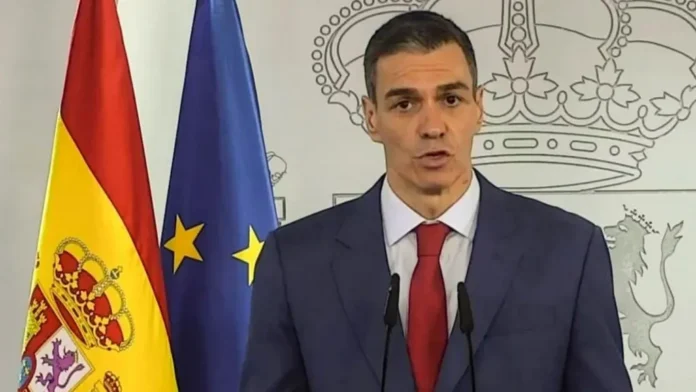
Spain’s Pedro Sánchez hits back at Trump threat to sever trade saying ‘no to war’

BBC -Pedro Sánchez has delivered a strong rebuttal to US President Donald Trump’s threat to end trade with Spain by restating his opposition to war and what he called the “breakdown of international law”.

In a 10-minute televised address, the Spanish prime minister reflected on the wars in Ukraine and Gaza, as well as the Iraq War more than 20 years ago, and said the Spanish government’s position could be summed up as “no to war”.

Trump threatened to impose a full trade embargo on Spain in response to its refusal to allow the US to use the jointly run bases at Morón and Rotafor to strike Iran.

“Spain has been terrible,” Trump said during a meeting with German Chancellor Friedrich Merz on Tuesday.

“We’re going to cut off all trade with Spain. We don’t want anything to do with Spain,” he added.

Merz said later he had told Trump very clearly that he could not conclude a separate trade agreement with Germany or all of Europe but not with Spain.

In response to the US economic threat, the Élysée Palace said French President Emmanuel Macron had conveyed his “solidarity” with Spain during a phone conversation with Sánchez on Wednesday. European Council President António Costa also said he had spoken to the Spanish leader “to express the EU’s full solidarity”.

Trump accused Spain on Tuesday of being a “terrible partner” in Nato for failing to increase its defence budget in line with a target of 5% of economic output (GDP).

Earlier this year, Sánchez drew Trump’s ire by speaking out against the US military incursion into Venezuela.

Watch: Trump lashes out at Spain, says he is ‘going to cut off all trade’

Sánchez said in his televised address from the prime minister’s official residence in Madrid on Wednesday that the government was studying economic measures to counter the impact of the conflict on Spaniards, though he avoided directly referring to Trump’s trade threat.

“The question is not if we are on the side of the ayatollahs [Iran’s clerical rulers] – nobody is. The question is whether we are in favour of peace and international legality,” he said.

“You cannot answer one illegality with another, because that is how the great catastrophes of humanity begin.”

Spain’s Socialist prime minister explained that the government’s position was comparable to its stance on Ukraine and Gaza. Sánchez has been a vociferous critic of Israel’s military response to the Hamas attacks in 2023.

Spain has been among Europe’s most outspoken governments on Gaza, describing Israel’s actions there as “genocide” and acknowledging a Palestinian state before many other EU members did.

That position was in step with his coalition partners to his left and, broadly speaking, with Spanish attitudes toward the Middle East.

Looking back to the invasion of Iraq in 2003, which he said had failed to achieve its goals and had made life worse for ordinary people, he warned that the attacks on Iran could have a similar economic impact for millions.

His reference to the Iraq invasion will connect with many Spanish voters. Spain’s support at the time from the conservative People’s Party (PP) government was deeply unpopular, and triggered mass anti-war protests.

Many believe it also lay the groundwork for the Socialist Party’s surprise election victory in March 2004, days after Madrid had been hit by deadly jihadist bombings.

Sánchez reminded Spaniards of the “Azores trio” – the then-US President George W Bush, the UK’s Tony Blair and Spanish conservative leader José María Aznar – who had met on a Portuguese base in the region days before the Iraq invasion.

He said they had handed Europeans the “gift” of “a more insecure world and worse life”.

The Spanish leader’s stance contrasts strongly with that of Merz, who told German TV on Tuesday that regime change in Iran would leave the world “a little better off”, though he also said this was “not without risk and we would also have to bear the consequences”.

Unlike Spain’s fellow Nato allies – the UK, France and Greece – it has not yet committed to any military involvement in response to the war.

White House press secretary Karoline Leavitt said on Wednesday that Spain had “agreed to co-operate” with the US military after hearing Trump’s message “loud and clear” – a claim Spanish foreign minister José Manuel Albares categorically denied, telling local media that his government’s position “has not changed one iota”.

Trump threatens to halt trade with Spain over military base access

Aside from the fierce criticism Sánchez has faced from the US, his coalition government has faced months of enormous political pressure, generating constant speculation that its collapse could be imminent.

It has been struggling to maintain its parliamentary majority, which includes an array of left-wing and regional nationalist parties.

Allegations of corruption against several of his allies and inner circle have severely weakened his position.

In Spain’s deeply polarised politics, much of the support for Sánchez is driven as much by concerns about the country’s right and far-right as it is by endorsement of his leadership and policies.

Standing up to the US president may have electoral benefits for the Socialist leader.

A recent poll by the CIS research institute found that 77% of Spaniards had a “bad” or “very bad” opinion of Trump, suggesting that even many right-wing voters may back Sánchez on this issue.

However, there is now uncertainty in Spain over whether Trump’s threats will translate into some form of economic reprisals, and many Spaniards will be watching this drama nervously.
Satellite images show Iranian navy and nuclear sites hit by US-Israeli strikes

BBC –A wave of US and Israeli strikes has destroyed or damaged at least 11 Iranian naval vessels since Saturday, new satellite images reviewed by BBC Verify show, with missile bases and nuclear sites also hit by attacks.

Images of the southern Konarak naval base and the Bandar Abbas facility, which sits on the Strait of Hormuz and houses the headquarters of the Iranian navy, show smoke billowing from multiple ships on Monday and Tuesday.

US President Donald Trump said on Monday that the US was “annihilating” the Iranian navy, listing the force’s destruction as one of America’s three main goals. His Defence Secretary Pete Hegseth confirmed that a US submarine had fired on an Iranian warship in the Indian Ocean on Wednesday.

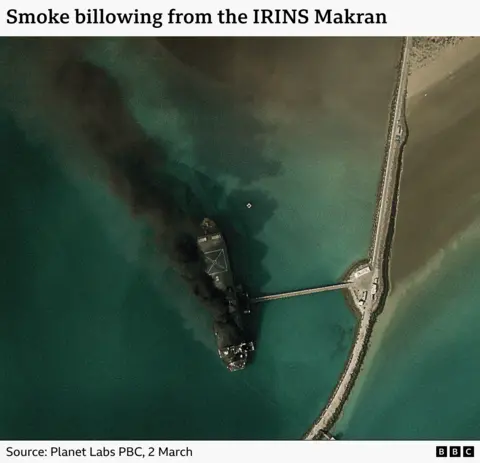
Among the vessels destroyed was the IRINS Makran, Iran’s largest naval vessel, which had served as a drone carrier. Satellite images showed black smoke pouring from the ship which had been docked at Bandar Abbas base.

Maritime security firm Vanguard said that the IRIS Bayandor, IRIS Naghdi, and the IRIS Jamaran were also among the ships destroyed in the strikes. The firm also claimed that the IRIS Shahid Bagheri, a state-of-the-art drone carrier ship launched by Iran last year, had been sunk – although BBC Verify cannot independently confirm this.

Analysts at the intelligence firm MAIAR said at least five ships at Bandar Abbas were “hit or sunk”. Satellite images of the southern end of the port show smoke rising from Makran, while two other vessels appear to be damaged, one visibly ablaze.

A satellite image showing an Iranian ship ablaze in a port. The caption reads "Smoke billowing from the IRINS Makran.

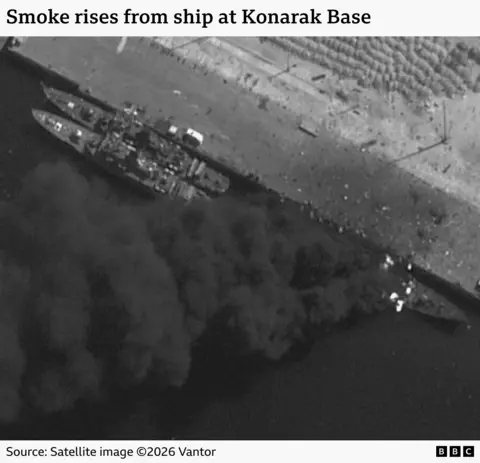
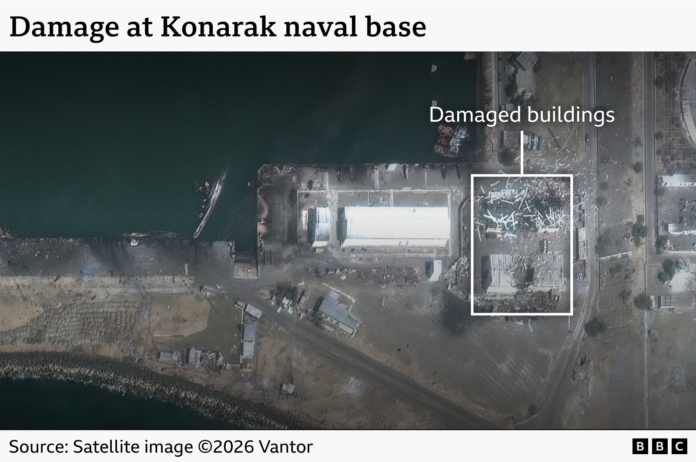
At Konarak, images show multiple damaged vessels, with MAIAR telling BBC Verify that they had identified damage to six vessels.

Three ships are seen docked at an Iranian port in a satellite image. Smoke can be seen billowing from one of the ships. The image is captioned "Smoke rises from ship at Konarak Base.

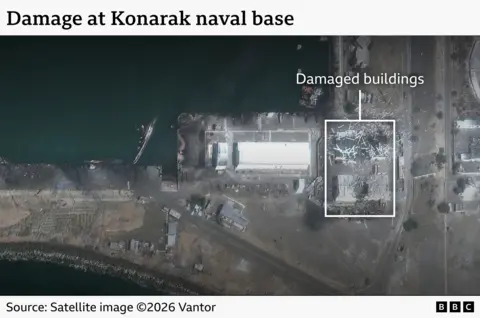
The photos taken on Monday show that multiple buildings at the base have also been demolished.

An image highlighting damaged buildings at Konarak Naval base.

The head of US Central Command (Centcom), which oversees American military operations in the Middle East, claimed that 17 Iranian vessels, including its “most operational” submarine, have been destroyed.

“For decades the Iranian regime has harassed international shipping,” Adm Brad Cooper said in a video posted to X. “Today, there is not a single Iranian vessel underway in the Arabian Gulf, Strait of Hormuz or Gulf of Oman, and we will not stop.”

Some vessels reportedly destroyed may have been obscured in satellite images by cloud or smoke, or struck at sea, and have not been independently verified by BBC Verify.

Sri Lankan officials said on Wednesday that one Iranian ship was sinking near its waters and that it launched a rescue operation, with 140 people currently missing. US Defence Secretary Pete Hegseth later said that a US submarine struck an Iranian ship with a torpedo in the Indian Ocean.

Vice-Admiral Mark Mellett, ex-head of the Irish military, told BBC Verify that the US and Israeli attacks appeared to have “largely neutralised for now or at least suppressed” the Iranian navy’s ability to sustain conventional attacks using its biggest warships.

But he emphasised that Iran retains the ability to launch unconventional attacks at sea through the use of drones, mini-submarines and shadow fleet vessels – a network of tankers sailing under obscured ownership. MAIAR analysts also told BBC Verify that Tehran could turn to smaller, fast-attack vessels armed with anti-ship missiles in the coming days as Iran’s largest warships continue to be targeted by US and Israeli strikes.

Iran also has the ability to disrupt commercial shipping, with Mellett observing that it could plant mines in key shipping lanes in the Strait of Hormuz or launch drone attacks on tankers and key ports.

Images show damage to missile sites

President Trump listed the destruction of Iranian missile bases and the prevention of nuclear weapons development as the other objectives of the American air campaign.

In his statement on Tuesday night, Adm Cooper said that hundreds of air defence sites, ballistic missiles and drones had been destroyed by US strikes. Satellite images also showed damage at the southern Khorgu and north-western Tabriz missile bases, and at the Konarak air base, missile storage facilities and bunkers were hit.

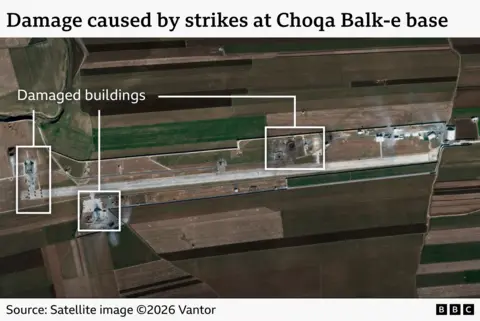
At the Choqa Balk-e drone base west of Kermanshah, extensive damage was seen to storage buildings, bunkers and drone launch equipment.

An image showing damaged buildings at Choqa Balk-e base. Three such buildings are highlighted.

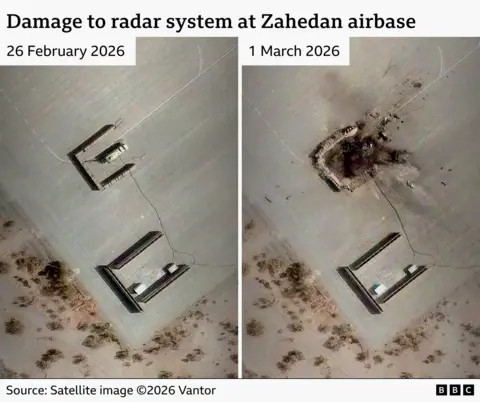
Destruction was also seen to a radar installation at the Zahedan airbase in eastern Iran, near the border with Afghanistan and Pakistan.

A satellite image showing the before and after photos of a destroyed radar array. The first image was taken on 26 February showing an intact array, with the second taken on 1 Marsh showing the destroyed shell of the system.

Satellite images show that the latest wave of strikes have targeted facilities at Natanz – long said to be at the heart of Iran’s nuclear programme and which were both targeted by the US last year.

Following those attacks last summer Iran denied Trump’s claims that the US had “obliterated” the nuclear sites.

The International Atomic Energy Agency (IAEA) said the buildings were used for pedestrian and vehicular access to the site’s underground enrichment facility and that “no radiological consequence” was expected as a result of the damage.

The total scale of the damage caused to Iranian military facilities remains unclear, with strikes continuing on Tuesday night and Israeli attacks targeting what it called “security headquarters” in the capital Tehran.

The Institute for the Study of War (ISW) said that the “decrease in Iranian missile attacks against Israel and the UAE strongly suggests that the effort to destroy ballistic missile launchers has had considerable success”.

Imagery shows extensive damage to the headquarters of the Islamic Revolutionary Guard Corps (IRGC). Pictures captured by intelligence firm Vantor on 3 March shows damage to at least six structures. There are also signs of damage at the National Defence University and Intelligence Ministry.

Gen Jospeh Vettel, ex-head of Centcom, told the BBC that many strikes had targeted Iran’s “internal security apparatus” and sought to degrade “the ability of the regime to control the population”.

A large number of civilian buildings also appear to have been hit in the capital and across Iran since the conflict began on 28 February. At least 160 people, including children, were reported killed after a school in Minab in southern Iran was hit, according to Iranian officials.

The US-based Human Rights Activists News Agency (HRANA) says 1,097 civilians have been reported killed since Saturday.

BBC Verify will continue to monitor satellite images as the situation develops.

Russia blames Ukrainian naval drones as tanker sinks in Mediterranean

A Russian liquefied natural gas (LNG) tanker has sunk in the Mediterranean between Libya and Malta after it was hit by explosions and a fire, Libyan port officials have said.

Russia accused Ukraine of targeting the Arctic Metagaz with “uncrewed sea drones” launched from the Libyan coast.

Ukraine’s SBU state security service has not commented on the allegation and the Libyan port authority said the cause of the fire was unclear.

The Libyans said the tanker was carrying about 62,000 tonnes of LNG before the blasts and that it sank about 130 nautical miles (240km) north of the Libyan port of Sirte.

Russia’s transport ministry said 30 Russians were aboard the Arctic Metagaz. Maltese Home Affairs Minister Byron Camilleri said they were all found “safe and sound in a lifeboat” during a rescue operation by Malta’s armed forces.

Unverified night-time footage has emerged purportedly showing the ship ablaze after the attack, which occurred on Tuesday.

Serhii Sternenko, a popular blogger and adviser to Ukraine’s defence minister, posted pictures on Wednesday morning of what he said was the tanker in the Mediterranean, which had a “serious hole in the engine room compartment and is beyond repair”.

He did not elaborate where the pictures came from and they have not been independently verified.

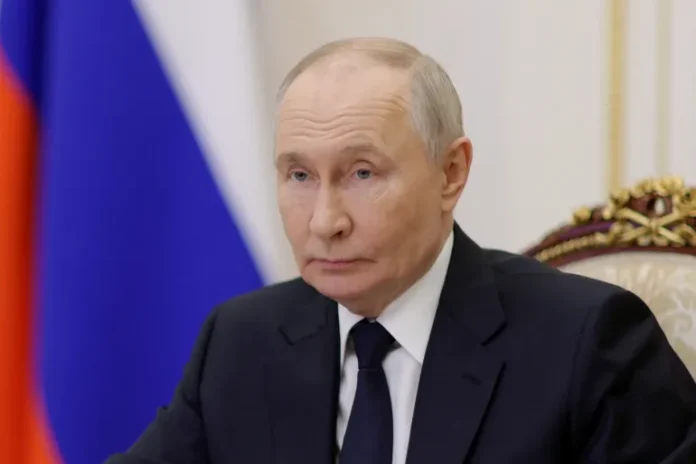
“This is a terrorist attack,” Russia’s Vladimir Putin told state TV. “This isn’t the first time we’ve encountered something like this.”

Russia’s transport ministry called it “an act of international terrorism and maritime piracy”, singling out the European Union for complicity.

Moscow said the Arctic Metagaz – which had been en route from Russia’s northern port of Murmansk – was carrying cargo cleared in accordance with international rules.

The tanker was apparently heading for Port Said in Egypt and is considered part of Russia’s so-called shadow fleet. It has been widely sanctioned by Western countries.

The ministry provided no evidence to back up its claim that the tanker was attacked by Ukrainian sea drones, though there were earlier unconfirmed reports of attacks from the Libyan coast.

The SBU told BBC Ukraine it was not commenting on “the situation with the tanker in the Mediterranean”, although a Ukrainian government-linked social media account, United24, teased that the drones were “Definitely. Maybe” not part of the Ukrainian fleet.

Marine tracking data indicated that the day before the fire, the tanker had last reported that it was sailing off the south-east coast of Malta.

It had sailed some considerable distance by the time the fire was reported and it is assumed the crew deactivated its automatic identification system.

Russia has deployed a surging number of vessels to transport oil and gas in an attempt to avoid international sanctions, which are aimed at slashing revenues that have been critical for funding Moscow’s war in Ukraine.

Its shadow fleet is largely made up of aged tankers, many with obscure ownership or insurance.

Following Russia’s full-scale invasion of Ukraine, which began in 2022, Kyiv has carried out a number of attacks on such vessels using naval drones.

However, nearly all of such strikes have been in the Black Sea, which Russia and Ukraine both border.

KQ announces repatriation flights to and from Dubai

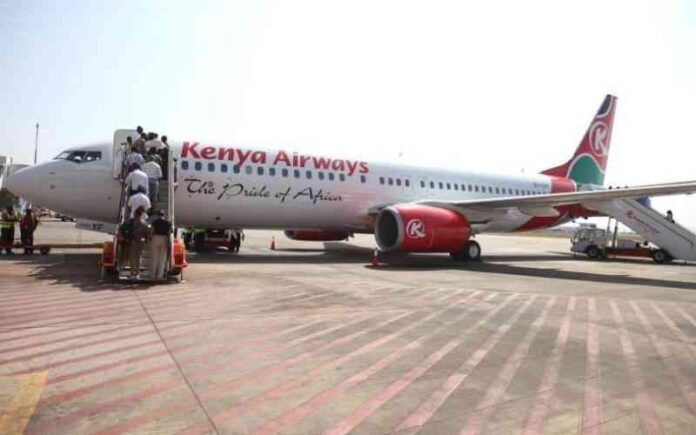
Kenya Airways will operate repatriation flights from Nairobi to Dubai on March 4, 2026, and from Dubai to Nairobi on March 5, 2026, following slots approval by Dubai Airport Management. 

In a customer update issued on March 4, 2026, the move follows the guidance by the United Arab Emirates (UAE) authorities on the resumption of limited operations at Dubai Airport on March 2, 2026, with a small number of flights permitted to operate from Dubai International Airport. 

The operation is, however, strictly for repatriation purposes.

“These are not regular scheduled flights, rather repatriation flights for Customers who are citizens or have residency in the UAE to be able to travel out of Nairobi and Vice Versa,” the statement read in part. 

“We request our customers in Dubai not to proceed to DXB Airport until we have communicated a confirmed departure date and time.”

Travellers were also advised to check their flight status on the Kenya Airways official website and update their contact details through the Manage Booking option to enable the airline to reach out to them for further guidance. 

“We sincerely apologise for any inconvenience caused and appreciate your patience and understanding. The safety of our crew and customers remains our highest priority, and we will communicate directly with affected customers to provide the necessary assistance.”

KQ, however, reiterated that it had not resumed scheduled operations to Dubai but assured the public to provide updates as soon as they get approvals from the UAE Authorities.

The statement comes as KQ temporarily suspended all flights to Dubai on February 28, 2026, following the closure of the UAE airspace.

The disruption emanated from escalating regional tensions between United States, Israel and Iran.

On February 28, 2026, the US and Israel launched missile strikes against Iran, leading to the deaths of Supreme Leader Ayatollah Ali Khamenei and senior officials. 

Despite ongoing negotiations with the United States over its nuclear programme, Iran vowed a harsh response and began carrying out retaliatory strikes targeting Israel, as well as several Gulf nations hosting US military assets, including the United Arab Emirates, Qatar, Kuwait and Bahrain.

Man Utd stunned by 10-man Newcastle as Michael Carrick’s unbeaten run ends

Three goals, each in added time at the end of the first and second halves, provided the scoring in this match as Newcastle stood tall on home turf with a 2-1 victory.

Down a man for most of the match due to a Jacob Ramsey red card in the first half, Newcastle finally surged ahead for good in second-half added time.

That was thanks to William Osula’s masterful counter-attacking goal in the 90th minute.

At the full-time whistle, St. James’ Park erupted as Newcastle secured a much-needed win against Manchester United.

What a finish from William Osula as Newcastle took the late lead!

First, Osula intercepted a pass to thwart a Manchester United attacking sequence. He passed back to Kieran Trippier and sprinted upfield in hopes of creating an opportunity.

Trippier booted a pass well upfield that nearly went out of play, but Osula tiptoed the sideline and maintained possession.

Closing in on the box, he worked a yard of space and drilled a shot with his left foot for the go-ahead goal.

It gave Newcastle hope they could pull it off — and they did.

The Newcastle head coach’s decision to send on Will Osula in the 85th minute, ahead of expensive summer signing Yoane Wissa, was also a masterstroke.

The 22-year-old was excellent and his winner was a sublime solo goal, running from inside his own half with the ball, before curling inside and curling into the far corner.

A memorable moment in a baffling Premier League season for Newcastle.

The torrid home run ends at three successive Premier League defeats at St James’ Park. What a massive victory this is for Newcastle and for Eddie Howe.

The team showed fight and organisation, earning the victory despite playing more than a half with only 10 men.

With the clock ticking over to 90 minutes, a poor pass from Matheus Cunha saw Osula regain possession and he dropped it off to Kieran Trippier before haring down the right flank.

William Osula, tall and rangy, ate up the ground with long strides and easily outpaced Tyrell Malacia, who looked very short of match fitness.

He kept it in well, cut inside past a static Malacia, who turned his back on it, threw in a step-over, and in the absence of any supporting team-mates, curled it towards the bottom-left corner from roughly the right corner edge of the box.

It swung and dipped superbly into the net. Senne Lammens didn’t even move!

 Arsenal moves seven points clear at the top of the Premier League table after 1-0 win over Brighton

Bukayo Saka scored the only goal of the game in a below-par Arsenal performance as they defeated Brighton & Hove Albion on Wednesday night.

They lacked much attacking threat throughout the 90 minutes, but equally, Brighton didn’t do enough to put the away side under pressure and force an equaliser.

The league leaders were dealt a blow before kick-off, with William Saliba missing from their side, with Mikel Arteta revealing that he’d suffered a minor injury in the win over Chelsea on Sunday.

While Arsenal came into this clash with a better win ratio with Saliba in the side (69%) than without (42%), the Gunners are much more stacked in defence than in seasons previous. Summer signing Cristhian Mosquera came into the side to take Saliba’s place alongside Gabriel Magalhães.

It was Gabriel who made the first meaningful action of the match, saving David Raya with a headed clearance off the line in what was the Spaniard’s 100th Premier League appearance for the club. Raya had made an uncharacteristic mistake with a poor kick out in only the third minute, but Carlos Baleba chipped shot couldn’t beat the Brazilian defender.

It only took nine minutes for Arsenal to get in front, with Saka celebrating his 300th competitive appearance for the club with a goal. After cutting in off the right side, the England international whipped a shot at goal that took a deflection before nutmegging Bart Verbruggen.

That would be Arsenal’s only shot in the first half, however. With the Gunners lacking any cutting edge and Brighton having the majority of possession and posing much more of a threat going forward.

That continued into the second half, and Brighton nearly forced an equaliser just shy of the hour mark thanks to the pace of half-time substitute Yankuba Minteh, who sped past Mosquera before seeing his powerful cross deflected inches past the post off an Arsenal defender.

It was mediocre game at best and at times Arsenal used all their nous to slow down the game and frustrate the home side.

In the end, though, this result handed Arsenal all three points in their quest for a first title since 2004, while their rivals Manchester City surprisingly dropped points at home to lowly Nottingham Forest, opening up a seven point gap between the sides in the Premier League table. The manner of this victory won’t matter come May.

Our Opta match centre delivers you all the Brighton & Hove Albion vs Arsenal stats from their Premier League meeting at American Express Stadium on Wednesday 4 March 2026.

The match centre below includes team and player stats, expected goals data, passing networks, an Opta chalkboard and more. It gives you everything you need to do your own match analysis.

Underneath the match centre you can find the official Opta stats on the game as well. 

China to send special envoy to mediate in Israel-Iran war

China will send a special envoy to mediate in the Middle East, Foreign Minister Wang Yi said on Wednesday, as the war triggered by US-Israeli strikes on Iran continued its regional spread.

Beijing is a close partner of Iran and has said it backs Tehran in defending its sovereignty, while urging the United States and Israel to cease their attacks.

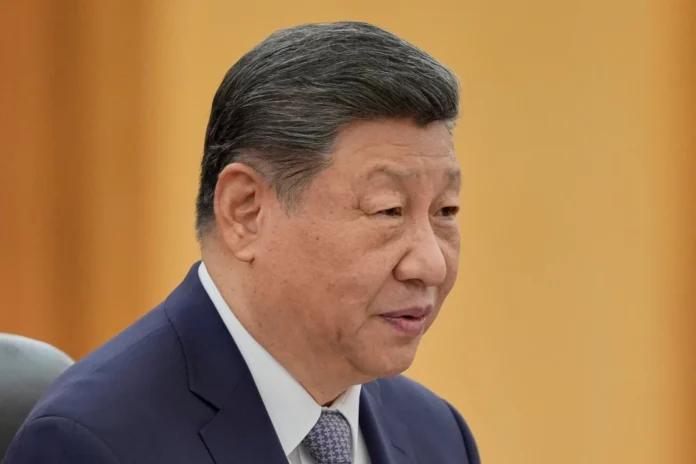
China “will send a special envoy on Middle East issues to regional countries for mediation”, Wang said during a call with his Saudi Arabian counterpart Prince Faisal bin Farhan, according to a readout by Beijing.

The statement did not name the envoy or give details about which countries they would visit.

Beijing “has always been a force for peace and is willing to continue playing a constructive role”, Wang said.

“China strongly urges all parties to… return to dialogue and negotiations as soon as possible, and prevent the further escalation of tensions,” he added.

Israel embassy in Nairobi defends joint US strike on Iran amid global backlash

The Israeli embassy in Kenya has defended its decision to jointly attack Iran with the United States.

In a statement issued on Wednesday, the embassy said the military action against Iran was taken in response to the Middle East country’s continued nuclear programme advancement, as well as its financing of terror activities.

The statement comes as Russia wades into the conflict, accusing the US of manufacturing threats as an excuse to attack Iran and orchestrate regime change there, while Spain and France continued to condemn the military action against Iran.

The embassy maintained that the decision to strike was born out of Iran’s relentless advancement of its nuclear programme and its continued financing of global terror networks.

For Israel, it said, this was not just a military manoeuvre, but an act of survival.

But as the smoke clears over Tehran, the international community is far from united. While the White House describes a unique window of opportunity to cripple Iran’s missile buildup, others see a dangerous departure from global norms.

“It appears that the actions are inconsistent with international law,” said Canada Prime Minister Mark Carney.

The dissent is not just coming from the usual sceptics. In Washington, the halls of Congress are echoing with internal debate.

While House Speaker Mike Johnson defends the strikes as a response to Iranian intimidation, others are questioning the legality of the administration’s “rush to war.”

“The US Constitution is clear that the power to declare war completely sits with Congress… this administration has not put forward a viable argument why the US should be going to war with Iran,” Congress Rep. Melanie Stansbury said.

Across the Atlantic, the fracture is even more pronounced. Spain and France have moved from concern to outright condemnation.

Spanish Prime Minister Pedro Sanchez has made it clear that Madrid will not be a silent partner in what he deems a moral and strategic error.

“We will not be complicit in something that is bad for the world and contrary to our values and interests, just because we might fear reprisals… we feel prouder than ever to be Spanish,” Sanchez stated.

That defiance has drawn the ire of President Donald Trump. In characteristic fashion, Trump did not just target Spain’s stance; he threatened its economy while simultaneously venting his frustration with the United Kingdom’s level of cooperation.

“I could stop tomorrow, or today, even better — stop everything having to do with Spain. All businesses having to do with Spain… embargoes, do anything I want with it. And we may do that… I’m not happy with the UK either. This is not Winston Churchill that we’re dealing with,” Trump noted.

As the West argues over trade and tactics, Russia is seizing the narrative. Moscow has accused the US and Israel of manufacturing a crisis to facilitate what it termed a long-planned scheme for regime change.

“There is no doubt that the so-called Iranian threat… was merely a pretext for carrying out a long-planned scheme to forcibly overthrow the constitutional government of a sovereign state,” Russian Foreign Ministry Spokeswoman Maria Zakharova said.

With missiles still flying and allies drifting apart, the narrow window the US spoke of may have set it on a path towards achieving its military goals, but the diplomatic cost is proving to be a price many are not yet willing to pay.

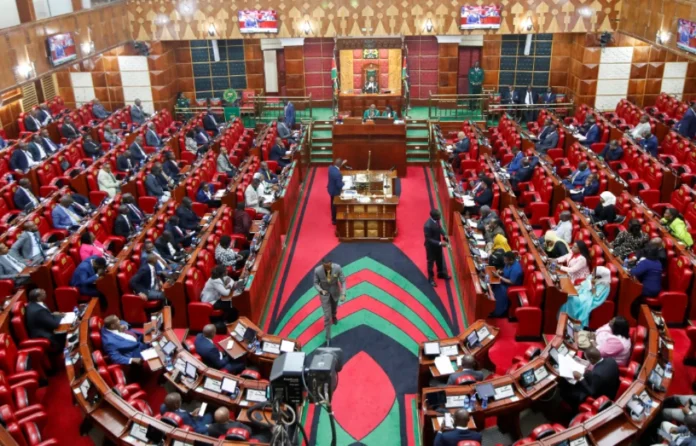
MPs clash over proposed National Infrastructure Fund amid oversight concerns

The proposed National Infrastructure Fund Bill on Wednesday continued to attract mixed reactions on the floor of the National Assembly, with critics questioning the heavy influence of the Executive and specifically Treasury Cabinet Secretary John Mbadi in its management.

Proponents of the bill say it is the surest way for the country to unlock trillions of shillings needed to develop previously neglected areas.

The bill has divided the House between those in support of President William Ruto’s “Singapore dream” and those sceptical of it.

“The President said we cannot continue funding development through borrowing and he said we cannot continue overburdening Kenyans with borrowing…” said National Assembly Majority Leader Kimani Ichung’wah. 

Suba South MP Caroli Omondi warned: “I forewarn, if we pass it, the court will declare it unconstitutional.”

The bill proposes a board of nine directors comprising a chairperson, the Treasury CS or their representative, four independent directors, two persons experienced in senior leadership in development banking and a chief executive officer.

It provides that the independent directors and the two senior experts shall be recruited competitively through a selection panel created by the Treasury CS.

Once appointed by the CS, the same CS shall determine the remuneration of the directors and also sign and review their performance contracts.

MPs questioned the powers granted to the CS.

“This board has been given sweeping powers… even if it prioritises projects… why is the CS sitting at the centre of control? That is not oversight, that is control. Consolidation precedes abuse,” Mukurweini MP John Kaguchia said.

Kathiani MP Robert Mbui added, “With this fund, there’s no way of fair distribution. We are passing for the next election. Kenyans will stop us.”

In November 2025, when President Ruto sold the “Singapore dream”, he told Parliament that the time had come for innovative ways of funding projects.

MPs now say that the fund, which was sold as one to take in proceeds of the privatisation of government institutions, is still keen on borrowing.

“What has been sold to the country and members here — that this was going to be the panacea that we are not going to borrow at all to finance infrastructure projects — any discerning person would have taken it for Gospel truth,” stated Funyula MP Wilberforce Oundo.

Kiharu MP Ndindi Nyoro on his part said: “We are moving the debt… I dare say the national illegal borrowing fund bill should be the correct title of this bill.”

Members of Parliament also questioned the place of oversight by the House.

“For the NG-CDF board we approve the board and committee. In this law, the Executive nominates, appoints…” Kajiado North MP Onesmus Ngogoyo noted.

Oundo added, “The National Assembly has no say in this. Marginalised parts of this country — what measures are put in place to make sure there is public input into this?”

Kitui Central MP Makali Mulu said: “Once passed, there will be minimal oversight by this House.”

Ichung’wah responded: “The Auditor General brings reports to the National Assembly; therefore, the oversight is guaranteed by the Constitution.”

The debate occasionally tilted towards the politics of regional development, showcasing the mixed understanding of the proposed law.

“In Marsabit, we need water; this is the only way we will get water,” noted Marsabit Woman Representative Naomi Waqo.

Dadaab MP Farah Maalim added: “The most viable areas are arid areas. They have minerals… These are not the days of coffee and tea.”

Ngogoyo said: “It is not a must that all constituencies have commercial viability. This is another way of saying there are areas with high potential.”

Mulu noted: “The fund to undertake feasibility study to check commercial viability of projects. The word is commercial.”

Omondi said: “It’s like members are waiting for this fund to finance their 30km roads. This is not for that. Go for the budget…”

Ichung’wah added: “Far from it, this will go to roads that can pay for themselves. Those others will be funded by budgets…”

Should it become law as it is, the bill will herald a project identification, funding and implementing agency that walks away from the national budget, away from Parliament, away from the Controller of Budget and away from State departments, with only after-the-fact visibility by the Auditor General and eventually by Parliament.

“Our Ksh.4 trillion budget is overseen by Parliament and counties. Now we want to hand over Ksh.5 trillion to be oversighted by an individual. You cannot be patriotic and support,” said Nyoro.

Homa Bay Woman Representative Joyce Atieno Bensuda said: “There is no clarity in this bill; some sections are ambiguous. I hope we save this bill by making the changes we need to.”

The bill will undergo amendments at the committee of the whole House stage before subsequent approval.

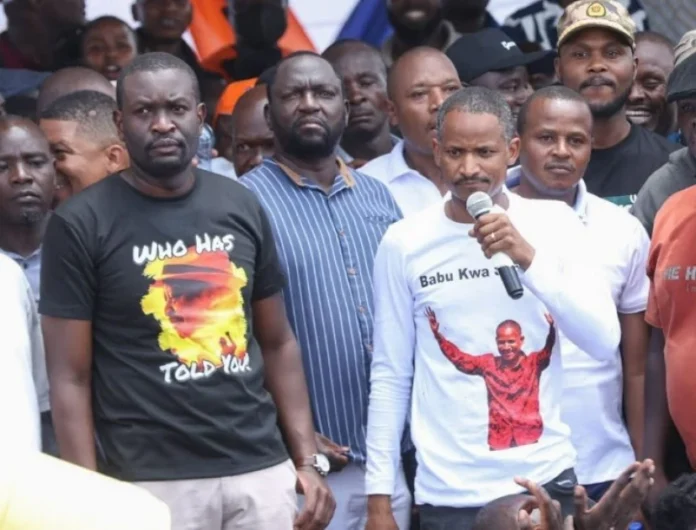
Sifuna, Babu Owino, Orengo oppose registration of Linda Mwananchi as political party

Members of the Linda Mwananchi faction have written to the Registrar of Political Parties opposing the registration of the movement as a political party by an individual not affiliated with them.

Through their advocates, Henia Anzala & Associates, the faction referenced a newspaper article stating that one Charles Wanyonyi has lodged an application to register ‘Linda Mwananchi’ as a party.

They pointed out that the Registrar is mandated by the Political Parties Act to publish a notice in the Kenya Gazette and at least two nationwide newspapers, inviting objections to the registration.

The faction also noted that if the pending registration process is approved, it would provide an avenue for fraudulent conmanship against the public. 

“The political party is likely to use our clients’ names, images and goodwill to fraudulently get financing either from members of the public or other entities,” the letter read in part. 

The faction urged the Registrar to thwart the attempt to defraud Kenyans by declining the application. 

The Linda Mwananchi movement reflects deepening internal divisions within the Orange Democratic Movement (ODM), with the party splitting along ideological lines.

The Linda Mwananchi faction supports the ‘one term’ narrative, and comprises Nairobi Senator Edwin Sifuna, Embakasi East MP Babu Owino, Siaya Governor James Orengo, Vihiga Senator Godfrey Osotsi, Kisii Senator Richard Onyonka, Saboti MP Caleb Amisi, Kitutu Chache South MP Anthony Kibagendi, Suba South MP Caroli Omondi, Kabuchai MP Majimbo Kalasinga, among others. 

The opposing Linda Ground faction, aligned with ODM party leader Dr. Oburu Oginga, backs a broad-based arrangement and is pushing for a coalition with the United Democratic Alliance (UDA). 

Both factions have been staging rallies across the country in a bid to advance their respective agendas.

Create a free account, or log in.

Gain access to read this content, plus limited free content.

Yes! I would like to receive new content and updates.

Sponsored Ad

Ad 1
Ad 2
Ad 3
Ad 4
Ad 5
Ad 6