The Social Health Authority (SHA) has announced a nationwide service disruption of its digital systems, affecting hospital pre-authorisation services.
In a statement on March 2, SHA CEO Dr Mercy Mwang’ang’i stated that the outage, which began on Sunday, March 1, has crippled hospital processes at contracted healthcare facilities countrywide.
This directly affects how quickly patients receive approvals for treatment.
According to the agency, the disruption is caused by a downtime affecting the Digital Health Agency’s services.
“This is to formally notify you of a service interruption and downtime affecting the Digital Health Agency’s services, which are critical to the Social Health Authority (SHA) operations. We have received notification from our service provider, Digital Health Agency, indicating a major incident leading to significant system unavailability,” SHA said.
SHA’s patient pre-authorisation service acts as a digital gatekeeping mechanism, ensuring high-cost or specialised medical procedures are approved for coverage before any treatment is administered to a patient.
It guarantees financial coverage, prevents claim denials, and confirms that medical interventions are both necessary and aligned with the SHA Benefits Package and Tariffs.
SHA Chief Executive Officer (CEO) Dr Mercy Mwangangi has personally addressed the situation, assuring the public that resolving the crisis is the authority’s top priority at this moment.
“Our technical teams, in close collaboration with the Digital Health Agency, are fully mobilised and working with the highest urgency to identify the root cause and restore full functionality,” Dr Mwangangi stated.
She also acknowledged the human cost of the disruption and that the SHA management fully understands the critical nature of these services for Kenyans’ daily operations and patient care.
“We understand the critical nature of these services for your daily operations and patient care, and we sincerely apologise for the significant inconvenience and disruption this is causing,” stated Dr Mercy Mwangangi.
In the very same notice, SHA stressed that updates will be shared regularly with healthcare providers and the public until services are fully and reliably restored, with no official timeline for restoration having been provided yet.
The High Court in Nairobi has issued temporary orders blocking the arrest and prosecution of a Nairobi-based doctor and a nurse who have challenged the decision to institute criminal proceedings against them, claiming the move is malicious and driven by business rivalry.
In orders delivered on February 24, 2026, Justice M. Muya certified the matter as urgent and granted conservatory relief, restraining the Director of Public Prosecutions (DPP), the Inspector General of Police, and the Directorate of Criminal Investigations (DCI) from arresting, charging, or prosecuting Dr. Jane Njeri Kamau and Vivian Masaai Chebef pending the hearing and determination of their application.
The case, filed as Petition No. E007 of 2026 before the High Court’s Criminal Division, stems from a decision by the DPP, communicated in a letter dated February 5, 2026, approving criminal charges related to alleged professional negligence arising from their medical practice.
Through a certificate of urgency filed by their advocate, the petitioners argue that the intended prosecution violates their constitutional rights, including the right to fair administrative action and a fair trial. They contend that the investigative and prosecutorial processes leading to the charges were flawed and failed to meet constitutional thresholds.
The court directed the respondents, together with an interested party, to file their responses within seven days. The matter is scheduled for mention on March 17, 2026, for further directions and compliance.
Separately, the doctor and nurse, represented by senior counsel, have moved to seek the intervention of their respective professional regulatory bodies, arguing that the councils under which they are registered have the mandate to safeguard the interests and integrity of licensed practitioners.
Their legal team has attributed the criminal complaint to alleged hostility within the beauty and cosmetic industry, claiming that trained dermatology professionals are increasingly being targeted by unqualified operators who feel threatened by their presence.
According to the defence, such individuals are resorting to “any means possible” to tarnish the reputation of legitimate practitioners, with the current case forming part of what they describe as a broader pattern of malicious complaints fueled by commercial competition.
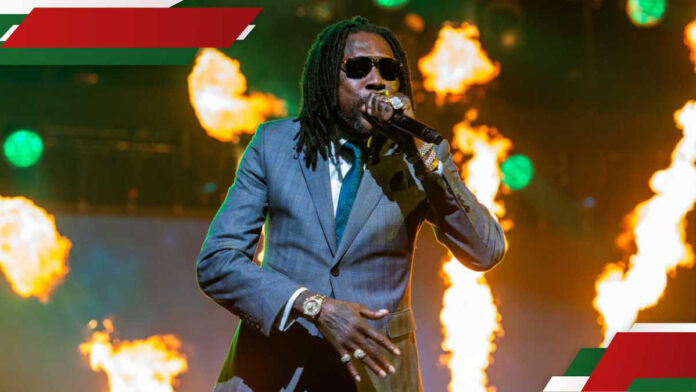
Vybz Kartel is set to perform in Kenya, with recent reports pointing toward a massive event in mid-2026.
The Jamaican dancehall star is scheduled to perform live in Kenya on May 8, 2026.
The performance is part of The Vybz Fest, which has been billed as Africa’s biggest-ever dancehall festival to be held in Nairobi.
Pre-registration for the event is reportedly ongoing through the Tickoz ticketing platform.
There has been significant buzz regarding the booking costs, with some reports suggesting Kartel’s performance fee ranges between $1.2 million and $1.5 million (approx. Ksh 155M – 195M).
Former Nairobi Governor Mike Sonko had previously expressed interest in hosting the artist.
This tour marks his long-awaited return to the global stage following his release from prison in late 2024.
He has repeatedly referred to Kenya as his “second home” and a key destination on his African tour.
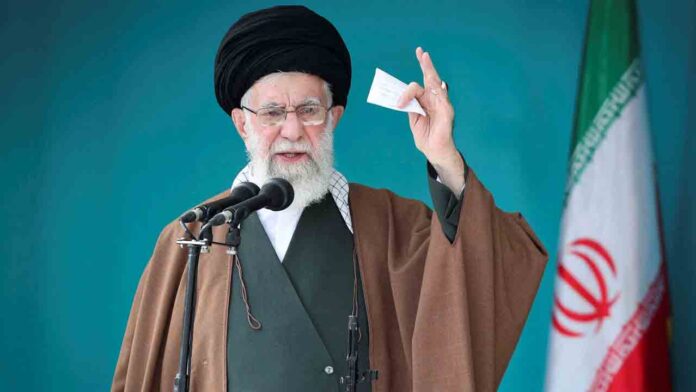
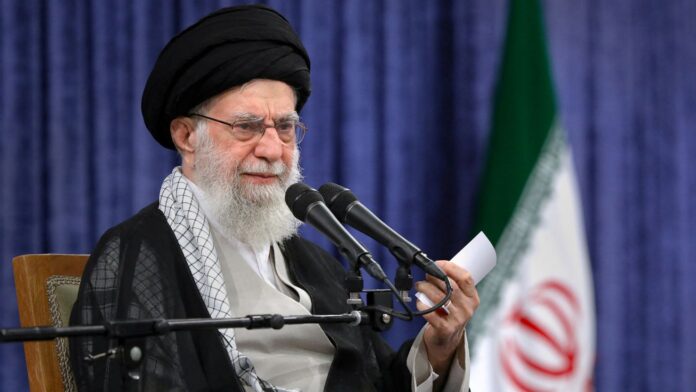
Ayatollah Ali Khamenei, Iran’s hardline supreme leader who ruled the country for almost four decades, was killed in Saturday’s joint US-Israeli strikes, Iranian state media confirmed Sunday, prompting celebration among Iranians who opposed his rule and fury from pro-regime loyalists.
An Iranian TV broadcaster broke down in tears as he confirmed Khamenei had reached “martyrdom” in a strike that Fars New Agency said hit his compound in Tehran as he was “carrying out his duties.”
The death of the cleric who repressed millions as he sought to exert Iran’s influence in the Middle East and beyond appears likely to plunge the Islamic Republic into the most serious crisis since its establishment, with no clear leader to take his place.
One of Iran’s most powerful figures, Ali Larijani, Secretary of the Supreme National Security Council, signaled Iran’s defiance on Sunday, vowing to “stab” America in the heart in retaliation.
Here’s what we know:
How did he die?
Satellite images from Airbus showed black smoke rising from the supreme leader’s compound in the capital, Tehran, on Saturday. The images appeared to show that several buildings in the compound had been severely damaged by strikes.
Initially, Iran’s Foreign Ministry had insisted that Khamenei was “safe and sound,” even as his death was announced by both US President Donald Trump and Israeli Prime Minister Benjamin Netanyahu.
“There are many signs” that Iran’s supreme leader is “no longer with us,” Netanyahu had said Saturday evening, without elaborating.
Smoke billows above the compound of Ayatollah Ali Khamenei in Tehran on Saturday, February 28. Airbus
Two Israeli sources told CNN that the strikes targeted senior figures, including Khamenei, President Masoud Pezeshkian, and the armed forces’ chief of staff Abdolrahim Mousavi.
Trump said one of the aims of the joint US-Israeli attack was regime change, and he called on the Iranian people to rise up against the government.
However, it was unclear whether such change would result from Khamenei’s death, which appeared likely to usher in hard-line rule by the Islamic Revolutionary Guard Corps, experts said.
What led to this?
Khamenei’s death comes at a time when Iran is arguably at its weakest since he took power in the 1989. Decades of Western sanctions had already left the country isolated and economically battered before US and Israeli strikes in June 2025 dealt his rule a severe blow.
Just six months later, protests that began over economic grievances quickly turned political, spreading across all 31 of the country’s provinces within weeks. The regime responded with a brutal crackdown, killing thousands of protesters and prompting a global outcry, including a threat of intervention from the Trump administration.
That intervention came on Saturday, when Trump said the US military was undertaking a “massive and ongoing operation to prevent this very wicked, radical dictatorship from threatening America and our core national security interests.”
President Donald Trump monitors US military operations in Iran, February 28, 2026. Portions of the photo have been blurred by the White House. The White House/X
Who could replace Khamenei?
Larijani, who been a key adviser to Khamenei, said a temporary leadership structure comprising of the president, the head of the judiciary would soon be in place.
Larijani said Iran had assured leaders in the region that it was not after war with them, but would continue to targeted American bases in Middle Eastern countries.
“It must be made clear once and for all that the Americans cannot bully the Iranian nation,” he said.
According to Iran’s constitution, an interim three-member council — consisting of the president, the head of the judiciary and a jurist of the country’s Guardian Council — would be tasked with carrying out the duties of the leader, until an Assembly of Experts appointed a new supreme leader, according to the Middle East Institute.
Who could lead Iran next remains a mystery, even to those who have removed him. In January, US Secretary of State Marco Rubio said that “no one knows” who would take over if Khamenei was removed.
Reza Pahlavi, the eldest son of Mohammad Reza Pahlavi, the last shah of Iran, said any attempt to appoint a successor to Khamenei “is doomed to fail from the outset.”
How are Iranians reacting?
Cheering could be heard in Tehran as news spread about Khamenei’s demise, but as morning broke on Sunday, thousands of people gathered in the capital to wave flags and chant “Death to America.”
For protesters who fought for regime change in protests across the country this January, prompting a brutal crackdown, Khamenei needed to go.
The regime employed unprecedented levels of violence, with officials framing the demonstrations as a continuation of an Israeli-American conspiracy against the Islamic Republic.
Iranian demonstrators protest the US-Israeli strikes, in Tehran on Saturday. Majid Asgaripour/WANA/Reuters
In one video obtained by CNN from an eyewitness in Tehran on Saturday as reports of Khamenei’s death circulated, the voices of two women can be heard chanting, “Death to the Islamic Republic” and “Long Live the shah,” in Farsi, before cheers and whistles erupt.
In a similar video, cheers are heard echoing across a residential neighborhood in the city. In cities around the world, members of the Iranian community took to the streets to celebrate a new era in Iran.
How could this impact the wider Middle East?
Khamenei’s death has the potential to trigger the greatest shift in regional dynamics since the Hamas-led attack on Israel on October 7, 2023, after which Israeli Prime Minister Benjamin Netanyahu launched a sweeping campaign to eliminate actors hostile to his country across the Middle East — including Iran and its regional proxies.
It’s the second time in less than a century that the United States has acted to remove an Iranian leader from power. In 1953, Mohammad Mossadegh, a secular, democratically elected prime minister, was overthrown in an Iranian army coup backed by the CIA and British intelligence after he nationalized the country’s oil industry.
Iran’s supreme leader, Ayatollah Ali Khamenei, arrives to cast his vote during parliamentary elections in Tehran on March 1, 2024. Majid Asgaripour/Wana News Agency/Reuters
That event restored Shah Mohammad Reza Pahlavi to the throne and, after the monarch was deposed in the 1979 Islamic revolution, played a central role in the Islamic Republic’s anti-US narrative. It regularly cited by Khamenei as a symbol of US imperialism and the reason for his distrust of the West.
Iran is home to a diverse population of more than 90 million, including Persians, Azeris, Arabs, Baloch and Kurds. Under Khamenei’s decades-long rule, the Islamic Republic largely managed to contain civil and ethnic unrest.
But with no clear successor, his death would raise serious concerns about the stability of Iran, as well as the wider region, with potential consequences for the global economy.
Iran’s clerical regime now faces the prospect of trying to find a successor to Supreme Leader Ayatollah Ali Khamenei following his killing in joint US-Israeli strikes.
The veteran leader, who ruled with an iron fist for nearly four decades, does not have an officially declared heir. Instead, an elected body of 88 senior clerics, known as the Assembly of Experts, will select the next leader.
Under the constitution, if the supreme leader leaves office, his powers transfer temporarily to a council comprising the president, the head of the judiciary, and a senior cleric from the Guardian Council until the Assembly of Experts selects a new leader.
On Sunday, Iran formed a provisional leadership council, naming Ayatollah Alireza Arafi, 67, President Masoud Pezeshkian, and Gholam-Hossein Mohseni-Eje’i, the head of the judiciary, as members.
Selecting a new leader is a task that has only been carried out by the Assembly of Experts once since the Islamic Republic was established in 1979, when Khamenei was hastily chosen on the death of Ayatollah Ruhollah Khomeini more than three decades ago.
The ruling establishment will want to move quickly to show stability in the republic, with members of the assembly expected to convene soon to deliberate over possible candidates before naming Khamenei’s replacement.
But it is unclear whether they can even risk any gathering given US President Donald Trump has vowed that the joint US-Israeli bombing campaign targeting the regime will continue in the days ahead.
The jurists would need to choose a successor who meets the qualifications stipulated in the constitution. The new leader must be male, a cleric with political competence, moral authority, and loyalty to the Islamic Republic. The assembly may interpret the rules to exclude reformist clerics who favor greater social freedoms and engagement with the outside world.
CNN takes a look at some of the contenders for the position, according to experts and analysts.
Mojtaba Khamenei, 56
The son of Iran’s Supreme Leader Ayatollah Ali Khamenei, Mojtaba Khamenei, attends a demonstration in Tehran on May 31, 2019. Morteza Nikoubazl/NurPhoto/Getty Images/File
The second son of Khamenei, Mojtaba is known to wield significant influence behind the scenes and has strong links with the Islamic Revolutionary Guard Corps (IRGC), the most powerful military body in the country, as well as its Basij volunteer paramilitary force.
But father-to-son succession is frowned upon in the Shiite Muslim clerical establishment and particularly in a revolutionary Iran that came about after toppling a widely reviled monarchy. An additional hurdle is that Mojtaba is not a high-ranking cleric and has no official role in the regime. He was sanctioned by the US in 2019.
Alireza Arafi, 67
Pope Francis is shown a gift as he receives Ayatollah Alireza Arafi, president of Islamic Seminaries of Iran, and entourage in a private audience at the Vatican May 30, 2022. Vatican Media/Handout/Reuters
A lesser-known figure, Arafi is an established cleric with a track record in government institutions who was also a confidant of Khamenei.
He currently serves as deputy chairman of the Assembly of Experts and has been a member of the powerful Guardian Council, which vets election candidates and laws passed by parliament. He is also head of Iran’s seminary system.
According to Alex Vatanka of the Middle East Institute, Khamenei’s willingness to appoint Arafi to senior and strategically sensitive positions showed he had “a great deal of confidence in his bureaucratic abilities.” Still, Arafi isn’t known to be a political heavyweight and doesn’t have close ties to the security establishment.
He is said to be tech-savvy and fluent in Arabic and English, as well as having published 24 books and articles, Vatanka wrote.
Mohammad Mehdi Mirbagheri, early 60s
Mirbagheri is a hardline cleric and a member of the Assembly of Experts who represents the most conservative wing of the clerical establishment.
He was recently reported to have justified the high death toll in Israel’s war in Gaza by saying that the death of even half the world’s population is “worth it” if it achieves closeness to God.
According to IranWire, an activist outlet, he is strongly opposed to the West and believes a conflict between believers and infidels is inevitable. He currently heads the Islamic Sciences Academy in the northern holy city of Qom.
Hassan Khomeini, early 50s
Ayatollah Ruhollah Khomeini’s grandson, Hassan Khomeini, at Khomeini’s shrine in southern Tehran, Iran June 4, 2025. Office of the Iranian Supreme Leaders/Wana News Agency/Reuters
Khomeini is the grandson of the founder of the Islamic Republic, Ayatollah Ruhollah Khomeini, giving him religious and revolutionary legitimacy.
He serves as the custodian of the Khomeini mausoleum but hasn’t held public office and appears to have little influence with the country’s security apparatus or ruling elite. He is known to be less hardline than many of his peers and was barred from running for the Assembly of Experts in 2016.
Hashem Hosseini Bushehri, late 60s
Bushehri is a senior cleric closely linked to the institutions that manage succession, particularly the Assembly of Experts, where he serves as first deputy chairman.
He is said to have been close to Khamenei but has a low profile domestically and isn’t known to have strong ties to the IRGC.
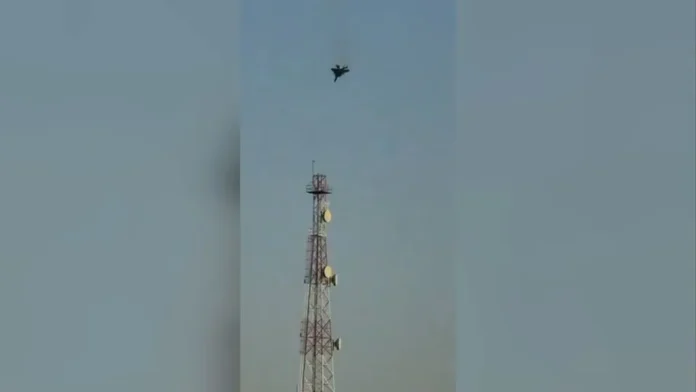
Kuwait’s Ministry of Defense said “several United States military aircraft crashed” on Monday and that “all crew members survived.”
The statement comes after videos geolocated by CNN showed a fighter jet crashing in Kuwait and a pilot parachuting to the ground. The video appeared to show an F-15E fighter jet, according to a CNN analysis.
It’s unclear what caused the crashes of the aircraft, which each cost tens of millions of dollars. CNN has reached out to US Central Command and the White House for comment.
“Relevant authorities immediately initiated search-and-rescue operations,” Kuwait’s defense ministry spokesperson Col. Said Al-Atwan said in the statement.
“The crews were evacuating from the crash sites and transferred to hospital to assess their condition and provided necessary medical care,” he said.
The crew members are in a “stable” condition, the ministry added.
Al-Atwan said Kuwait was in “direct coordination” with US authorities.
One video geolocated by CNN shows a fighter jet crashing over Kuwait near a US air base. The v ideo shows a jet on fire and falling in a tailspin out of the sky, and it suggests the jet came down within 10 kilometers (6.2 miles) of the US Ali Al Salem base in Kuwait.
The crashes come during heavy bombardment on Gulf nations as part of an expanding war with Iran. It also comes as smoke has been seen over the area surrounding the US Embassy in Kuwait.
It is notable when US fighter jets crash overseas and often triggers an investigation.
In 2024, a US ship “mistakenly fired” upon a F/A-18 operating from the USS Harry S. Truman in the Red Sea. The incident was investigated, and the two Navy pilots ejected safely.
The US military has a significant number of military assets in the region, deployed in the weeks leading up to the joint US-Israeli military operation that kicked off early Saturday morning Eastern Time. A list put out by CENTCOM on Sunday showing the assets employed thus far included F-18s, F-16s, F-22s, F-35s, A-10 attack aircraft, MQ-9 Reaper drones, refueling aircraft, counter-drone systems, Navy aircraft carriers and guided-missile destroyers.
More than 1,000 targets have been struck, the CENTCOM release on Sunday said, adding that the military is focusing on military targets like command and control centers, Iranian Navy ships and submarines, Islamic Revolutionary Guard corps headquarters and more.
This story has been updated with additional details.
For more CNN news and newsletters create an account at CNN.com
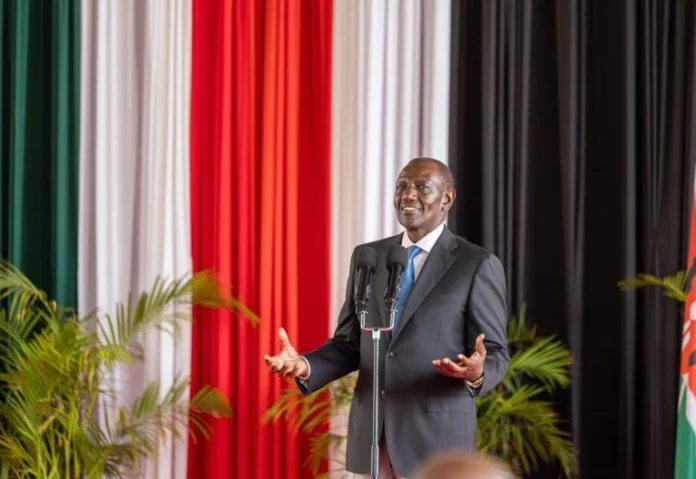
President William Ruto has issued a firm 30-day ultimatum to the Ministry of Transport and the NTSA to fully operationalize a nationwide instant traffic fine system and smart road cameras.
The directive, announced on Monday, March 2, 2026, during a meeting with the National Council on the Administration of Justice (NCAJ), includes several key measures:
Smart cameras must be installed in at least five to six major towns within one month.
The system will automatically detect violations and send “painful to pay” fines directly to the offender’s phone via SMS, eliminating the need for court appearances for minor offences.
A network of 1,000 cameras (700 fixed and 300 mobile units) will be linked to a National Command and Control Centre and integrated with the Second-Generation Smart Driving Licenses.
The President backed a demerit point system where repeat offenders face increasingly higher fines or license suspension.
By digitizing enforcement, the government aims to seal bribery loopholes that reportedly cost the exchequer billions annually.
In a related move, Ruto ordered the fast-tracking of a Public-Private Partnership (PPP) framework for motor vehicle inspection, with a full rollout expected by July 1, 2026.
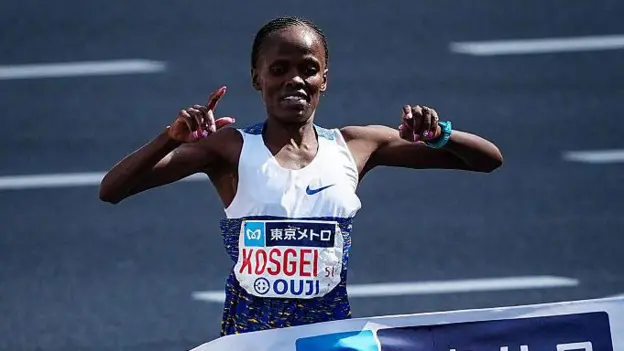
Kenya’s Brigid Kosgei set a new course record with a commanding victory at the Tokyo Marathon.
The 32-year-old finished in 2:14:29 – more than two minutes ahead of Ethiopia’s Bertukan Welde, who was second in 2:16:36.
Welde’s Ethiopian compatriot Hawi Feysa came third in 2:17:39.
The previous course record was 2:15:55 – set by two-time Tokyo winner Sutume Asefa Kebede in 2024.
Kosgei, who won marathon silver for Kenya at the Tokyo Olympics in 2021, is planning to represent Turkey at the 2028 Los Angeles Games.
“We have a lot of athletes in Kenya,” said Kosgei. “I want some young generation to follow my step to join me in Turkey.”
In the men’s race, Ethiopia’s Tadese Takele defended his title in a thrilling sprint finish with Kenyan duo Geoffrey Toroitich and Alexander Mutiso Munyao.
Takele clocked 2:03:37, which was the same official time as second-placed Toroitich, with Munyao finishing just one second further back in third.
“I knew that the final stage would be decisive,” said 23-year-old Takele.
“Around 41km I wanted to wait and see what would happen and then I made my move right before the finish.”
When Marin Petrović arrived in Bamako in early September last year, he was elated. The Bosnian national had spent years applying for tourist visas to Mali, only to be repeatedly denied on security grounds.
The West African country has long been afflicted by civil war, foreign military interventions, and Islamist insurgencies.
Petrović declined to speak to the BBC for this article.
The plan was to visit some of the country’s dramatic landmarks, before returning home. In Bamako, Petrović enjoyed the sights and sounds of markets, busy roads, schools, and even sampled some local beers, according to the post.
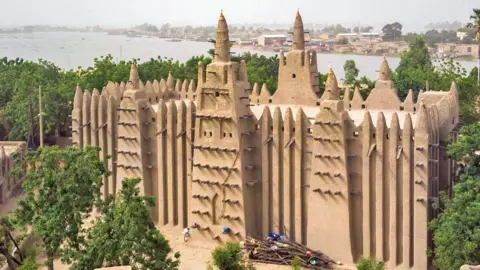
“The next day I set off for Mopti, known for its 100-year-old mud mosque,” he continued, referring to the Grand Mosque of Mopti, a 15m (49ft) tall architectural feat made from mud bricks.
Marin Petrović was heading to Mopti to see its famous mosque when he was abducted by Islamist militants
On Instagram, Petrović describes himself as a “mountain rescue” expert and “guide”, whose motto is not to “dream your life”, but to “live your dream”. But before Petrović could continue his dream of exploring Mali’s ancient treasures, his trip took an unexpected turn.
“An armed attack takes place on the road between Bla and San,” he says in the same Instagram post.
“Six motorbikes with two long-bearded terrorists, each armed with Kalashnikovs, surround the vehicle and drag me into the bushes, along non-existent paths through the undergrowth, through swamps, far from the main road… I was kidnapped by al-Qaeda jihadists!!!”
Petrović had become the latest victim of a concerning trend for foreign travellers and expatriate workers in West Africa’s Sahel region.
His story is not unusual. In 2025, growing insecurity and new jihadist tactics led to a notable increase in high-profile abductions of foreign nationals in the Sahel.
The latest data from Acled, an independent global conflict monitor, shows a considerable increase in the kidnapping of foreigners in Mali and Niger in 2025, compared to previous years.
There were 30 separate kidnapping events affecting foreigners by the end of November, and the number for the whole year is likely to be even higher.
Some cases of kidnapping received considerable international media attention. Two citizens of the United Arab Emirates (UAE) – one of whom is thought to be a member of the Emirati royal family – were kidnapped in Mali in late September.
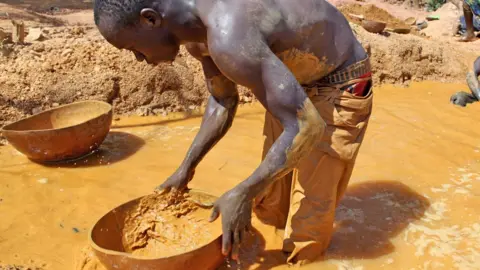
The purpose of their visit and the exact circumstances of their abduction remain murky. Some local media outlets suggested that at least one of the men was involved in a business venture, possibly gold mining.
“Royal ransoms, a top money-maker for Mali’s jihadist kidnappers,” ran one headline.
Other especially high-profile cases took place in Niger: 73-year-old Austrian national Eva Gretzmacher and US civilian pilot Kevin Rideout. Both were involved in humanitarian work and kidnapped from their homes.
But analysis by BBC Monitoring of high-profile kidnapping in Africa has shown that, in terms of numbers, Chinese workers bore the brunt of foreign abductions.
Approximately 70% of cases tracked across the continent occurred in the Sahel countries of Mali and Niger.
Out of a total 89 foreigners kidnapped, 38 held Chinese passports – significantly higher than the next most common nationality, those from India who number 14.
The overwhelming culprit for last year’s spike was al-Qaeda affiliate Jama’at Nusrat al-Islam wal-Muslimin (JNIM), which was behind a surge in jihadist attacks sweeping across several West African nations last year, especially Burkina Faso, Mali and Niger.
Foreign nationals are thought to be especially valuable to JNIM because they generate higher ransoms than locals, in addition to giving the group a stronger footing to negotiate with other conflict actors, such as the Malian government.
“Ransom is an obvious incentive for the group,” explained Héni Nsaibia, Acled’s West Africa senior analyst.
“But I think it fits more into broader economic warfare, and it has had direct ramifications for bilateral relations.”
Since September last year, JNIM has been attacking fuel tankers heading to Mali’s capital, Bamako, effectively choking the city of the essential import and bringing many activities there to a standstill.
Nsaibia believes that kidnapping is another way to put pressure on the Malian economy, with the ultimate aim of undermining the military government which seized power in 2020.
According to Nsaibia, Chinese workers are an obvious target for JNIM, both to deprive the regime of resources and to undermine its ties with China.
“The Chinese are heavily involved in co-operation with Malian state. They run mining sites, industry, construction,” he told the BBC.
The militants’ ultimate aim is to make it too costly and dangerous for foreign companies to invest in Mali.
Petrović spent more than a month as JNIM’s prisoner.
“I slept on the hard ground for 55 nights, 55 days boiling water from a pond where cattle defecate in order to survive, eating dry rice and nothing else. I woke up to the sounds of all kinds of animals, mostly wolves and hyenas, and every day I killed scorpions around the place where I slept,” he said in a follow-up post on 16 November.
In some moments, Petrović even managed to see the humanity in his captors, despite his discomfort and constant fear of being killed.
“I realised that, as incredible as it may sound, there are nice people in al-Qaeda, bearded men who, no matter how cold they may be on the outside, open up their souls after a while,” he wrote.
“No matter how much they hide behind long beards and powerful guns, no matter how primitive and uneducated they may be, many of them have a heart.”
Fortunately for Petrović, his traumatic ordeal had a happy ending. JNIM released him and one other Bosnian national in late October, after 50 days in captivity.
The release occurred without a ransom being paid, according to Nsaibia, who is an authority on kidnapping in the region.
Petrović has not publicly posted about the details of his release but said that he managed to survive thanks to his mountain rescue experience and by “‘playing the game’ persistently and convincingly from beginning to end”.
Nsaibia believes that JNIM released the Bosnians without ransom because the group is on the charm offensive towards the West and is generally making concerted efforts not to kidnap or kill American or Europeans.
“They avoid it to build credibility among international stakeholders and for the international community,” Nsaibia said.
Another factor may be that China does little to intervene or apply diplomatic pressure in cases where their nationals are kidnapped, according to the analyst.
However, there are some recent signs of a shift in tone from the Chinese government.
Christoph told the BBC that he was wary of giving further interviews while the dust settled on his most recent media push to ensure that “the case didn’t fade from public attention”.
“Right now, I need to wait and see how that pressure translates into concrete movement, while also gathering fresh information from the region and observing how the different key players are repositioning themselves,” he explained.
“Ultimately, this is about one human life and the responsibility that comes with it. I remain committed to doing everything I can – carefully, responsibly and in co-ordination with those involved – to help bring my mother home safely.”
In little over 100 days, the United States will co-host a football World Cup that Iran have qualified for.
On Saturday, the US attacked Iran as part of a joint, ongoing operation with Israel, sparking retaliatory strikes across the Middle East.
So what could the conflict mean for the countries involved, for Fifa, and for what was already set to be a highly politicised World Cup?
BBC Sport takes a closer look.
Will Iran still play at the World Cup?
Iran’s group matches in what would be their fourth consecutive World Cup are against New Zealand and Belgium in Los Angeles, then Egypt in Seattle.
The country did not pull out of the competition last summer when the US bombed three nuclear facilities in the country. But in the wake of the more serious current upheaval, the head of Iran’s football federation has reportedly cast doubt on their participation.
“With what happened… and with that attack by the United States, it is unlikely that we can look forward to the World Cup, but the sports chiefs are the ones who must decide on that,” Mehdi Taj is reported to have told Iranian television., external
But in the aftermath of the killing of Iran’s Supreme Leader Ayatollah Ali Khamenei, and amid huge uncertainty over the future political landscape in the country, predicting such a decision – or even who would make it – is impossible.
“For Tehran, this is not a short 12-day war or a contained round of escalation that can be paused and reset,” said Dr Sanam Vakil – director of the Middle East and North Africa Programme at international affairs think-tank Chatham House.
“This new stage of conflict is existential and clearly about regime survival. It is also unlikely to end quickly.”
Fifa – football’s world governing body – has said it is monitoring developments but, at this stage, officials are privately saying they expect Iran to be at the World Cup. On Saturday, Fifa’s general secretary Mattias Grafstrom said “our focus is to have a safe World Cup with everybody participating”.
BBC Sport has asked Fifa what it would do if Iran were to boycott the tournament amid suggestions they could be replaced with an alternative team from the Asian Football Confederation (AFC).
On that basis, Iraq, who could qualify anyway via a continental play-off at the end of the month, or the UAE, who missed out on qualification, would be favourites to step in.
Iran’s women’s team, meanwhile, are preparing for their first match of the Asia Cup in Australia, with the squad training as planned on the Gold Coast on Sunday.
The AFC said in a statement that it continued to “closely monitor the recent developments in the Middle East during this challenging period…we are in close and regular contact with the Iran women’s national team and officials on the Gold Coast and are offering our full support and assistance.”
At a pre-match news conference on Sunday, Iran coach Marziyeh Jafari stuck to football, saying the tournament was a chance to show “the potential of Iranian women”.
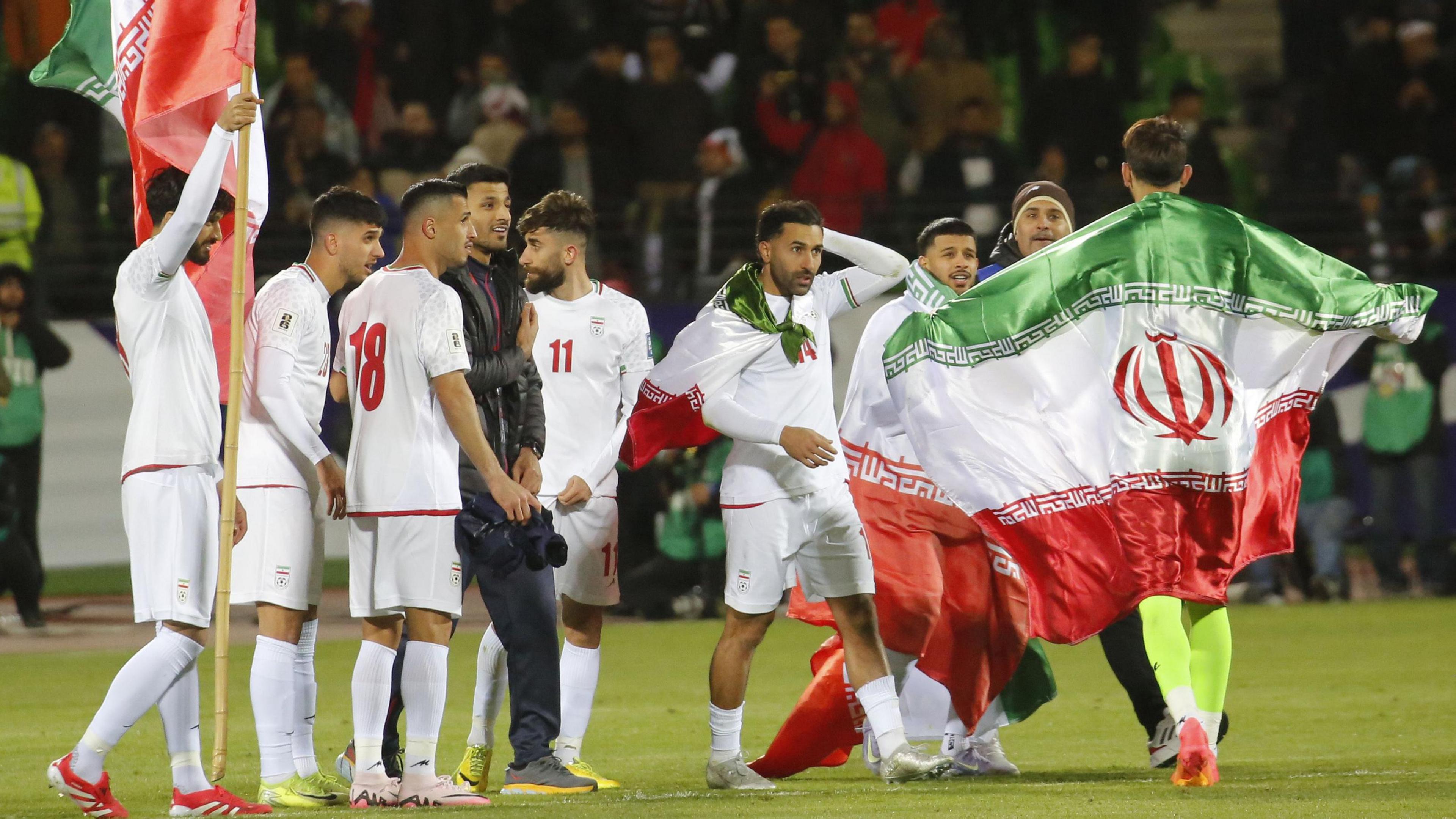
Image caption,Iran’s men’s football team celebrated qualifying for the 2026 World Cup after a draw with Uzbekistan in March
‘We are in uncharted territory’
US President Donald Trump last year signed an executive order banning nationals from 12 countries – including Iran – from entering the US, citing an effort to manage security threats. Although World Cup players and coaching staff are exempt, Iran threatened to boycott December’s draw in Washington after some of its officials’ visa applications were rejected.
But if Iran do play, there is now likely to be even more scrutiny on safety around the team’s matches, and the squad’s planned training base in Arizona.
The country’s games at the 2022 World Cup in Qatar – including against the US – took place against a backdrop of mass anti-government protests in Iran.
During their second match against Wales, there were even confrontations between fans with opposing views about Iran’s government, and given Trump’s hopes for regime change in Iran, it is possible a similar scenario could play out this summer. LA, where Iran are scheduled to play twice, is home to one of the world’s largest Iranian communities.
“We are in uncharted territory in that we are just over three months away from the start of the World Cup and the hosts have just launched a war of aggression against a participating country,” says Nick McGeehan of human rights advocacy group FairSquare.
“If Iran withdraws its team – an outcome that seems entirely plausible – Fifa is likely to breathe a sigh of relief given the scope for protest and unrest.”
But even if Iran are absent, tensions could be heightened, especially given the event will help to celebrate the 250th anniversary of the US Declaration of Independence, and Trump is expected to be a highly visible presence, as he was at the Club World Cup and Ryder Cup last year.
The conflict began just days after US government officials were warned there could be “catastrophic” security consequences if the 11 US cities hosting matches do not receive funding that has been frozen amid a partial government shutdown, with preparations said to be behind schedule.
Over the weekend, Andrew Giuliani – head of the White House’s World Cup taskforce – praised Trump’s strikes on Iran, posting on social media it would “make the world a safe place”.
“We’ll deal with soccer games tomorrow,” he added. “Tonight we celebrate [the Iranian people’s] opportunity for freedom.”
However, the conflict in the Middle East is also likely to lead to added scrutiny of Fifa president Gianni Infantino over the close relationship he has forged with Trump.
How about the Fifa ‘Peace Prize’?
In December, Fifa awarded Trump its inaugural ‘Peace Prize’ at the 2026 World Cup draw ceremony, saying he had “played a pivotal role” in establishing a ceasefire between Israel and the Palestinians, and that he had sought to end other conflicts.
In the few weeks since, the US has taken military action in Venezuela, Nigeria and Iran, and has hinted at possible further operations in Greenland, fellow World Cup co-host Mexico, and Colombia – another participant in the tournament. In January, Trump also told Cuba to “make a deal” or face consequences.
Trump has fiercely defended his foreign policy, insisting he is acting in the United States’ interests.
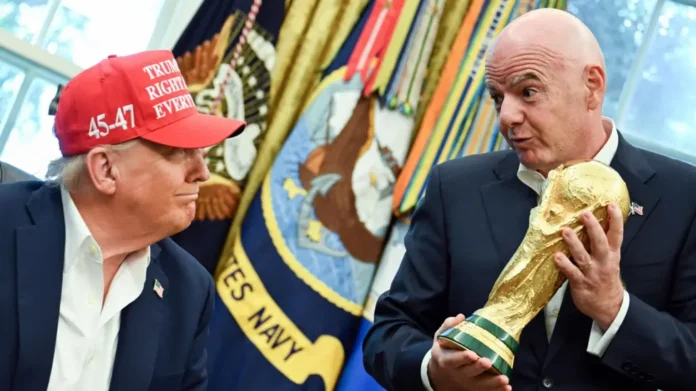
Last month, Infantino defended the awarding of the ‘Peace Prize’, even appearing at the first meeting of the US President’s Board of Peace while wearing a Trump-themed ‘USA’ cap branded with ’45-47′ in reference to his terms of office.
Trump’s decision to attack Iran has received both support and condemnation, but what is certain is it will lead to more scrutiny of Fifa’s decision to align itself with him, with critics arguing it risked politicising the governing body.
In January, 27 politicians from Labour, the Liberal Democrats, Green Party and Plaid Cymru signed a motion in parliament calling on international sporting bodies to consider expelling the US from major international competitions, including the World Cup. The motion said such events “should not be used to legitimise or normalise violations of international law by powerful states”.
Such demands could now be repeated, and there could also be calls by Gulf states for Iran to be punished for its retaliatory attacks on their territory.
Fifa insists that as an organiser of football events it has a statutory duty to remain neutral. Indeed, last year Infantino said it could not “solve geopolitical problems” amid pressure to sanction Israel after a United Nations commission of inquiry concluded the country had committed genocide against Palestinians in Gaza.
Israel’s foreign ministry said it categorically rejected the report, denouncing it as “distorted and false”.
Some critics believe Fifa’s rules should be strengthened so it can properly respond to serious geopolitical events, and this is not the first time it has come under pressure over the actions of a World Cup host.
In 2018, the tournament went ahead in Russia despite the country annexing Crimea four years earlier. Russia also stood accused of cyber attacks, meddling in western elections and carrying out the Novichok nerve-agent attack in Salisbury.
Russia was eventually banned by Fifa in 2022 over its invasion of Ukraine, after a number of European countries refused to compete against it.
But Infantino has recently said the punishment has not worked, and that he wants it lifted. There is no sign he has any appetite to sanction the US, however controversial its foreign policy is.
What is clear is that in the past 48 hours, what was an already complicated political landscape for the World Cup has become even more challenging.