Sponsored Ad

Ad 1
Ad 2
Ad 3
Ad 4
Ad 5
Ad 6
30.8 C
Kenya
Sunday, April 26, 2026
Home Blog Page 3271

Spain Beat Sweden In Dramatic Finish To Reach Final

Olga Carmona’s stunning late strike gave Spain a 2-1 win over Sweden on Tuesday to propel them into the Women’s World Cup final for the first time in their history.

Spain’s thrilling victory at Eden Park sets up a showdown in Sydney on Sunday with either Australia or England, who meet in the other semifinal on Wednesday.

The semifinal in Auckland seemed to be drifting towards extra time before suddenly bursting to life when substitute Salma Paralluelo put Spain ahead with nine minutes left.

Rebecka Blomqvist equalised for Sweden in the 88th minute only for full-back Carmona, Spain’s captain, to score with a superb shot in off the underside of the crossbar from the edge of the box.

It has been a remarkable run for a nation who had never previously gone beyond the last 16 at a Women’s World Cup, and for a team who had been in disarray in the months leading up to the tournament.

Fifteen Spanish players told their federation last September that they no longer wished to be considered for selection, principally out of unhappiness with coach Jorge Vilda, and only three of them returned for this World Cup run.

While their dream of World Cup glory remains alive, Sweden are left with a familiar feeling after going so far at another major tournament before falling short.

This is the third time in four World Cups in which they have reached the semifinals, only to lose on each occasion.

Peter Gerhardsson’s side also lost in the last four at the European Championship last year, having been beaten in the final of the Tokyo Olympics on penalties against Canada in 2021.

SUPER-SUB PARALLUELO

Vilda decided against handing a start to Paralluelo, after she came off the bench to score the winner in the quarterfinal against the Netherlands.

Instead he recalled Alexia Putellas and the reigning Ballon d’Or winner started for the first time since Spain were walloped 4-0 by Japan in the group phase.

The plan was clearly to dominate possession and make a more physically imposing Sweden do the chasing.

Spain had far more of the ball in the first half yet neither Putellas nor Aitana Bonmati were allowed the time and space to really influence the game.

The closest they came to breaking the deadlock was from long range, when Jennifer Hermoso laid the ball back to Carmona, whose shot whistled wide.

Sweden had taken the game to Japan in an impressive 2-1 win in the quarterfinals but they offered next to nothing here until suddenly they almost struck three minutes before halftime.

Nathalie Bjorn sent a hanging cross from the right to the back post for Fridolina Rolfo –- facing seven of her Barcelona club colleagues in the Spain starting line-up -– but her side-foot volley was saved by Cata Coll.

Vilda’s plan was clearly to save the pacy Paralluelo for when the Swedish defence was beginning to tire, and it was just before the hour mark that he turned to the former athlete.

Paralluelo took the place of Putellas, who has still not completed 90 minutes at this World Cup as she continues to recover full fitness following a serious knee injury.

The substitute’s persistence almost brought the opener for Spain with 20 minutes left as she stretched to keep the ball in play following a cross by Hermoso, but Alba Redondo turned her cutback wide.

Paralluelo then struck with nine minutes of normal time remaining, showing a killer instinct to lash a shot low into the corner.

But Sweden did not give up, drawing level in the 88th minute thanks to two substitutes of their own.

Lina Hurtig had only just come on when she nodded down a cross for Blomqvist to fire home, raising the spectre of extra time once again.

But Carmona, the Real Madrid left-back, had other ideas as she clinched victory for Spain in style.


Kenya Launches An Inquiry Into Alleged Abuses By A British Army Training Unit — Including A Murder

A Kenyan parliamentary committee has launched an inquiry into alleged human rights violations and ethical breaches by a British Army training unit active for decades in what the UK calls “our defense partner of choice in East Africa.”

Britain’s Ministry of Defense didn’t immediately respond to a request for comment on Tuesday.

The British have roughly 200 military personnel permanently based in Kenya, most of them training more than 1,000 Kenyan soldiers a year before their deployment to neighboring Somalia to combat al-Qaida’s longtime East Africa affiliate, al-Shabab. The British government invests more than 1.1 billion Kenyan shillings ($9.6 million) every year into the partnership.

But some Kenyans have raised concerns about the way British forces treat locals as well as the environment during the military training in arid, bandit-plagued areas north of Mt. Kenya. In late 2021, Kenyan police said they were reopening the case of a local woman, Agnes Wanjiru, allegedly killed by a British soldier in 2012 and found in a septic tank.

And in 2021, a local advocacy group and residents went to court alleging that a devastating fire at a wildlife conservancy had been started by a British Army training exercise. More than 10,000 acres (15 square miles) were destroyed.

Kenyan lawmakers in April ratified a new five-year defense cooperation agreement with Britain and voted to recommend that British soldiers be tried locally for murder. The British government has said it has been cooperating on the Wanjiru case.

The parliamentary committee chair, Nelson Koech, earlier this year said the inquiry “would provide an opportunity for aggrieved Kenyans to finally get justice, and that this would be a critical pillar to the committee’s resolve to ensure Kenya can hold to account visiting troops that flout the law on Kenyan soil,” according to a Parliament statement.

The parliamentary committee on defense, intelligence and foreign relations has asked the public to submit materials for its inquiry by Oct. 6.

8-Man Gang Steals Car, Maize And Beans In Narok

Police in Narok County are looking for a gang of armed thugs who stole a car, food, and other valuables from a home in Ololunga.

The 8-man gang, stormed Beatrice Akoth’s home while armed with machetes, beat her up, and stole her valuables.

Other items stolen were 10 bags of beans, eight bags of maize, a mobile phone, a gas cylinder, personal documents, and assorted foodstuffs.

One of the thugs told Ms Akoth they had been sent to kill her, but they decided to spare her life.

DCI officers from Narok South confirmed the incident.

Gatundu Residents Gripped By Fear After 4 Beaten To Death

Fear has gripped residents of Gachugi Ngorongo in Gatundu after four men were beaten to death on Monday night by unidentified assailants.

Tobias Wanyama, who miraculously survived the assault, recounted his harrowing encounter with the media. He shared that an unfamiliar individual confronted him, wielding a sizable cudgel and demanding Ksh. 10 from him.

According to Wanyama, the stranger suddenly attacked him at approximately 8:30 p.m., striking him on the head with an object resembling a stout stick. He recounted how he regained consciousness in a hospital several hours later, having sustained severe head injuries.

Describing the incident, Wanyama expressed, “I crossed paths with this young man, and he demanded ten shillings from me. I explained that I had just enough money for food and had barely taken a few steps…”

The four men who tragically lost their lives in separate attacks all bore similar injuries, suggesting that a blunt instrument had been used as the cause.

A resident from Gachugi recounted the events to Inooro TV, revealing that they were informed of the fatal occurrences on the night in question.

Apparently, three of the victims were attacked while they were out attending to errands, each meeting a brutal demise.

One of the victims had been returning home with a bottle of milk when the attack took place, while another met his end with a shattered skull as he carried a kilo of meat home for his family.

The third individual was assaulted as he ventured out to purchase soap from a nearby location, according to the community members.

A resident expressed the pervasive sense of terror by stating, “We are unsure if we can even step outside our homes anymore. You leave to buy basic necessities and are confronted with death on your way back.”

Amidst the growing unease, the residents called upon the government to intensify security measures in their region, as they live in constant fear and uncertainty.

Pauline Njoroge Claims Over KSh 300k Was Illegally Withdrawn From Her Account After Arrest

Digital strategist and political blogger, Pauline Njoroge, has leveled allegations against detectives from the Directorate of Criminal Investigations (DCI), claiming that they illicitly withdrew Ksh 302,000 from her account during her arrest.

On the 22nd of July, Pauline Njoroge found herself in custody, caught up in the government’s pursuit of opposition figures and their associates.

Alongside her, Jane Nduta and taxi driver Emanze Jilani were also apprehended on Watamu-Jakaranda road.

As her case was deliberated on Monday, August 14, with the objective of deciding whether to charge her or close the case, a troubling issue came to light.

Njoroge raised concerns about her missing funds. To be precise, a sum of KSh 302,842 had been withdrawn from her bank account without authorization.

Njoroge’s legal representatives made it known to the Malindi Chief Magistrates Court that only DCI officers had access to her accounts prior to this incident.

In an official statement from the court papers, Njoroge’s defense stated, “The defense informed the court to put on record that on 03/08/2023 at 19:05:03 hrs there was theft of Kshs. 302,842.00 from VISA bank account of Pauline Njoroge Njoki.

Consequently the defense also applied that investigation be done by DCI alongside the current investigation and a report be filed in court on the grounds that; before the theft, the DCI officers were the only third parties who had actual possession and access to the said Bank Cards before the theft.”

In response to these developments, the prosecuting counsel indicated that they would consult with the investigating officer before reaching a conclusive decision on the two orders put forth.

Njoroge’s case is scheduled for another mention on Friday, August 18. During this proceeding, the court will address the release of her personal device and will also seek the DPP’s response concerning the missing funds.

Gov’t To Create 1 Million Jobs In Digital Transformation Agenda

CS Eliud Owalo noted that the government has begun a significant digital transformation agenda and improving ICT infrastructure by laying 100,000km of fibre optic cables, creating 25,000 free public Wi-Fi hotspots, and establishing 1,450 digital laboratories for the purpose of providing digital skills.

“We are rolling out the digital infrastructure to digitalize all government services, we have already digitalised a total of 5,084 services, which are available on the e-citizen platform,” he said.

The CS observed that the Ministry is also digitising government records with an aim to run a paperless government.

He reiterated that the government has embarked on massive digital skilling among Kenyans to ensure there is commensurate level of digital skills that facilitate consumption of virtual government services and create digital jobs.

“we believe that we should be able to create about 1 million jobs in the digital space,” said CS Owalo.

The CS added that in the domain of digital entrepreneurship, the government has created the Konza Technopolis and the foundation in the hopes that private partners will join in and turn it into Africa’s Silicon Savannah.

Kenya, China To Partner in Manufacturing Computer Softwares, Cheap Smartphones

Eliud Owalo, Cabinet Secretary for the Ministry of Information, Communications, and the Digital Economy, received a visit from a group from China led by Minister for Culture and Tourism Hu Heping and the Chinese Ambassador to Kenya Zhou Pingjian.

The CS expressed interest in collaborating with China and other partners to produce computer software and enable local production of affordable cell phones.

The following potential areas of cooperation between Kenya and China were highlighted by CS Owalo: digital skilling, cyber security, digital inclusion, innovation through digital transformation, digital services, and applications.

Other potential areas included the promotion of e-commerce, the revitalization of the Kenya Broadcasting Corporation and the Kenya Postal Corporation, and emergency telecommunications by putting in place ICT infrastructure.

According to the ICT and The Digital Economy Principal Secretary Eng. John Tanui, the government is strategizing on best ways to propel the digital economy by enhancing connectivity and growing the digital economy by making businesses out of the established infrastructure.

“China has been very successful in this space and we can have an opportunity to learn from them our bilateral relations are at the best time in history,” said PS Tanui.

PS Tanui appreciated the efforts by China to support various developmental projects in Kenya and encouraged the idea of collaboration between the two nations to implement projects such as the intelligent transport system that will bring efficiency in the transport sector.

On his part, Mr. Heping said that China and Kenya have understood each other on issues majorly related to their core interests and major concerns.

The Minister suggested that media outlets in both countries cooperate, and he added that cooperation between think tanks, such as academic institutions, will be essential for both nations’ progress.

Mr. Heping stressed the value of digital transformation in expanding the economies of both countries and promised to assist Kenya in pursuing its digitalization goal.  

He pointed out that there are currently strong foundations on ongoing projects for cooperation between China and Kenya, and as they pursue them, additional chances will present themselves.

MWIKI: Two Revelers Found Naked In Car After Being Drugged By ‘Mchele Babes’

Written by Lisa Murimi

Two men were discovered unconscious and partially unclothed in a car, hours after falling victim to a stupefying attack by a gang at a club in Mwiki, Nairobi.

The incident occurred as the men, who were part of a group enjoying drinks and food at the establishment, were reportedly stupefied by unidentified women.

Witnesses recalled seeing the men alongside these women on their way to the car.

The following day, the incapacitated men were found in the car and swiftly transported to the hospital. Authorities suspect they may have consumed a potent substance.

Currently hospitalised and under medical care, the men’s condition suggests possible poisoning.

The police have initiated a search for the individuals responsible for the stupefying crime.

Perpetrators of such offences could face severe consequences, including life imprisonment, according to Section 230 of the Penal Code.

The surge in stupefying incidents, particularly among revellers, has alarmed law enforcement. 

Recent developments indicate progress in tackling this issue, as two women were apprehended in the Kasarani area of Nairobi.

These women, dubbed ‘pishori babes,’ were implicated in a related case involving the death of a man in Kisii. Found in possession of the deceased’s electronic devices, the women have since been charged in court.

As investigations continue, additional suspects are being sought by the police.

Kenya’s Political Dialogue Is A Welcome Sign Of Democracy At Work – If Both Sides Understand Their Roles

Since Kenya’s presidential election in August 2022, the new government has been in conflict with the opposition.

In democratic systems, such conflict is healthy; it can enhance governance. But it must not interfere with the government’s ability to perform its constitutional functions.

In Kenya, the friction between the government and opposition led to mass protests in March 2023. The opposition organised them around rising taxes and the high cost of living.

If carried out peacefully, political protests can deepen democracy. Kenya’s have often deteriorated into violence, however. Heavy-handed government interventions have then created even more violence. This threatens the sustainability of the country’s democratic institutions.

The opposition recently called off street protests to engage the government in dialogue. I have studied democratisation and political economy in Africa for more than two decades, and in my view, these talks are an opportunity to strengthen Kenya’s democratic systems.

Both the government and the opposition have a duty to work towards creating a Kenya in which all citizens can live peacefully, by the values that are important to them, and elect who they want.

But for this to happen, each party to the talks must understand its constitutional role. It must play its part constructively and within the law. The opposition should be a check on the exercise of government power, but it must not obstruct governance. The opposition should evaluate public policy and offer alternatives, but allow the government to formulate the national agenda.

On the other hand, the government must recognise the important role the opposition plays in a democratic system. An effective opposition provides the government with feedback that advances national objectives. It contributes positively to peaceful coexistence, the protection of human rights and national development.

The importance of the talks

The opposition suspended its call for mass protests in July 2023 to engage in dialogue with the government. The talks will be facilitated by former Nigerian president Olusegun Obasanjo. Opposition leader Raila Odinga wants the talks concluded in just over seven weeks.

Odinga’s team of five has tabled five issues. It wants the government to:

  • address the cost of living

  • reconstitute the elections agency

  • audit the 2022 poll

  • prevent state interference with political parties

  • resolve outstanding constitutional issues.

The government also brings a five-member team. Its list includes establishing the offices of the leader of opposition and prime cabinet secretary, as well as implementing gender diversity laws. President William Ruto has said he has no interest in reopening debate on the results of the 2022 election.

These talks are a welcome sign of Kenya’s democracy maturing. But as the ruling party, Kenya Kwanza, has reminded the opposition coalition, Azimio la Umoja, that the opposition’s job is to analyse government policies and offer alternatives. It is not to force its economic and political agenda on the government.

Regardless of what is on the table for discussion, the dialogue should enhance governance and promote national development.

Parties to the talks should:

  • consider ways to enhance government efficiency, accountability and productivity

  • concentrate on creating jobs, fighting inflation and helping Kenyans deal with climate change and other development challenges

  • help Kenya strengthen its democratic institutions, and promote their growth and maturity

  • provide an institutional environment within which all Kenyans, regardless of their ethnic affiliation, can live together peacefully.

Understanding the roles

In emerging democracies, such as Kenya’s, a key source of conflict is the failure or inability of the government, the opposition and their supporters to understand and appreciate the roles that the constitution gives them.

In a functioning democratic system, the opposition is part of the governance architecture. It makes sure that the government is open, transparent and accountable to both the people and the constitution. However, it must not frustrate or interfere with government.

The government must consult and interact peacefully with all stakeholders, not just its supporters. This is critical in a country like Kenya which has a significant diversity of people, cultures, values, languages and economic and social aspirations.

A misunderstanding of roles could paralyse the government and make it non-functional.

Way forward

The present dialogue’s function must be:

  • to strengthen the government, not cripple it

  • to advance the interests of all Kenyans, not just of specific politicians or ethnic groups

  • to improve the rule of law, not to open up political spaces for the benefit of opposition leaders

  • to build the country’s democracy, not to tear it down

  • to unite Kenyans, not to divide them

  • to ensure the advancement of a peaceful and productive Kenya.

Kenya’s national leaders – both in government and opposition – must build a political system in the country that advances inclusive development.The Conversation

John Mukum Mbaku, Professor, Weber State University

This article is republished from The Conversation under a Creative Commons license. Read the original article.

How To Grow Rhinos In A Lab: The Science That Could Save An Endangered Species

There are several parallel projects running across the world to save the northern white rhinoceros (Ceratotherium simum simum), one of Africa’s captivating and iconic wildlife species. With the death of last male in 2018 and with only two females alive, the species is functionally extinct.

The most famous of these projects is an international research consortium called BioRescue. It was founded in 2019 by a team of scientists and conservationists under the leadership of the Leibniz Institute for Zoo & Wildlife Research in Berlin, Germany.

In one of its research lines, the BioRescue team collects mature eggs – scientifically called oocytes – from one of the only two northern white females. They reside in Kenya’s Ol Pejeta Conservancy, a privately run wildlife sanctuary. These eggs will be fertilised with frozen sperm that were collected from several northern white male rhinos before their death.

The two remaining females, Najin and Fatu, are not capable of delivering offspring anymore. Najin’s back legs are too weak to carry a pregnancy and Fatu has problems with her uterus. Therefore, the resulting embryos from the fertilised eggs will be transferred into surrogate mothers.

The most suitable surrogate mother would be a southern white rhino as it is the closest related species. But, placing a northern white rhino embryo in a southern white female rhino isn’t an easy task. However, there was promising news in May 2023. Next to the addition of five more northern white embryos – which brings the total to 29 – two wild southern white rhinos were identified as suitable surrogates, as they can still get pregnant and are able to carry the pregnancy through.

The goal of producing a new northern white rhino calf now seems more realistic than ever before.

Sometimes people question the funding and effort spent on one species, but the science behind the rhinoceros story is much bigger. Any species going extinct has huge consequences on the ecosystem, and people’s survival depends on resources provided by this same ecosystem. As a recognisable, impressive and majestic animal, rhinos certainly have a role as a flagship of conservation efforts.

Further, joint efforts on one species can provide scientific knowledge that allows for a multi-species conservation approach. These techniques would not only save the northern white rhinoceros, but also other rhino species, related species with a common ancestor, and all other creatures in need.

Different approaches

Despite the great scientific strides made in efforts to save the northern white rhino, the success rate of embryo transplantation followed by pregnancy to term is extremely low. Parallel initiatives focusing on different conservation approaches are indispensable to ensure the future of this species.

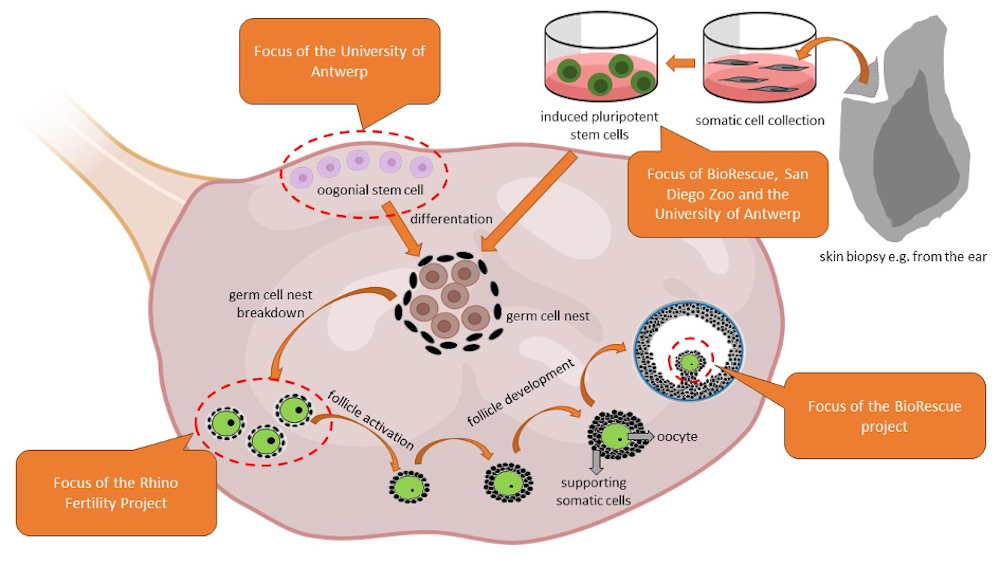
While BioRescue is collecting matured eggs after hormonal stimulation, the Rhino Fertility Project at the University of Oxford in the UK is focusing on growing follicles, which are structures found in the ovary containing an immature egg surrounded by a few layers of supporting cells. These supporting cells provide signals and components essential for the development of the eggs. The idea is to make use of the much greater potential of the ovary by collecting the very small follicles and growing them all in a petridish in the lab.

This would bypass atresia, which is the degradation of follicles that occurs during a natural hormonal cycle. As member of this project, one of us, Ruth Appeltant, was hopeful that this method had the potential to quickly provide a vast number of in vitro-grown oocytes, or mature eggs.

Unfortunately, it became clear that the ovarian tissue of older rhinoceroses contained extremely few to no oocytes. These eggs were needed as the starting material for the project. Without eggs, there is nothing to grow. Ongoing efforts are now looking to establish ways to localise and process the few remaining follicles in old ovarian tissue.

An overview of the focus of different initiatives around the world to save the northern white rhino. Ruth Appeltant

This bottleneck led us to the area of stem cell technologies. At the Gamete Research Centre of the University of Antwerp in Belgium, our group is aiming to produce eggs outside the body from stem cells. These could be used to conserve endangered species like the rhinoceros.

The BioRescue project and a research group at the San Diego Zoo in the US are also aiming to produce artificial eggs from body cells present in tissues.

The common thread is turning cells into induced pluripotent stem cells, which are immature cells generated from mature cells, and that can in turn differentiate into eggs. In fact, this process can transform a skin cell into an egg. The procedure has so far been completed successfully in mice and could already provide a kind of precursor to oocytes in the northern white rhino.

The collection of oocytes is a really tricky process due to the technical difficulties in reaching the site of the ovaries in living animals. Advanced artificial reproductive techniques using body cells, such as skin cells, introduce a spectrum of new possibilities. Most biological samples stored to date consist of small skin samples, but not of oocytes.

A downside to this approach is the fact that scientists first need to succeed in producing stem cells in the species of interest.

At the University of Antwerp’s Gamete Research Centre, we’re not only interested in developing stem cell technologies based on induced pluripotent stem cells, but are currently establishing the in vitro gametogenesis – or “in vitro oocyte-creation” technique – based on stem cells present in the ovary. Due to a scarcity of tissues from endangered species, we are using the pig as a large animal model. This will give us more in-depth knowledge on how to approach egg creation from stem cells already present in the animal, termed endogenous stem cells.

What next?

When we do not have eggs, let’s create them. When we have stem cells, let’s use them. Researchers now know that samples of the northern white rhino individuals currently stored in biobanks have enough genetic variability to establish a viable and sustainable population.

A decade ago, we would have never imagined eggs could be produced from other cells. This is becoming a reality that gives us hope, motivation and energy to save the northern white rhino.The Conversation

Ruth Appeltant, Assistant research professor, University of Antwerp and Rita L. Sousa, PhD Candidate, University of Antwerp

This article is republished from The Conversation under a Creative Commons license. Read the original article.

Create a free account, or log in.

Gain access to read this content, plus limited free content.

Yes! I would like to receive new content and updates.

Sponsored Ad

Ad 1
Ad 2
Ad 3
Ad 4
Ad 5
Ad 6