Sponsored Ad

Ad 1
Ad 2
Ad 3
Ad 4
Ad 5
Ad 6
23.3 C
Kenya
Wednesday, May 6, 2026
Home Blog Page 3389

Elon Musk Rebrands Twitter’s Icon Blue Bird Logo After Nearly 17 Years

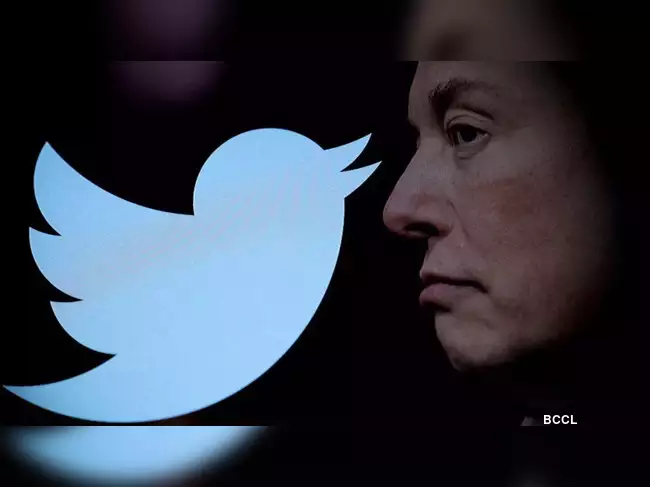
In a radical rebranding, Twitter owner Elon Musk has begun the process of replacing Twitter’s iconic bird logo with X.

Musk made the shock announcement of his plans early Sunday. By Monday morning US time, he tweeted that X.com now points to Twitter.com.

“Interim X logo goes live later today,” he wrote, shortly before sharing a photo of Twitter’s headquarters lit up by a giant new X.

The social media giant’s official account now features the same logo, even as the familiar blue bird can still be seen on the site.

Previously, he said he was bidding “adieu to the twitter brand and, gradually, all the birds.”

Twitter (TWTR), founded in 2006, has used its vivid, globally recognized blue bird emblem for more than a decade.

The renaming could be seen as something of a brand overhaul “Hail Mary” for the company: Musk in recent months has repeatedly warned that Twitter, facing steep losses in ad revenue, was on the edge of bankruptcy.

Increasing the pressure, earlier this month rival social media platform Threads launched from Facebook (FB) parent Meta. It surpassed 100 million user sign-ups in its first week.

Twitter had 238 million active users prior to being taken private by Musk in October 2022.

Spats, mass layoffs

One of the world’s richest men, Musk was once best known for his innovative efforts through companies SpaceX and Tesla (TSLA) to launch rockets and build electric cars.

Now, many of the headlines he makes are for his eccentric remarks on his personal Twitter account – often sharing conspiracy theories and getting into public spats on the social media platform.

Musk overhauled the site after acquiring it for $44 billion in late October, then followed with mass layoffs, disputes over millions of dollars allegedly owed in severance and Musk’s note to employees that remaining at the company would mean “working long hours at high intensity.” He wrote: “Only exceptional performance will constitute a passing grade.”

The upheaval prompted organizations, including the Anti-Defamation League, Free Press and GLAAD, to pressure brands to rethink advertising on Twitter.

The groups pointed to the mass layoffs as a key factor in their thinking, citing fears that Musk’s cuts would make Twitter’s election-integrity policies effectively unenforceable, even if they technically remain active.

Musk also began overseeing controversial policy changes which led to frequent service disruptions at Twitter and upended his own reputation in the process.

‘A second chance’

In June, Musk named Linda Yaccarino, a former NBCUniversal marketing executive, CEO of the company.

She commented on the name change on Twitter Sunday afternoon: “It’s an exceptionally rare thing – in life or in business – that you get a second chance to make another big impression. Twitter made one massive impression and changed the way we communicate. Now, X will go further, transforming the global town square.”

As the new venture begins, it faces challenges. Musk recently disclosed that the platform still has a negative cash flow due to a 50% drop in advertising revenue and heavy debt loads.

Criticizing the exit, or pause, of such Twitter advertisers as General Mills (GIS), Macy’s (M) and some car companies that compete with Tesla, Musk has called himself a “free speech absolutist” and said he wanted to buy Twitter to bolster users’ ability to speak freely on the platform.

Musk explained his approach to free speech by saying: “Is someone you don’t like allowed to say something you don’t like? And if that is the case, then we have free speech.”

He added that Twitter would “be very reluctant to delete things” and that the platform would aim to allow all legal speech. Many users have worried that could mean a rise in hate speech.

Meanwhile, the initial frenzy around rival Threads appears to have come back to earth, especially as it has been plagued with spam and lacks several user-friendly features Twitter, or, now X, offers.

Adam Mosseri, who is overseeing the Threads launch for Meta, has hinted at plans to add features such as a desktop version of the app, a feed of only accounts a user follows and an edit button.

Its ability to draw advertising support is, as yet, unproven.

11 Dead After School Gym Roof Collapses In China

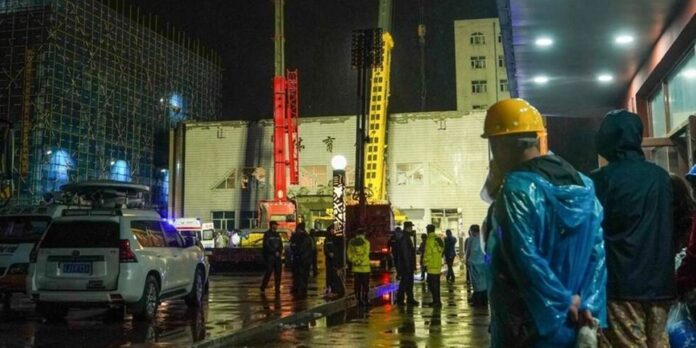
Eleven people died after the roof of a school gym collapsed in northeastern China, state media reported Monday.

The collapse in Qiqihar, Heilongjiang Province was caused by construction workers illegally placing perlite — a form of volcanic glass — on the building’s roof, state news agency Xinhua said.

Heavy rain then led the perlite to expand and increase in weight, causing the roof to collapse, it added.

Footage aired by state broadcaster CCTV showed the roof — made of concrete slabs, according to state media — gave way in its entirety.

Rescue workers broke through large chunks of concrete and twisted metal in a bid to reach victims, the footage showed. One worker used a pneumatic jackhammer.

“A total of 11 people died in the accident,” state broadcaster CCTV said.

An in-depth investigation of the accident was in progress, state media has said, with those in charge of the construction company having been placed in police custody.

The gym at the No. 34 Middle School collapsed just before 3 pm (0700 GMT) on Sunday, Xinhua said.

Nineteen people were at the gym when the accident took place, local newspaper Heilongjiang Daily said. Four escaped and four others survived after being pulled from the rubble.

The search and rescue operation, which had involved nearly 160 firefighters and 39 fire trucks, has now wrapped up, CCTV said.

One unnamed source told the state-owned Chongqing News that concerns had been raised prior to the collapse over the materials being piled up on the roof.

“The gymnasium was built more than 20 years ago, and had long fallen into disrepair in many places,” the source was quoted as saying.

“Everyone was worried that something could happen with all the stuff piled up on the roof.”

Industrial accidents are common in China due to lax safety standards and poor enforcement.

Last month, an explosion at a barbecue restaurant in northwestern China left 31 dead and prompted official pledges of a nationwide campaign to promote workplace safety.

In April, a hospital fire in Beijing killed 29 people and forced desperate survivors to jump out of windows to escape.

And one of the worst such accidents took place in 2015 in Tianjin, where a gigantic explosion at a chemical warehouse killed at least 165 people.

Pauline Njoroge To Be Arraigned in Malindi Court

Digital strategist Pauline Njoroge is scheduled to be arraigned at Malindi Law Courts on Monday, July 24, at 9:00 AM.

Her lawyer, Soyinka Lempaa, told local media that Pauline was being moved from Watamu Police Station to appear in court to answer a case for being in possession of narcotics.

The lawyer complained that his client was being harassed for political reasons while dismissing the charges.

“We are here at Malindi and Pauline is upbeat despite spending the weekend in jail with her colleague Jane Nduta,” he told Kenyans.co.ke.

On the charges placed against her, Lempaa stated, “Those are baseless allegations. They were just fabricated as a reason to hold her.”

Lempaa also refuted previous allegations that Pauline made a political post that ruffled feathers within the government.

“They have been following her for a long time. Her being arrested on Saturday, July 22, had been a long time coming,” he explained.

According to police reports, Pauline was found in possession of a clear container containing ten (10) tablets suspected to be narcotic substances.

A further search revealed that she was in possession of an extra 50 tablets which were also suspected to be of narcotics substance.

Lempaa dismissed the police report, noting that at no particular time was Pauline in possession of any narcotics substance.

Jubilee Party and Azimio Coalition have maintained that Pauline is being detained due to her constant criticism of President William Ruto’s government. 

RACHIER: No More Foreign Players For Gor Mahia

Gor Mahia chairman Ambrose Rachier has vowed that the club will not sign any foreign-based player after the team was locked out of the Champions League for failing to pay on time three of its former players.

Speaking on Radio 47 on Sunday evening, Rachier said the club’s top management decided last week and insists it will stay this way for a long time to come.

“It looks like many of the foreign-based players we have been signing only come here to cause us problems and take money without giving us value. We have had a discussion as the top leadership of the club and for now, we are not going to sign any foreign player,” he said,

The statement came hours after the Confederation of African Football (CAF) released a list containing the clubs that will take part in the preliminary stages of the 2023-24 Champions League whose draw will be done on Sunday.

Gor have been locked out after failing to prove that it did not have any overdue payments to three former players including Malian goalkeeper Adama Keita, Burundian striker Jules Ulimwengu and Congolese Yangayay Sando Sando.

Rachier also defended his club insisting that they had done everything possible to clear what was owed to the players and wants Football Kenya Federation (FKF) to intervene so that they are allowed to play in the CAF tournament.

“When we were made aware of the situation, we did everything possible to sort out the payables. The draw will be held on Tuesday and I believe there is still something FKF can do to ensure that we take part in the tournament.”

With Gor Mahia out, no Kenyan club will participate in the tournament with only Kakamega Homeboyz set to represent the country in the CAF Confederations Cup tournament.

16 Killed In Cameroon Building Collapse: Firefighters

At least 16 people were killed and several more seriously injured on Sunday when a building collapsed in Cameroon’s business hub Douala, firefighters said.

A three-year old girl was among the victims and another three children are in intensive care, said hospital officials.

A senior fire brigade official told AFP on condition of anonymity that the current death toll of 16 people was a provisional toll.

The four-storey block collapsed onto another residential building around 1:30 am (0030 GMT) in the north of the city.

Rescuers were searching through the wreckage for survivors.

“The situation is under control and firefighters are working to ensure no one remains under the rubble”, said Littoral region governor Samuel Dieudonne Ivaha Diboua, who visited the site of the collapse.

Douala’s Laquintinie hospital said it had taken in 13 patients and said two — a girl of three and a young woman of 19 — had died.

It added that three children among those injured were receiving emergency treatment.

The others in hospital included two teenage girls, a 28-year-old woman and five men.

Five people died in similar circumstances in Douala in 2016 when authorities blamed poor state of repairs and apparent violations of building regulations.

In June that year, local authorities identified 500 buildings in danger of collapse.

Nine Killed In Civilian Plane Crash In Sudan, As War-Hit Capital Left Hungry

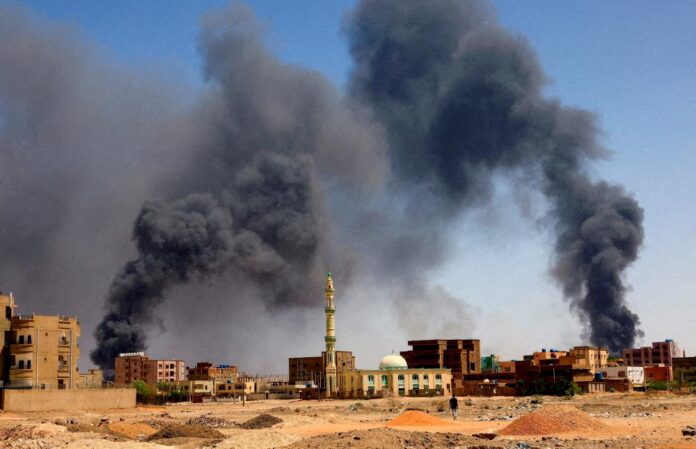
Nine people, including four soldiers, were killed Sunday evening when a civilian plane crashed in Sudan due to “technical” reasons, the army said, as the war in the east African country entered its 100th day.

The fighting has left millions trapped in their homes and some without water, particularly in the suburbs of the capital Khartoum where residents were calling for food donations to help them survive.

In a war-devastated district of the city, Abbas Mohammed Babiker says he and his family have only been able to eat once a day. Now even that is in doubt, but on Sunday a citizens’ support group issued an urgent appeal for donations to help people like him.

“We only have enough for two more days,” Babiker said from Khartoum North, where residents said at least one person, a local musician, has already died from hunger.

In Port Sudan, on the east coast largely spared by the war, the army said a child had survived the crash of an Antonov plane which killed nine others.

Port Sudan airport is the only one still working in the country due to the conflict.

Since April 15, battles between the army led by Abdel Fattah al-Burhan and the paramilitary Rapid Support Forces (RSF), headed by Mohamed Hamdan Daglo, have killed more than 3,900 people, according to the latest toll from the Armed Conflict Location & Event Data Project (ACLED).

More than 2.6 million people have been internally displaced, mostly from Khartoum, the International Organization for Migration said.

Thousands who remain in the capital, particularly in Khartoum North, are trapped without water since the local water station was damaged at the start of the war.

Residents say there is only intermittent electricity and food has nearly run out.

Across the country, about one-third of the population already faced hunger even before the war began, said the United Nations’ World Food Programme. Despite the security challenges, the agency says it has reached more than 1.4 million people with emergency food aid as needs intensify.

“With the fighting, there is no market any more and anyway we have no money,” said another resident of Khartoum North, Essam Abbas.

To help them, the local “resistance committee”, a pro-democracy neighbourhood group, issued an emergency appeal.

“We have to support each other, give food and money and distribute to those around us,” the committee wrote on Facebook.

In adjacent Omdurman, Khartoum’s other battle-scarred sister city, locally known violinist Khaled Senhouri “died from hunger” last week, his friends wrote on Facebook.

In his own online posts, Senhouri had said he was unable to leave home because of the fighting and had tried to hang on with the supplies that he had. It wasn’t enough.

Why America Stopped Building Public Pools

Growing up in Louisville, Kentucky, Gerome Sutton looked forward all week for his chance to swim at Algonquin Park pool on the weekend.

“It was like Christmas in the summer time,” said Sutton, now 66 and a local minister. “It was the best time of the week.”

Louisville’s public parks were desegregated in 1955, a year before Sutton was born. This included the newly built Algonquin outdoor swimming pool on the West Side of Louisville.

It cost 35 cents to swim at Algonquin at the time, Sutton said. He and his seven siblings took turns going on alternating weekends because the family could not afford to send all eight children at the same time.

“We would go swimming. That makes a big statement” against segregation, he said. “There was an organized effort on the part of government to keep children engaged with an activity.”

Public pools have played a critical role in American culture over the past century. But as climate change and extreme heat worsen, they are taking on an urgent public health role. Heat kills more Americans than any other weather-related disaster, according to data tracked by the National Weather Service.

Yet just as public pools become more important than ever, they’re disappearing from sight.

Pools have become harder to find for Americans who lack a pool in their backyard, can’t afford a country club, or don’t have a local YMCA. A legacy of segregation, the privatization of pools, and starved public recreation budgets have led to the decline of public places to swim in many cities.

“If the public pool isn’t available and open, you don’t swim,” Sutton said.

‘Swimming is mental health’

In the early 2000s, Louisville had 10 public pools for a population of around 550,000.

Today, the city has five public pools for a population of around 640,000, ranking 89 out of the largest 100 cities in swimming pools per person, according to Trust for Public Land, an advocacy organization for public parks and land.

Algonquin is the only pool left in West Louisville, and residents say the city has neglected basic maintenance and improvements for years.

This summer, as temperatures climb to the 90s in Louisville, Algonquin is closed for repairs, leaving around 60,000 people — most of whom are Black and middle-or-lower income households — without convenient access to the water.

Some will miss out on a chance to learn how to swim, get more comfortable in the water, and build life-saving skills. Kids and teens won’t have a key place to gather and play during the summer months when school is off. And seniors can’t participate in Aqua Zumba fitness classes held at Algonquin during the summer to help them stay active.

“Swimming is mental health. It’s therapy. You have to have activities. It’s bigger than just a pool,” said Louisville Councilwoman Tammy Hawkins, who represents the district.

Swimming disparities

Access to swimming pools has long been hotly contested in America.

Giant municipal pools were built in the first half of the twentieth century, and desegregating public pools was a key target of the civil rights movement. But, strapped for funding, many local governments have neglected public pools.

“We’ve gotten to a point where a lot of the recreation taking place in the summers is happening in private spaces or in places with lack of support,” said Andrew Kahrl, a historian at the University of Virginia and author of “The Land Was Ours: How Black Beaches Became White Wealth in the Coastal South.”

“We’ve seen the complete erosion of the public side of this equation,” Kahrl said.

There is one outdoor public pool for every 38,000 people in America — from 34,000 in 2015 — according to the National Recreation and Park Association.

The retreat of government and privatization of swimming pools and recreation has hurt poor and minority groups hardest, historians and public recreation experts say.

“Poor and working-class Americans suffered most directly from the privatizing of swimming pools,” writes Jeff Wiltse, a historian at University of Montana, in “Contested Waters: A Social History of Swimming Pools in America.”

Today, 79% of children in families with household incomes less than $50,000 have no or low swimming ability, according to a 2018 study. Sixty-four percent of Black children, 45% percent of Hispanic children and 40% of White children have no or low swimming ability, the study found.

When America built pools

While public pools are a rarer sight today, governments built enormous pools during the twentieth century.

The New Deal led to the biggest burst of public pools in American history. The federal government built nearly 750 pools and remodeled hundreds more between 1933 and 1938.

New York Parks Commissioner Robert Moses opened 11 pools funded by the federal Works Project Administration, and San Francisco opened Fleishhacker Pool, the largest of the era.

A 1933 survey of Americans’ leisure activities found that as many people swam frequently as went to the movies.

“Pools became emblems of a new, distinctly modern version of the good life that valued leisure, pleasure and beauty,” Wiltse writes.

Racial violence

Before the 1920s, swimming pools in the North were segregated along gender lines but not racial ones.

This changed as they became gender integrated.

Racial stereotypes around cleanliness and safety, as well as intense fears of Black men interacting with White women in bathing suits, turned pools into some of the most segregated public spaces in America, said Victoria Wolcott, a historian at the University at Buffalo and author of “Race, Riots, and Roller Coasters: The Struggle over Segregated Recreation in America.”

In the late 1940s, there were major swimming pool riots over integration in St. Louis; Baltimore; Washington, D.C.; and Los Angeles, Walcott said. In Cincinnati, Whites threw nails and glass into pools, and in St. Augustine, Florida, they poured acid into the water to prevent Black swimmers.

The Kerner Commission, tasked with studying the underlying causes of disorder in cities during the 1960s, found in its landmark 1967 report that the lack of recreation facilities, including pools, was a “deeply-held grievance” among Black people fueling urban unrest during sweltering summers.

Abandoning public pools

Gaining entry to swimming pools was a top priority for civil rights groups, who saw recreation as a fundamental human right.

In Martin Luther King Jr.’s 1963 Letter from a Birmingham Jail, he described the tears in his daughter’s eyes when “she is told that Funtown is closed to colored children.”

But the success of the civil rights movement integrating pools coincided with a surge of private pools and swim clubs.

Millions of middle-class White families left cities for the suburbs and built pools in their new backyards during the era. New suburbanites chose to organize country clubs with fees rather than build pools open to the public.

From 1950 to 1962, 22,000 private swim clubs opened, mostly in White suburbs.

The development of private, gated communities and homeowners associations in the suburbs also led to the privatization of recreation. Towns formed their own tax bases and local governments with their own services and amenities.

“The decline of public pools happens at the same time as the push to privatization,” said Wolcott.

Some parts of the South revolted against integration by paving over or draining their pools rather than integrating them. Of the public pools open in 1961 in Mississippi, for example, nearly half had closed by 1972.

As Whites withdrew from public pools and parks, taxpayer funding and support for pools dwindled. In Cleveland, the city’s recreation budget was cut by 80%.

Disinvestment in public recreation grew following tax revolts of the late 1970s, Kahrl said. In 1978, California voters passed Proposition 13, which slashed local property tax rates and made it more difficult for the state to fund public recreation.

As cities closed pools and stopped maintaining existing ones, private swim clubs filled the void for those who could access them and backyard pools proliferated.

In 1972, there were 1.1 million residential pools, according to pool industry market research firm PK Data. Two decades later, there were 3.8 million.

Starved budgets

Lifeguard shortages and underfunded public recreation departments continue to strain local pools.

Parks and recreation agencies tend to be the first area to cut when budgets are tight and the slowest to get money back, said Kevin Roth, vice president of research, evaluation and technology at the National Recreation and Park Association.

“The budget challenge is something we’re very concerned about. It’s not new and it’s not going away anytime soon,” he said.

Public pools are costly for cities to maintain and insure.

Cities also have struggled to staff pools with lifeguards. High-school and college students have more summer job options and are less likely to pick up a job as a lifeguard over the summer than they once did, he said.

But the loss of public pools cannot be picked up fully by private pools or non-profit groups.

To give people in West Louisville a place to swim this summer, the city approved $100,000 in funding for free summer passes to the YMCA and an amusement park.

Passes will be only be available to a limited number of residents, and many residents lack transportation to get to the YMCA or amusement park.

Louisville’s metro government has allocated $6 million to renovate Algonquin and another local pool. But some local residents and leaders say renovating the Algonquin pool is not enough.

They want an indoor swimming pool open all year, like the aquatics center on the predominantly White East Side of the city, so people can access the water, take classes and stay fit.

“I would love for it to be year-round with water safety classes,” said LaShandra Logan, 35, who grew up in West Louisville and has gone to Algonquin since she was a child.

Last year, she learned how to swim through a local non-profit group, Central Adult Learn-to-Swim. Eighty-seven percent of the program’s students are Black and 85% are women.

“My biggest fear was drowning, and I wanted to learn,” Logan said. “I felt like if I could learn how to swim nothing else could intimidate me.”

She is currently enrolled in a lifeguard instruction class and wants to help other people in the community learn how to swim. Currently, there is a 2,500-person wait list of adults in Louisville who want to learn to swim through the non-profit.

“It’s a life-changing experience,” Logan said.

Wilson To Rescue As Newcastle Draw 3-3 With Villa

Callum Wilson scored a second-half equalizer as Newcastle recovered from a two-goal deficit to secure a 3-3 draw with Aston Villa in their Premier League pre-season friendly in Philadelphia on Sunday.

Newcastle, the surprise package of the Premier League last season after securing a top-four finish and a ticket to the Champions League, were rocked early on after Villa took the lead after just seven minutes through Ollie Watkins.

Villa midfielder Emi Buendia split the Newcastle defence with a fine run before passing to Watkins who controlled deftly to fire home a low finish.

Buendia doubled the Villa lead four minutes later with a rasping finish to beat Newcastle goalkeeper Martin Dubravka and make it 2-0.

Newcastle however hit back on 28 minutes when a long ball by Jacob Miller caught the Villa defence napping, allowing Elliot Anderson to control before tucking away a low shot.

The Magpies, who will play Villa in their opening Premier League fixture on August 12, leveled on the stroke of half-time, with Swedish international Alexander Isak burying a rebound from close range.

Newcastle manager Eddie Howe and Villa counterpart Unai Emery made a flurry of substitutions at half-time but it was the impressive Buendia who struck next.

Another surging run by the Argentine launched a Villa counter-attack which ended with teenager Omari Kellyman firing a shot off the foot of the post.

Buendia was alert to the rebound and tapped in from close range to make it 3-2.

Once again though, Newcastle were able to take advantage of Villa’s high defensive line.

A superb pass over the top from Jamal Lascelles found Anthony Gordon, whose shot was parried but only as far as Wilson, who stroked home for 3-3.

Twitter To Be Renamed X, Get New Logo

Twitter’s owner Elon Musk and its new CEO said Sunday that the social media network would ditch its bird logo, be rebranded with the name X and move quickly into payments, banking and commerce.

Founded in 2006, Twitter takes its name from a play on the sound of birds chattering, and it has used avian branding since its early days, when the company bought a stock symbol of a light blue bird for $15, according to the design website Creative Bloq.

Late on Sunday night, Musk changed his profile picture to the company’s new interim logo — a white X on a black background — and changed his Twitter bio to “X.com”.

Musk said the company was “Going with (a) minimalist art deco” logo, and that “X.com now points to twitter.com.”

He had earlier tweeted that “If a good enough X logo is posted tonight, we’ll make (it) go live worldwide tomorrow.”

Musk also tweeted that under the site’s new identity, a post would be called “an X.”

The changes were not visible on the website as of 0530 GMT Monday.

Musk had already named Twitter’s parent company the X Corporation, and previously said his takeover of the social media giant was “an accelerant to creating X, the everything app” — a reference to the X.com company he founded in 1999, a later version of which went on to become payments giant PayPal.

Such an app could still function as a social media platform, and also include messaging and mobile payments.

“Powered by AI, X will connect us in ways we’re just beginning to imagine,” Twitter chief executive Linda Yaccarino tweeted Sunday.

Yaccarino, an advertising sales executive at NBCUniversal who Musk poached last month to become Twitter’s CEO, said the social media platform was on the cusp of broadening its scope.

“X is the future state of unlimited interactivity – centered in audio, video, messaging, payments/banking – creating a global marketplace for ideas, goods, services, and opportunities,” Yaccarino tweeted.

– New revenue streams –

Since Musk bought Twitter for $44 billion last October, the platform’s advertising business has partially collapsed as marketers soured on mass firings at the platform that gutted content moderation — as well as on Musk’s management style.

In response, the billionaire SpaceX boss has moved toward introducing payments and commerce through the platform in a search for new revenue.

Twitter is thought to have around 200 million daily active users, but it has suffered repeated technical failures since the 52-year-old Tesla founder bought the app and sacked much of its staff.

Since then, many users and advertisers alike have responded adversely to the social media site’s new charges for previously free services, its changes to content moderation and the return of previously banned right-wing accounts.

Musk said earlier this month that Twitter had lost roughly half of its advertising revenue since he took control in October.

Facebook parent Meta earlier this month launched its own text-based platform, called Threads, which has up to 150 million users according to some estimates.

But the amount of time users spend on the rival app has plummeted in the weeks since its launch, according to data from market analysis firm Sensor Tower.

15 Dead, 19 Missing After Indonesia Boat Sinks

At least 15 people were killed and 19 more were missing on Monday after a wooden boat sank off the coast of Indonesia’s Sulawesi island, search and rescue officials said.

The boat sank with 40 people onboard just after midnight local time (1700 GMT on Sunday), the local office of Indonesia’s search and rescue agency said in a statement.

Six people were rescued and taken to hospital for treatment, it said, and the cause of the sinking was being investigated.

“Provisionally, there are 19 people who are still being searched for,” Muhamad Arafah, head of the local search and rescue agency in Kendari city in Southeast Sulawesi, said in the statement.

One search team will dive around the accident site, while another will search the water’s surface using boats, he said.

The agency shared images of rescuers mobilising for the search effort, and several dead bodies covered by sarongs laid on tarpaulin at a local hospital.

The boat was crossing a bay between the villages of Lanto and Lagili in Central Buton regency on Muna island in Southeast Sulawesi, the local office’s spokesperson Wahyudin, who like many Indonesians goes by one name, told AFP.

Wahyudin said the vessel was a wooden passenger boat and not a ferry as initially reported.

He warned the total number of passengers on board could have been higher than registered but refused to confirm local media reports the boat was overcrowded.

Indonesian media reported that villagers had travelled for a local celebration and gathered on an overcrowded boat that capsized on its way back across the bay.

Wahyudin said the agency would provide an update on the cause and missing passengers later on Monday.

It is common in Indonesia for the number of actual passengers on a boat to differ from the manifest.

Marine accidents occur frequently in the Southeast Asian archipelago nation of around 17,000 islands, where people rely on ferries and small boats to travel around despite poor safety standards.

In 2018, more than 150 people drowned when a ferry sank in one of the world’s deepest lakes on Sumatra island.

In May last year, a ferry carrying more than 800 people ran aground in shallow waters off East Nusa Tenggara province and remained stuck for two days before being dislodged.

No one was hurt in that accident.

Create a free account, or log in.

Gain access to read this content, plus limited free content.

Yes! I would like to receive new content and updates.

Sponsored Ad

Ad 1
Ad 2
Ad 3
Ad 4
Ad 5
Ad 6