Sponsored Ad

Ad 1
Ad 2
Ad 3
Ad 4
Ad 5
Ad 6
23.6 C
Kenya
Friday, May 8, 2026
Home Blog Page 3432

Olympic Champion Caster Semenya Wins Appeal Case At European Rights Court

Double Olympic champion runner Caster Semenya won an appeal against track and field’s testosterone rules on Tuesday when the European Court of Human Rights ruled she had been discriminated against.

The ruling could force sport’s highest court to re-examine the regulations that force Semenya and other female athletes to artificially reduce naturally high testosterone levels in order to compete at top meets such as the Olympics and world champinships.

The Strasbourg-based rights court ruled in Semenya’s favor by a 4-3 majority of judges.

The court also ruled the South African runner was denied an “effective remedy” against that discrimination when the Court of Arbitration for Sport and Switzerland’s supreme court denied her two previous appeals against the rules.

It was not immediately clear if the ruling would force an immediate rollback of the rules and if the 32-year-old Semenya would be allowed to compete at next year’s Olympics in Paris.

She was the 2012 and 2016 Olympic champion in the 800 meters but has been barred from running in that event since 2019 by the testosterone rules and did not defend her title at the Tokyo Olympics.

Senegal’s Lone Developer Fights To Revive Photography With Film

DAKAR (Reuters) – From a concrete jetty on Dakar’s sun-baked coastline, Senegalese photographer Amy Saar clicked the shutter of her vintage Pentax camera, capturing the light of the horizon on colour film purchased from the country’s only developer.

“Dakar looks great with certain coloured films, because they really bring out the warm, vibrant colours,” Saar said, loading a fresh roll into the camera. “Film can be really great in Africa, because in general it’s sunny (and) very colourful.”

Saar is part of a growing resurgence of analogue photography enthusiasts in Senegal, nurtured by Le Sel studio in the capital’s Ouakam neighbourhood.

Founded two years ago in owner Kevin Aubert’s apartment, Senegal’s only studio of its kind aims to rekindle the country’s love for the craft through film sales and workshops.

After decades of dwindling interest, the global market for film cameras and equipment is expected to grow nearly 4% through 2029, according to a study published by Precision Reports in May.

Limited access to film and darkroom spaces have hindered African photographers’ ability to participate in film’s global resurgence, despite the craft having played a significant role in the region’s post-colonial artistic history.

Le Sel’s mission is not just to develop film, Aubert said, but to educate photographers about the origins of the medium, and show that understanding the analogue process can enhance their digital expertise.

“When they see the image they shot themselves appearing for the first time, it is always a treat.” Aubert said as he led a workshop. “It teaches us a lot about the image, the way to look at it, and the way to manage it.”

Aubert hopes to expand Le Sel into a larger space to house more workshops, exhibits, and even an in-house gallery. In the meantime, local photographers like Eva Diallo are already showing works developed there at some of Dakar’s most prestigious art houses.

“The film process is much more conscious than digital or iPhone photos,” Diallo said during her solo exhibition at Dakar’s Gallerie Cecile Fakhoury. “It’s important to be aware during the time it takes, from the moment you take the image … and the moment you have it on paper.”

Kenyan Female Referee Mary Njoroge To Officiate At 2023 Women’s World Cup

Kenyan Mary Njoroge is among 33 referees, 55 assistant referees, and 19 video match officials (VMOs) selected to officiate at the 2023 Women’s World Cup.

Australia and New Zealand will co-host the women’s World Cup from July 20 to August 20, 2023, and Njoroge expressed her elation on the achievement, “I am happy beyond words. This is a dream coming true. I thank God”.

Njoroge, according to FKF CEO Barry Otieno, was an example of the caliber of Kenyan authorities, “We are happy for Mary. She deserves it. Assignments like this show that we have quality officials in our country, and in our leagues and competitions.”

She was on the list when CAF made history by including female referees in men’s tournaments for the first time at the 2019 Under-17 African Cup of Nations (AFCON) in Tanzania.

Mary Njoroge and Gilbert Cheruiyot were chosen to serve as referees for the 2020 FIFA Men’s and Women’s Olympic Football Tournament in 2021.

In early 2021, she was chosen to preside over the CAF Confederation Cup group stage encounter between Zambia’s NAPSA players and Cameroon’s Coton Sport.

Equity Bank Revises Rates As High-Interest Regime Sets In

Equity Group has announced an increase in its lending rates effective July 10 as the era of expensive loans sets in after the Central bank increased its benchmark lending rate to commercial banks by 100 basis points to 10.5 percent last month (June 26).

In a public notice last week, the regional lender with operations in Kenya, Uganda, Tanzania, Rwanda and Democratic Republic of Congo said the adjustment of interest rate on loans is intended to reflect the lender’s revised reference rate of 14.69 percent plus a margin based on the customer’s risk profile.

The revised rates will apply to all existing and new borrowers whose loans are denominated in Kenya shillings.

Central Bank of Kenya (CBK), through its Monetary Policy Committee increased its policy rate to 10.5 percent from 9.5 percent on June 26, in an attempt to curb inflationary pressures fuelled by soaring food and fuel prices.

The overall inflation for June remained elevated at 7.9 percent largely due to an increase in the price of food, fuel and electricity according to Kenya National Bureau of Statistics data. Inflation for May stood at eight percent.

The increase in interest rates is, however, expected to trigger high loan default rates in the banking sector and stifle credit to the productive sectors of the economy.

Growth in private sector credited remained unchanged at 13.2 percent in April and May this year.

According to the central bank, overall inflation is expected to remain elevated in the near term mainly due to the recent increases in electricity prices, removal of fuel subsidy and associated second round effects.

The National Treasury has already written to CBK setting the inflation target for the 2023/24 fiscal year. The target is set at five percent with a flexible margin of 2.5 percent on either side in the event of adverse shocks.

Traders Shift From Northern Corridor To Rail On High Fuel Costs

Increasing the cost of fuel in Kenya after enactment of the Finance Act 2023 will increase transport cost along the Northern Corridor by more than 30 percent, with some traders already opting to use rail to ferry cargo from the Port of Mombasa to the hinterland.

The Shippers Council of Eastern Africa (SCEA) has already shown more interest in using railway to cut cost of transportation as rail charges remain unchanged since the standard gauge railway freight train was introduced five years ago.

Recent data by the Kenya Ports Authority shows a shift to use of railway to the Naivasha Inland Container Depot (ICD) for both containerised and conventional cargo for the last three months despite Kenya announcing return of port services to Mombasa.

In March last year, long distance transporters increased transportation charges by five percent and the announcement to increase charges further will make the corridor one of the most expensive routes in the region.

According to latest traffic cargo report, Naivasha ICD recorded a sharp increase in usage by conventional cargo compared to containerised, with grain and fertiliser boosting throughput – an indication of a shift resulting from high cost of transporting cargo using trucks.

The report shows in March, the Naivasha ICD recorded 1,670 tonnes of conventional cargo which included wheat, maize and fertiliser.

The subsequent month registered a sharp increase of throughput to reach 3,662 tonnes of cargo while in May cargo handled increased to 4,530 tonnes.

Total Grain Bulk Handlers (GBHL) isthe main company using the facility. Its throughput in twenty feet equivalent units (teus) also indicated an improvement this year, increasing from 358 teus in March to 446 in April and 444 in May.

Since March, the facility received 116 (teus) containers of imports compared to 54 in February, April (118) and May 178 teus.

Despite promotional tariffs by the Kenya Railways Corporation (KRC), few traders are using railway to return empty containers to Mombasa. Numbers have been declining since January where it registered 173 containers before this reduced sharply to 34 in February and 13 containers in May.

KTDA deal

Throughput of the number of containers received at the Naivasha ICD for export remained average after the recent deal between the Kenya Tea Development Authority (KTDA) and KRC to export tea and other farm inputs for tea farmers.

SCEA chief executive Gilbert Lagat said shippers choose mode of transport depending on time and cost.

“Traders will only choose mode of transport be either road or rail depending on if it is cheaper and if it is timely to deliver cargo,” he said.

The recently inaugurated linkage line from the SGR to the meter gauge rail through the Naivasha ICD, enabling end-to-end rail cargo movement especially on transit goods from the Port of Mombasa to Jinja/Kampala and beyond, has gained momentum according to data.

Already some traders through Bill of Lading have nominated Nairobi and Naivasha ICDs as their clearance and picking of cargo to be ferried by SGR from the Port of Mombasa.

Last week, Kenyan long-distance transporters warned of an increment of transport charges starting July, after parliament voted to Kenya’s idea to use rail was aimed at reducing time and cost of ferrying cargo from Mombasa port destined for Malaba where cargo is to be loaded at the port and transported via the SGR before being transhipped onto the MGR line at the Naivasha ICD.

Safaricom Adds 675 New Jobs After Ethiopia Entry

Safaricom added 675 jobs in the one year to March, many of them being in its Ethiopia subsidiary that went into full operation during the period.

The Nairobi Securities Exchange (NSE)-listed telco says in its annual report for 2023 that its headcount rose to 6,616 in the period from 5,941 as at March 2022.

The Ethiopia unit, which rolled out pilot operations in August 2022 before making a full network launch later in October, saw its staff jump from 305 to 909, with locals comprising 81 percent by March 2023 compared to 50 percent a year earlier.

Meanwhile, the Kenyan operation added 71 jobs to reach 5,707, with the firm mainly targeting software developers to run its highly digitised business amid a talent war with global digital companies that have set up in Nairobi.

“…a total workforce complement of 6,616, including Safaricom Ethiopia staff at 909, of which 81 percent is local talent,” said Safaricom in the report.

As a result of the additional headcount on account of the Ethiopia rollout, Safaricom saw its employee costs for the year rise to Ksh28.3 billion ($200.71 million) from Ksh22.6 billion ($160.28 million) a year earlier.

These expenses include salaries, statutory and medical contributions, allowances, club membership payments and costs for employees seconded to the firm by Vodafone affiliate companies.

Salaries accounted for the lion’s share of these expenses at Ksh19.1 billion, which was an increase from Ksh17.1 billion ($121.28 million) in the year to March 2022, followed by the salaries for seconded staff at Ksh4.6 billion – $32.62 million (2022: Ksh1.24 billion – $8.8 million).

The higher employee costs show the heavy expenditure the company undertook to establish its presence in Ethiopia, where it is part of a consortium that also has South Africa’s Vodacom, Japan’s Sumitomo Corporation and British International Investment. 

The IFC has also recently announced a $257.4 million (Ksh36.3 billion) debt and equity injection into the operation.

Sudan Army Refuses To Attend Peace Talks In Ethiopia

Sudan’s government on Monday refused to join a regional meeting aimed at ending nearly three months of brutal fighting, accusing Kenya, which chaired the talks, of favouring the rival paramilitaries.

A power struggle between Sudanese Army Chief Abdel Fattah al-Burhan and his former deputy Mohamed Hamdan Daglo, commander of the paramilitary Rapid Support Forces (RSF), spilled into war in mid-April and has since killed thousands of people and displaced millions.

The East African regional bloc Intergovernmental Authority on Development (Igad) had invited the foes to a meeting in Ethiopia’s capital on Monday, while fighting still raged across Sudan.

Neither Burhan nor Daglo personally attended the talks in Addis Ababa, although the RSF sent a representative to the “quartet” meeting led by Kenya, South Sudan, Djibouti and Ethiopia.

Since April 15, around 3,000 people have been killed in the violence, according to the Armed Conflict Location and Event Data Project, but the actual death toll is believed to be much higher as parts of the country remain inaccessible.

A further three million people have been displaced internally or fled across borders, according to the International Organization for Migration.

Multiple diplomatic initiatives to halt the fighting have produced only brief respites, with the UN warning on Sunday that Sudan was on “the brink of a full-scale civil war, potentially destabilising the entire region”.

Previous truce deals have been brokered by Saudi Arabia and the United States, but the East African bloc now seeks to take the lead.

However, on Monday Sudan’s foreign ministry said its delegation would not participate until its request to remove Kenya as chair of the talks was met.

The ministry had asked for “Kenyan President William Ruto (to) be replaced… in particular because of his partiality”, the statement said.

‘External interference’

In a communique released after Monday’s meeting, the quartet noted “the regrettable absence of the delegation of the Sudanese Armed Forces in spite of the invitation and confirmation of attendance”.

Daglo had sent a political adviser to the talks in Addis Ababa, while the RSF in a statement denounced “irresponsible behaviour” on the army’s part.

The quartet agreed to “mobilise and concentrate the efforts of all stakeholders towards delivering a face-to-face meeting between the leaders of the warring parties”, its statement said.

It also called on the rival generals to “immediately stop the violence and sign an unconditional and indefinite ceasefire”.

Igad said it would request the African Union to look into possibly deploying the East Africa Standby Force — usually tasked with election observer missions — in Sudan “for the protection of civilians and… humanitarian access”.

Sudanese ex-rebel leader Mubarak Ardol, now aligned with Burhan, denounced “a plan to occupy Sudan” and moves to “promote military interference”, while praising the army for boycotting the meeting.

US Assistant Secretary of State for African Affairs Molly Phee was also in the Ethiopian capital on Monday for meetings with Sudanese and regional officials.

In a statement on Sunday, she had called on the forces loyal to Burhan and Daglo to “immediately end the fighting”.

“We echo the call of countries in the region to prevent any external interference and military support which would only intensify and prolong the conflict,” added Phee.

Experts say that both the army and the RSF enjoy support beyond Sudan’s borders. Neighbouring Egypt backs Burhan, while the United Arab Emirates and Russia’s Wagner mercenary group support Daglo’s efforts.

On the ground, residents reported battles and air strikes in several areas of Khartoum.

“Rockets fell on houses of civilians”, one told AFP.

Witnesses also reported fighting in El-Obeid, the capital of North Kordofan and a commercial hub some 350 kilometres south of Khartoum.

An army source said troops “pushed back against an attack” by rebel forces in Blue Nile state near Ethiopia.      

Numerous Hurdles Ahead Of South Sudan’s First-Ever General Election

South Sudan is now 12 years old, but the celebrations may not be as loud as expected of a country marking an independence anniversary.

And, after years of war, the South Sudanese are still waiting for the day they will line up again, since that historic referendum in 2011, to elect their leaders.

The country has failed in previous attempts, blamed on insecurity, lack of funds and other challenges. And the latest bid is planned for December 2024. This week, President Salva Kiir promised that it will happen.

“We are committed to implement the chapters in the Revitalised Peace Agreement as stated, and the election will take place in 2024,” President Kiir said on Monday, after his Sudan People’s Liberation Movement (SPLM) endorsed him to run for president.

But he did admit that the road to those polls won’t be smooth.

He has been the country’s only President since it gained independence, but he has never been elected.

Since 2017, the country has not been able to publicly celebrate Independence, Day citing financial constraints to a struggling economy. In fact, some questioned the need for the ceremony.

This anniversary, though, comes at a point of reflection: Will the country have the capacity to hold credible elections in 17 months’ time? There is also the question of the status of the implementation of the 2018 peace agreement, known formally as the Revitalised Agreement on the Resolution of the Conflict in South Sudan (R-ARCSS), which helped bring together a coalition of President Kiir and former opponents and armed groups, including his First Vice-President Riek Machar.

South Sudan Permanent Representative to the African Union James Morgan says Juba will prove itself this time round.

“South Sudan will hold its first democratic elections in 2024 bringing to an end the past years of political uncertainty, instability, and conflicts,” Mr Morgan said.

The head of the United Nations Mission in South Sudan, Nicholas Hayson, expressed concern, however, that this year will be a “make-or-break” period for the country. For South Sudan to hold credible elections, it needs to complete security sector reforms, resettle more than two million refugees in the neighbouring countries, and enact a permanent constitution.

The chairman of the Joint Monitoring and Evaluation Commission (JMEC), Maj-Gen (rtd) Charles Gituai, on June 21, told the UN Security Council that for South Sudan to hold free and credible elections in December 2024, the unification and redeployment of forces must be completed in order to provide election-related security; institutions concerned with the preparation of conduct of elections such as the Political Parties Council and the National Elections Commission must be reconstituted.

The third prerequisite is to complete a people-centred constitution to guide the conduct of elections; carry out judicial reforms to enhance the capacity and independence of the judicial institutions to deal with elections-related disputes; and the improvement to the overall political and civic space in which multiparty elections are conducted.

“The 2018 peace agreement legitimises the Transitional Government of National Unity and remains the most plausible blueprint for a peaceful transition. With prospects of elections looming only 18 months away, there is a need for our collective efforts to focus on South Sudan at this critical time and ensure that the Agreement is implemented in letter and spirit,” said Maj-Gen Gituai.

He added that over the past five years of the implementation of the agreement, South Sudan has enjoyed its longest period of relative peace and stability since its independence. However, the pace of implementation has been slow, as much of what was expected to have been implemented by the end of the stipulated 36 months of the transitional period was not achieved.

Consequently, the Revitalised Peace Agreement was extended for 24 months, from February 2023 to February 2025, to enable the completion of the unification of forces, the making of the permanent constitution, and to prepare for the conduct of credible, free, and fair elections in December 2024.

Overall, key achievements in the implementation include the fact that the parties have addressed the issues of governance with the executive and legislative arms of the transitional government having been established at both the national and state levels.

The dispute over the number of states was resolved, and the peace agreement was incorporated into the transitional constitution.
Also, some crucial legal, judicial, and institutional reforms are ongoing.

There have also been security arrangements, with about 55,000 of the expected 83,000 unified have been trained.

These troops remain in their training areas awaiting deployment to their respective units. However, Phase 2 and the disarmament, demobilisation and reintegration process is yet to commence.

On humanitarian affairs, the opening of key humanitarian corridors has facilitated the return of some South Sudanese refugees and IDPs.

However, over 2 million South Sudan refugees are still stuck in neighbouring countries such as Kenya, Uganda, and Ethiopia.

Peter Biar Ajak, a South Sudanese peace activist, scholar, and former political prisoner says that over 80 percent desire that elections will be held so as to help South Sudan move forward. “But despite this excitement from the people of South Sudan to go to the ballot, many prerequisites remain outstanding and could hinder the conduct of free and fair elections,” he says.

Then there is the issue of the constitution which could take time.

The constitution will allow South Sudanese to debate and agree on critical issues of governance including: whether the country will have a presidential or a parliamentary system of governance; the nature of federal arrangement between the national government and sub-national units; term limits for executive and legislative posts; whether to adopt federalisms being agitated by holdout groups such as Gen Thomas Cirillo; the independence of judiciary and development of robust dispute resolution mechanisms.

Gen Gituai says that challenges abound. There is a trust deficit among the parties; a lack of adequate resources; a lack of capacity of some institutions relevant to the implementation of the peace agreement; persistent levels of inter-communal violence in the states; negative activities of the holdout groups, and natural calamities like floods.

“Without predictable and adequate funding, our assessment is that South Sudan will continue to struggle to adhere to the implementation schedule of the agreement Most recently, additional strain has been placed on humanitarian and other resources in South Sudan by the influx of refugees and returnees from the conflict in the Republic of Sudan,” said Gen Gituai.

The country needs at least $50 million for the National Election Commission (Nec) to conduct the general elections.

According to a new survey released by the UN Mission in South Sudan on June 21, the security situation in South Sudan declined in 2022 compared with 2021, with more than half of South Sudanese expressing concerns about their safety.


EAC Drags Feet In Adopting Official Use Of Kiswahili

The East African Community lacks a policy on Kiswahili that would make its use mandatory in all the seven EAC partner states.

Swahili is yet to be fully adopted for official use, even in the East African Legislative Assembly, despite the EAC having declared it – together with English and French – as the three official languages of the bloc.

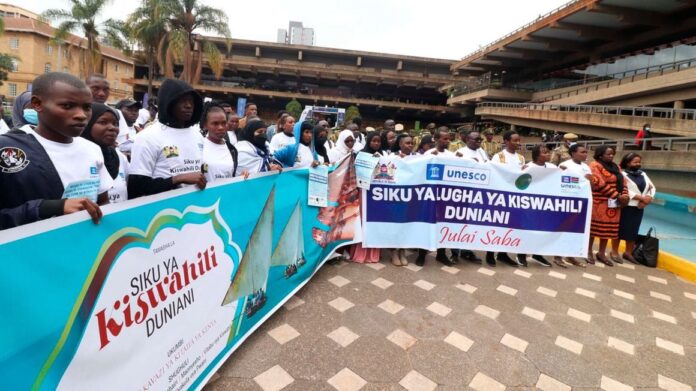
As the World marked the World Kiswahili Day on July 7, Dr Caroline Asiimwe, executive secretary of the East African Kiswahili Commission, blamed the lack of a language policy across EAC for partial use of the language.

“The major issue we are facing in the EAC is the issue of multilinguism. Our partner states have many languages. Even when we talk about Kiswahili as an official language, we have different status in these countries. In some, Kiswahili is an official language, in others it is either official or national, or both, while in some partner states, it is not clear whether it is official or national,” she told The EastAfrican.

Kiswahili, a Bantu language with Arabic influences, is the first African language to be recognised in such a manner by the UN.
The theme of this year’s celebrations is “Kiswahili and Multilingualism: Achieving More Together.”

Kiswahili is among the 10 most widely spoken languages in the world, with more than 200 million speakers, mostly in Africa and the Middle East.

Global language

Kiswahili speakers are spread out in Tanzania, Kenya, Uganda, Rwanda, Burundi, the Democratic Republic of Congo, South Sudan, Somalia, Mozambique, Malawi, Zambia and Comoros and as far as Oman and Yemen in the Middle East.

Within the EAC, Kenya and Tanzania are a step ahead of partner states in the use of Kiswahili as both an official language and national language.

“When you go to other EAC countries you will find that they still have other languages as official languages, but they are taking steps,” said Asiimwe. “Countries are at different levels, so they have to look at their legal status, see whether it is in their constitution, and they also have to look at capacity, human resources, so these are some of the factors that are derailing partner states from implementing Kiswahili as an official language.”

Rwanda recently adopted Kiswahili as an official language, even though only 0.7 percent of Rwandans speak it (54 percent speak Kinyarwanda).

Burundi and the DRC have also taken steps to ensure the language becomes official. In South Sudan, though spoken, Kiswahili is still not well used.

Dr Asiimwe is urging Ugandans to embrace Kiswahili, adding that mastery of the language would open up immense opportunities in trade, media, criminal justice system and healthcare.

Rebecca Alitwala Kadaga, Uganda’s Deputy Prime Minister and Minister for East African Community Affairs, also added her voice to the call.

“I want to urge Ugandans to embrace Kiswahili as it is now an official language of the EAC,” she said.

Kadaga said Kiswahili had earned a bad reputation partly because it was used in pre-colonial times by slave traders from the East African coast.

Roadside Bomb Kills 8 Family Members In Somalia

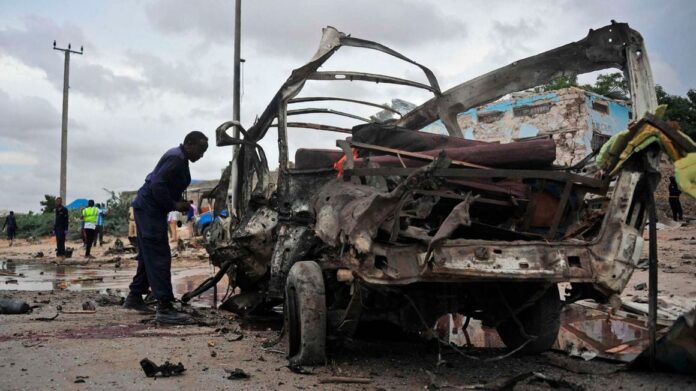
A roadside bombing blamed on the militia group Al Shabaab killed eight members of an extended family in central Somalia, a local mayor said on Monday.

The blast occurred late Sunday near a village outside Buloburde, which lies about 220 kilometres north of Somalia’s capital, Mogadishu.

“Eight innocent civilians were killed from the same family, among them a woman,” Sadam Abdi Idow, the mayor of Buloburde, told reporters.

“Al Shabaab terrorists planted the mine after they were defeated in ongoing military operations in the region. These terrorists have no regard for civilians.”

According to witnesses, seven victims died at the scene, while another died later.

“This was a disaster… three were from one family, and the rest from another related family. They were all related,” said Abdikarin Hassan, from Buloburde.

Al Shabaab, which is affiliated with Al Qaeda, has been trying to overthrow the foreign-backed government in Mogadishu since 2007 through a bloody insurgency.

Its fighters were driven from Mogadishu in 2011 but it remains a deadly force, despite a major offensive launched last August by pro-government forces, backed by African Union troops and US air strikes.

The attack near Buloburde followed a sustained firefight in the region, military sources said.

“The terrorists were defeated during this armed confrontation… and they took their revenge on civilians. They planted a landmine along the main road used by civilians,” Ahmed Ali, a Somali military commander, said by phone.

Create a free account, or log in.

Gain access to read this content, plus limited free content.

Yes! I would like to receive new content and updates.

Sponsored Ad

Ad 1
Ad 2
Ad 3
Ad 4
Ad 5
Ad 6