Sponsored Ad

Ad 1
Ad 2
Ad 3
Ad 4
Ad 5
Ad 6
32.7 C
Kenya
Thursday, May 7, 2026
Home Blog Page 358

Two men sentenced to 11 years for vandalising Kenya Power transformers

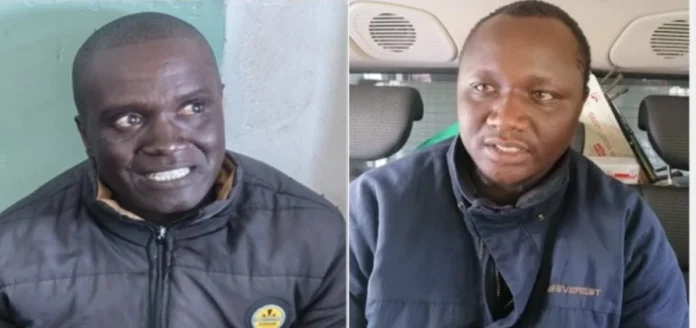
Two suspects have been sentenced to 11 years in jail each after they were found guilty of vandalising Kenya Power transformers and stealing critical energy equipment.

According to the Directorate of Criminal Investigations, the two; Amos Swahili and Ernest Kemboi, were behind a string of transformer vandalism incidents that left parts of the North Rift and Western regions without electricity.

The suspects were cornered on July 15, 2025, in Elgeyo Marakwet during an operation by detectives attached to Kenya Power, arrested, and later arraigned in court.

On February 23, 2026, the Butali Law Courts found the two guilty, ruling that the prosecution had proved its case beyond reasonable doubt before sentencing each of them to 11 years’ imprisonment.

Authorities noted that the convicts still face similar charges in separate cases pending before courts in Iten and Eldoret.

The DCI described the sentencing as a significant milestone in the ongoing crackdown on vandalism targeting critical national infrastructure, warning that such acts pose serious risks to power supply, economic activity, and public safety.

Auditor General Gathungu, Treasury CS Mbadi clash over e-procurement efficiency

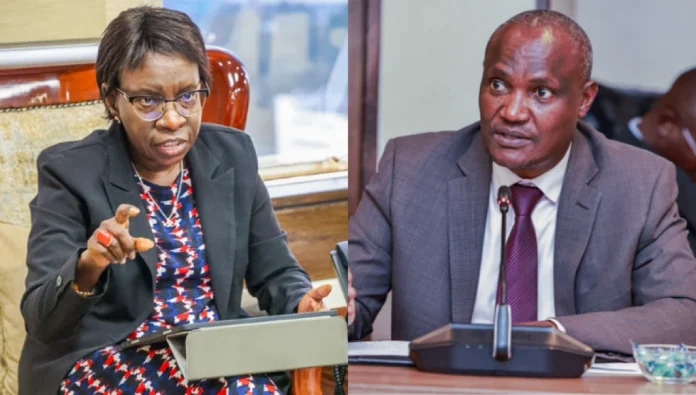
Source Citizen Digital -Auditor General Nancy Gathungu and Treasury Cabinet Secretary John Mbadi on Tuesday clashed over the efficiency of the Electronic Government Procurement (e-GP).

Appearing before Parliamentary committees on Budget and Finance, Gathungu faulted the system for procurement delays, slow project startups, under absorption of funds and growth in pending bills.

While presenting her 2026 Budget Policy Statement to the National Assembly Budget Committee, Gathungu poked holes into the e-GP system, which she says has failed on its mandate to digitize end to end public procurement planning, tendering and contract management.

“Many users struggled to navigate the system and submit compliant digital bids. These capacity gaps were compounded by system downtimes, freezes during peak tenders, and One-Time- Password (OTP) failures, disrupting tender opening and evaluation. We also noted integration weaknesses where the system is not synchronized to KRA iTax compliance,” she said.

The Auditor General also revealed that as at 20 February 2026, uptake remained low with only about 540 contracts processed nationwide, which is far below expectations for a national platform.

“The e-GP challenges have translated into procurement delays, slow project startups, under absorption of funds, growth in pending bills, and widening gaps between approved budgets and actual out turns, thereby posing a material risk to credible and timely budget execution over the period under review. Urgent action is required to stabilize the platform, complete integration with IFMIS and compliance databases,” said Gathungu.

But CS Mbadi differed with the Auditor General over the efficiency of e-procurement in public service, stating it is work in progress.

“The Auditor General is then acting in illegallity if she’s using manual procurement. I hope the Auditor General is not using this as an excuse. e-procurement will be 100% functional in the next financial calendar,” said Mbadi.

The Treasury CS also differed with the Auditor General on the government’s sale of Safaricom shares and other critical national assets, when the two appeared before the National Assembly Committee on Finance and Planning.

“We are racing against time in privatization of KPC whose deadline is today and Ksh.106 billion and Ksh.244 billion on Safaricom in the next few weeks,” he said.

Gathungu, on her part, however stated: “I am opposed to selling of national assets to put funds into infrastructure fund…in future, if we have no more assets to sell what happens to the fund?’’

The Parliamentary Finance watchdog insisted that Treasury must only complete the Safaricom-Vodacom deal after the culmination of the 2025/2026 financial calendar, to ensure government doesn’t lose dividends amounting to Ksh.7 billion.

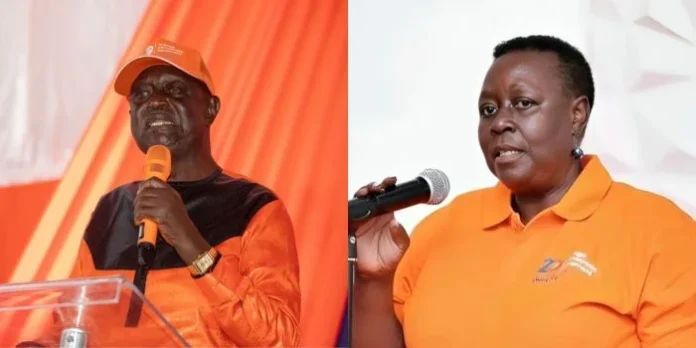
Ruth Odinga, MP Caroli Omondi among ODM rebels removed from powerful committees.

ODM rebels opposed to the broad-based government were on Tuesday kicked out of powerful committees in the National Assembly and moved to less lucrative ones, as the government-leaning team of the party moved in to crack the whip.

Suba South MP Caroli Omondi was ejected from the powerful Constitution Implementation and Oversight Committee, with his position in the committee taken by the latter-day convert of the broad-based government, Githunguri MP Gathoni Wamuchomba. 

The changes were bound to happen, as the ODM wing in the broad-based political arrangement drew the first blood.

In the changes, Suba South MP Caroli Omondi, who was recently declared the secretary general of the Azimio la Umoja One Kenya Coalition, was kicked out of his plum Constitution Implementation and Oversight Committee where he served as chairperson.

The house leaders sent a statement that dissidents will not be spared.

“I wish I go back as a whip, I used to be dangerous. Those people playing with the party, ningenyoa hao bila maji,” stated Junet Mohammed, Minority Leader, National Assembly.

“Caroli Omondi went on national TV and threatened this house that we wanted to remove him. I have no interest in ODM,” stated Kimani Ichung’wah, majority leader, National Assembly.

Other ODM members affected in the latest purge include Kisumu Woman Representative Ruth Odinga, who was moved from the Agriculture Committee to the less lucrative Committee on Members’ Services and Facilities.

Ruth, who is the sister of the former ODM party leader, the late Raila Odinga, has been a key critic of the broad-based government, coming out guns blazing in support of the embattled SG Edwin Sifuna.

Others affected in the house “fumigation” exercise include Kitutu Chache South MP Antony Kibagendi, who was removed from the powerful Public Investments Committee on Governance and Education and replaced by a greenhorn, Kasipul MP Boyd Were. The leaders said that was just the beginning.

“I am serving a warning. Anyone who will not adhere to party position will relinquish their committee positions to lesser ones, so that they know that it is parties which reward people to positions,” Junet noted. 

Several allies of the former Deputy President Rigathi Gachagua were also affected in the changes, with Naivasha legislator Jayne Kihara moved to the Committee on Members’ Services and Facilities.

However, it was a happy day for the MPs who came back to UDA, as they were reinstated to lucrative committees from those considered punishment dockets.

They include Githunguri MP Gathoni Wamuchomba, who was moved back to the Constitution Implementation Committee (CIOC) from the Committee on Members’ Services and Facilities.

Marakwet MP Timothy Kipchumba was also moved to the Justice Legal Affairs Committee from the Members’ Services and Facilities Committee.

Juja MP George Koimburi, who recently ditched Gachagua, was also handed two equally powerful dockets. More changes are expected at the Senate.

Source -Citizen Digital

Groundbreaking for SGR extension to Kisumu set for March 2026

The government is set to begin identifying and compensating persons that will be affected by the Standard Gauge Railway (SGR) extension project, whose groundbreaking has been set for March.

Speaking in Kisumu on Tuesday, Kenya Railways MD Philip Mainga indicated that phase 2B of the line will be completed by June 2027, opening up the Western region for the movement of goods and services.

Two months after Cabinet gave a greenlight for the phase 2B of the 269 km SGR, leaders convened in Kisumu for a detailed brief on the project’s scope and timeline.

Mr. Mainga called for close collaboration in community sensitization, especially regarding the acquisition of 5,000 acres of land required for the SGR corridor.

“The route has been finalised, identified and costed. We cannot change it simply because if you change even 100 metres of a railway line it will go offline. It is not like a road,” he said.

Kisumu West MP Roza Buyu said: ”We know that the areas that are mapped will knock off one of our schools. We know that homes are going to be affected, so my people are really eager to hear from Kenya Railways on the issue of compensation.”

The rail will feature a 264 km mainline, and an 8.6 km line branching to the Kisumu port. It will also have a 4,000 tonnes freight capacity.

Kisumu Governor Prof. Anyang’ Nyong’o said: “Kisumu stands to emerge as a multimodal logistics hub. It integrates rail, lake transport and road networks. This synergy will unlock commerce in Uganda, Tanzania, Rwanda, South Sudan and beyond.”

President William Ruto will lead groundbreaking on March 20, 2026.

This extension project is not only expected to ease the movement of people but also open up the region for more trade prospects.

Source -Citizen Digital

“State Houses and State Lodges land grabbed” State House Comptroller.

State House Comptroller Katoo ole Metito has revealed that most State Houses and State Lodges’ land have fallen into the hands of land grabbers, hampering the process of renovating them.

Katoo, who appeared before the National Assembly Committee on Administration and Internal Security, told MPs that they have recovered 100 acres in Kakamega, with their next focus being Nakuru and Kisumu.

MPs have also raised concerns over the construction of multi-storey buildings next to State Houses and State Lodges, which they say poses a security threat.

In his appearance before the committee, Katoo ole Metito revealed that State Houses and Lodges land are in the wrong hands.

Katoo said hundreds of acres of land have been grabbed in different counties, a situation that has hindered planned renovations.

“Almost all these State Lodges and State Houses… their land was really encroached, so it is a process. We are trying one by one. Even the Eldoret one we did, we had to repossess it from the club,” said Metito.

MPs, who questioned the audacity of the grabbers, told the State House Comptroller to give particular attention to Nakuru State House and Kisumu State Lodge, where encroachment poses a security threat.

“When we went to Kisumu, despite some renovations that have taken place, there was a lot of land dispute. It is being said that part of State Lodge has been taken up by the county government; actually, one house was occupied by a nominated MCA,” said Gabriel Tongoyo, Chairman of the Committee on Administration and Internal Security.

The MPs have also directed that a multi-storey building under construction next to State House, Nakuru, be stopped.

Katoo, who was put to task over State House’s request for more allocation after being given KSh11 billion out of the proposed KSh20 billion in the next budget, defended the use of cash at State House. He stated that they spend over KSh120 million during national holidays held outside the city.

“On average, we spend KSh123 million per function, and the minimum number of guests is 4,500. So when you talk of costs of tents, food, you know…,” he said.

The State House Comptroller said they are implementing 13 projects in State Houses and State Lodges.

President Trump to address a changed America at vital moment for his presidency

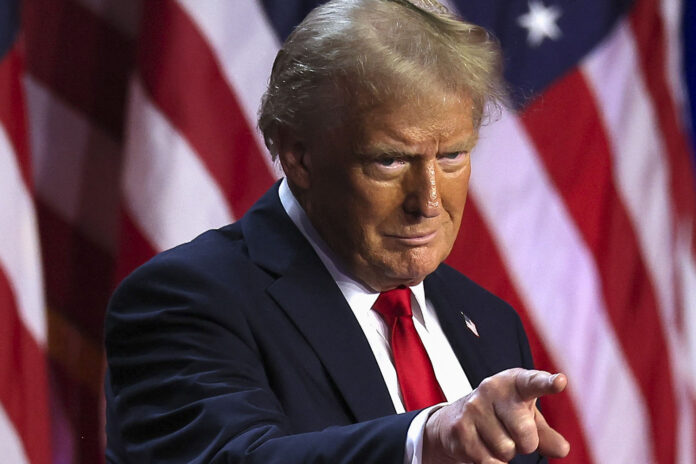
Republican presidential nominee and former U.S. President Donald Trump points his finger following early results from the 2024 U.S. presidential election in Palm Beach County Convention Center, in West Palm Beach, Florida, U.S., November 6, 2024. REUTERS/Carlos Barria

Bonface Mulyungi

BBC -Few of Donald Trump’s speeches to Congress have had as much riding on the outcome as the State of the Union address he will deliver on Tuesday night.

Over the course of the past year, Trump has pushed the envelope of presidential power in a multitude of directions.

He has achieved substantive accomplishments, both domestically and in foreign policy. But not all of his achievements have been popular – and some have been highly divisive.

Regardless of how his policies have been perceived, Trump will address an America notably different than the one he returned to lead last year.

He has enacted his sweeping second-term agenda at breakneck speed; cracking down on illegal immigration and effectively sealing the border, upending foreign alliances, challenging the checks and balances that are foundational to the American political system, and fundamentally redefining the role of the presidency.

He has, however, run headfirst into significant obstacles, both from the public and key institutions that have curtailed his ambitions.

Opinion polls suggest public mood has soured on Trump in his second term. A recent CNN poll indicated only 36% of Americans approved of the job Trump is doing. A Washington Post survey returned a similar figure at 39%. This State of the Union address represents an opportunity for Trump to stop the bleeding at a pivotal time.

In just over eight months, voters will pass judgement on Trump’s second presidential term in November’s midterm elections. They could preserve his Republican majority in Congress or hand power to the Democrats, assuring two years of legislative gridlock and aggressive oversight that could, in his own words, see him impeached once again.

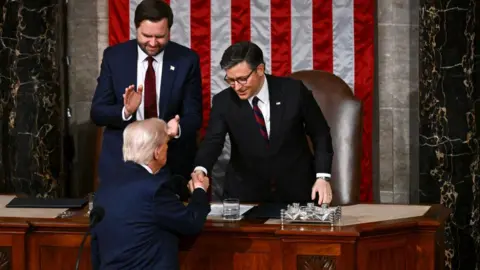
Getty Images Trump seen shaking hands with Vice-President Vance and Speaker of the House Johnson during his March 2025 speech to Congress
Trump seen shaking hands with Vice-President Vance and Speaker of the House Johnson during his March 2025 speech to Congress

Tuesday’s speech is Trump’s one and only chance to make his case to the US public before those elections in a major set-piece event before an audience of millions.

On Monday, he previewed what he hopes to accomplish with the address. “We have a country that’s now doing well, we have the greatest economy we’ve ever had and the most activity we’ve ever had,” Trump said. “It is going to be a long speech, because we have so much to talk about.”

According to Robert Rowland, a professor at the University of Kansas who has written a book analysing Trump’s rhetoric, it is standard fare for Trump to boast about his accomplishments, leavened with attacks on his perceived enemies and critics.

His past speeches to Congress including last year’s, which stretched for nearly two hours, have followed a similar pattern. But at what he called a “critical moment” for the president, Rowland said a typical Trump speech may not be the best approach.

“State of the Union addresses are normally a time when the president does two things that President Trump essentially never does,” Rowland said. “The president makes a case for his agenda. And they try to broaden the appeal of the agenda of the administration.”

Much of Trump’s second-term agenda, and his efforts to tout it, have been directed at his political base. Broadening his appeal can at times feel like less of a priority than going on the attack. The political reality, however, suggests the president has some work to do in selling his agenda before November’s elections.

His decision to surge federal immigration agents to cities like Minneapolis may have been popular with the party faithful who waved “mass deportations now!” signs at the 2024 Republican National Convention, but polls indicate many Americans believe he has gone too far.

Getty Images 'No Kings' protests against Trump were held across the US last year. Protesters are seen carrying anti-Trump signs
‘No Kings’ protests against Trump were held across the US last year

The president’s trade policies, including high tariffs on some of America’s biggest partners, have also proven to be stubbornly unpopular. Last Friday, the US Supreme Court ruled that many of the president’s duties were illegal, casting the administration’s trade regime in doubt.

The president has since imposed new tariffs and pledged to be even more expansive in their use, but the end result is continued uncertainty around the impact that the president’s actions will have on the US economy and consumer prices.

While there has been some good news for Trump on the economy, with the stock indexes near record highs and unemployment low, the latest figures on economic growth were below expectations.

The economy and immigration had traditionally been two areas where Trump had the most public support. But his standing on those issues has declined since he returned to the White House, contributing to his sinking overall approval levels.

Mexico hunts 23 inmates sprung from jail during wave of violence

By Bonface Mulyungi

BBC -Police in Mexico are searching a number of inmates sprung from a prison in Puerto Vallarta during a wave of attacks launched by the Jalisco New Generation Cartel (CJNG) on Sunday.

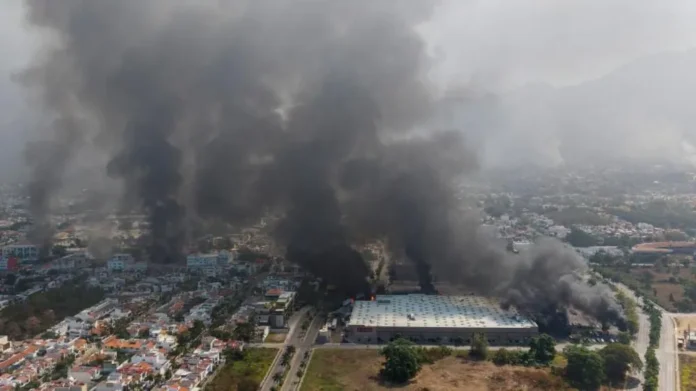
Puerto Vallarta, a beach resort on Mexico’s Pacific coast, was among the towns where the CJGN blockaded roads and torched cars in retaliation for the killing by security forces of their leader, Nemesio Oseguera Cervantes, known as “El Mencho”.

During the unrest, armed men rammed one of the prison gates with a car, paving the way for 23 prisoners to escape, an official said.

More than 70 people – including 25 National Guard members – were killed in the operation to capture El Mencho and the violence which followed.

Juan Pablo Hernández, security secretary for the state of Jalisco, said that his office was working with other states to capture the fugitives.

Officials have not yet released details of the identities of the prisoners who escaped.

Cartel members torched several vehicles across Puerto Vallarta on Sunday.

Tourists and locals were urged to seek shelter and not venture out and footage they recorded showed black plumes of smoke rising above the popular beach resort.

A number of airlines temporarily halted their flights and at least two major cruise liners said their ships would skip planned stops in Puerto Vallarta.

The Mexican government said on Monday that most of the road blocks erected by cartel members had been cleared.

But El Universal newspaper reports that in the state of Morelia, where drug lord El Mencho was born, armed men continued to spread fear on Monday, torching cars and vandalising shops and public buildings.

El Mencho was Mexico’s most wanted man. Under his leadership, the CJGN became a powerful transnational criminal organisation which spread from its stronghold in the state of Jalisco into many other Mexican states, where it engages in drug production and trafficking.

It often resorts to extreme violence and has been behind a number of high-profile attacks on the security forces and government officials.

The Trump administration had described El Mencho as a “top target for the Mexican and United States government as one of the top traffickers of fentanyl into our homeland” and had offered a $15m (£11.1m) reward for information leading to his capture.

The drug lord was captured by Mexican security forces in the town of Tapalpa, in Jalisco state, on Sunday.

Mexico’s defence minister said they were able to locate him by following one of his “romantic partners”.

He died shortly after being captured due to injuries in the firefight which broke out between his security guards and Mexico’s special forces sent to arrest him.

MPs Push for Law Changes as KMTC Dispute Exposes Health Training Crisis

A parliamentary Committee has called for urgent legal reforms and proper alignment of funding to end a long-running dispute over the management and student placement process at the Kenya Medical Training College (KMTC).

The National Assembly Departmental Committee on Health, while considering the Budget Policy Statement (BPS) told Health Cabinet Secretary Aden Duale that persistent back-and-forth between ministries and institutions was undermining training, staffing and service delivery.

Seme MP Hon (Dr.) James Nyikal who chairs the committee said the country could no longer afford policy inconsistencies on critical health training matters.

“We can’t keep moving back and forth as a country,” Dr Nyikal told the CS. “The question is simple: who carries the function and who carries the money?”

The KMTC matter, which has lingered for nearly a decade, revolves around control, admissions and oversight of health training institutions, and the broader question of how health sector training is coordinated between the Ministries of Health and Education.

The standoff centres on overlapping mandates between the Ministries of Health and Education. Currently, placement of KMTC students is handled by the Kenya Universities and Colleges Central Placement Service (KUCCPS), which falls under the Ministry of Education.

However, admissions and oversight of KMTC institutions are managed by the Ministry of Health through the State Department for Public Health and Professional Standards.

Dr. Nyikal observed that the dual system has created confusion, administrative delays and policy inconsistencies that are affecting training and planning in the health sector.

“In your office Honourable CS, there is an advisory letter indicating that KMTC should admit students. That advice followed a formal inquiry to the Attorney General,” Dr Nyikal said. “It is now for you to execute at Cabinet level what is already lawful, unless the law is changed.”

He emphasized that concurrence at Cabinet level would not amount to a policy shift, but rather implementation of an existing legal position.

The committee, he noted, had previously engaged the Ministry of Education on the matter and established a common understanding.

“Without clear legal and financial alignment, disputes over control will persist, undermining the training of health professionals at a time when the country faces staffing shortages,” Nyikal held.

However CS Duale described it as a “hot potato” requiring collective political responsibility.

“This matter has been there for about 10 years. If you want me to touch this hot potato, we must share it,” he said. “Unless Parliament changes the law, what the courts are doing is legal and it will not just disappear.”

He said he would formally seek and circulate advice from the Attorney General, copy the Education Ministry and the Head of Public Service, and involve Parliament in resolving the legal impasse.

“The people who change the law are you,” he told MPs. “If you say we will change it, then we will align accordingly. Until then, we must operate within the law.”

The CS also disclosed that he had engaged the Education Cabinet Secretary on harmonising control over health training.

“There is no way the entire training of the health sector can be run by the Ministry of Education alone. They own the institutions, yes, but we own the curriculum and the health ecosystem. There must be a link,” he said.

Mr Duale warned against allowing commercial interests to drive medical training, cautioning that compromised standards could damage the country’s reputation internationally.

Beyond KMTC, the Committee turned its focus to the training and remuneration of medical registrars in public referral hospitals.

Dr Nyikal said Parliament had previously resolved that registrars should be admitted strictly according to approved training positions based on national health needs.

“Registrars must be admitted according to the needs of the facility and the country. We create training positions at Kenyatta, at Moi and in other referral hospitals. When they finish, they leave and are replaced. The positions rotate. That is the only fair system,” he said.

He opposed any policy that would allow financial capacity to determine access to public training facilities.

“Once you create a policy that favours money in a public institution, you create an imbalance against those who cannot afford. We rejected that principle before, and we must reject it again,” he said.

The Chairperson also urged the Ministry to provide a specific budget line for training slots.

“I don’t want to hear about a registrar working 24 or 48 hours and not being paid. That is wrong. It is a human rights issue. If they work as they train, that work must be paid for,” he said.

Moyale MP Guyo Jaldesa backed the collegiate training model, saying it was introduced to address specialist shortages in counties.

“When we started the collegiate system, it was to address specialist gaps. Doctors train while working. For the years they are in training, they are offering services. Previously, the Ministry paid their salaries and fees. Now that is no longer happening, and that is questionable,” he said.


Intersex individual arrested in Busia over infant defilement case

Yellow crime scene do not cross barrier tape in front of defocused background. Horizontal composition with selective focus and copy space.

On February 24, 2026, police in Busia County arrested a 38-year-old intersex suspect for the alleged defilement of a nine-month-old infant.
Case Details

The child’s mother reportedly left the baby in the care of the suspect while she went to fetch water. Upon her return, she discovered the infant bleeding and in pain.

Residents in Nambale sub-county raised the alarm, leading to the suspect’s arrest. The individual is currently being held at the Nambale Police Station.

The infant was rushed to Nambale Sub-County Hospital for emergency medical treatment and forensic examination to aid the investigation.

Police noted that the suspect’s intersex status has presented unique challenges regarding their detention, as the station lacks specialized facilities for intersex individuals.

Authorities are consulting with the Office of the Director of Public Prosecutions (ODPP) on how to proceed with the charges and detention.
Community Reaction

Local leaders and human rights activists in Busia have condemned the act, calling for a speedy trial while emphasizing the need for the justice system to handle the suspect’s gender identity in accordance with the High Court’s previous rulings on intersex rights and detention.

By Anthony Solly

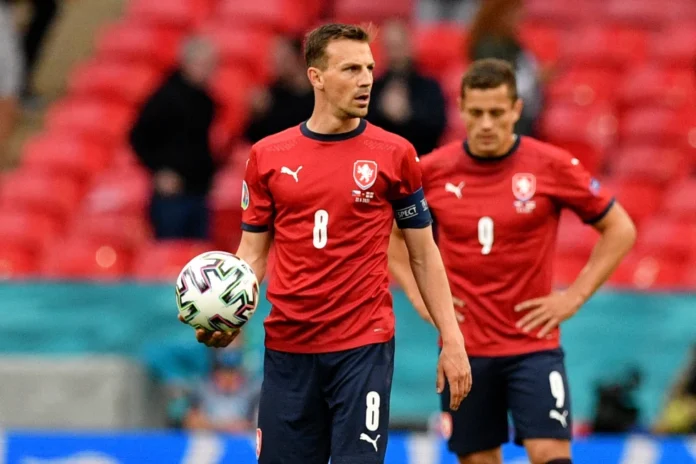
Darida coming out of retirement to help the Czechs qualify for the World Cup

(AP) — Former captain Vladimír Darida has agreed to come out of international retirement to help the Czech Republic try and qualify for the World Cup.

The 35-year-old Darida retired from internationals in 2021 after the Czechs were eliminated in the quarterfinals of the European Championship.

The playmaker agreed to rejoin the team after he was approached by coach Miroslav Koubek and Czech Football Association general manager Pavel Nedvěd.

Darida said on Tuesday his decision was not about his personal ambitions but about “doing together the maximum to return Czech football to the World Cup.”

The Czechs last appeared in the World Cup in 2006.

Darida debuted for the national team in 2012 and played 76 games, scoring eight times. After previously playing in Bundesliga sides Freiburg and Hertha Berlin and Greece’s Aris Thessaloniki, Darida returned home last summer and captains Hradec Králové in the Czech league.

The Czechs are in the World Cup playoffs after finishing runner-up in their qualifying group behind Croatia. They meet Ireland in a single elimination game on March 26 at home. The winner then will host Denmark or North Macedonia for a spot at the tournament co-hosted by the United States, Canada and Mexico.

The team that makes the tournament will join Mexico, South Africa and South Korea in Group A.

Create a free account, or log in.

Gain access to read this content, plus limited free content.

Yes! I would like to receive new content and updates.

Sponsored Ad

Ad 1
Ad 2
Ad 3
Ad 4
Ad 5
Ad 6