By Peter John
The partial US government shutdown has become the longest in American history, as lawmakers in Washington continue to fight over funding for the Department of Homeland Security (DHS).
On Sunday, the shutdown reached 44 days, surpassing the previous longest funding lapse, which ended in November 2025.
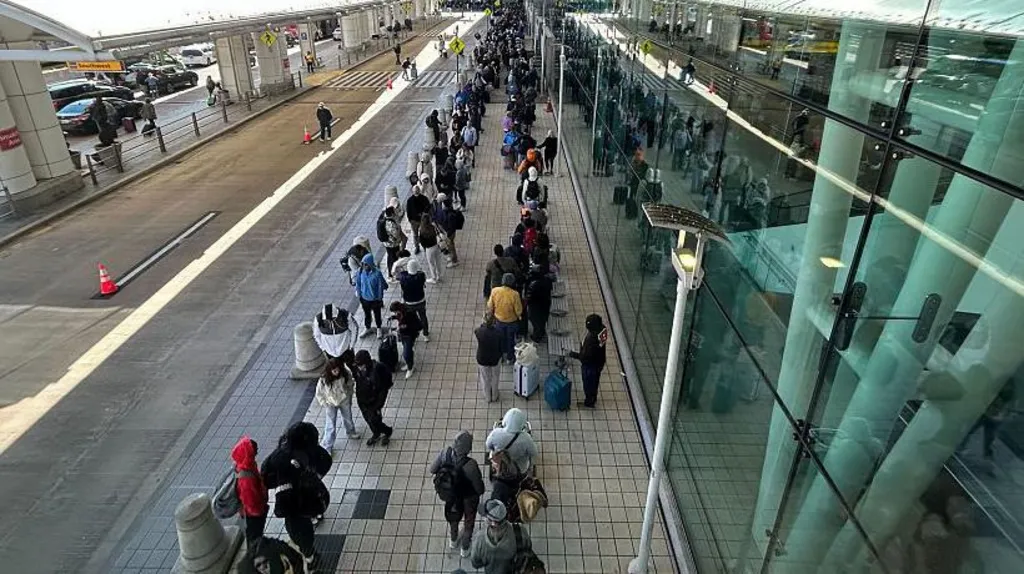
The current impasse has led to chaos at airports, due to a shortage of Transportation Security Administration (TSA) officers at security checkpoints as employees go without pay cheques.
Congress is now on a two-week break so a deal to fund the DHS – which covers TSA agents, as well as immigration agencies – appears unlikely to pass any time soon.
On Friday, lawmakers failed to agree a deal to re-open the DHS, which has been shut since 14 February.
The US Senate passed a compromise deal that would partially fund the DHS and aimed to alleviate airport travel delays, but Republicans in the US House of Representatives rejected the bill and instead voted to approve a short-term measure that funded the department in its entirety.
The Senate is not expected to pass that short-term measure, as Democrats have opposed funding for the department, which oversees Trump’s immigration agenda, without reforms, such as bans on Immigration and Customs Enforcement (ICE) agents wearing masks and racial profiling.
At airports, thousands of TSA officers have not been getting paid amid the ongoing dispute. This has led to some not turning up for work and around 500 agents quitting, according to DHS.
Videos on social media of travellers snaked around buildings in massive queues have gone viral, and led to concerns about the US’ ability to co-host the World Cup starting in June.
On Friday, more than 3,560 TSA officers called out of work, according to DHS, accounting for 12.35% of the agency’s total workforce.
Agents from ICE have been deployed to several airports to help while TSA agents are going unpaid.
White House border czar Tom Homan said on Sunday that some ICE units may remain at airports after the shutdown eventually ends, depending on how many TSA agents “come back to work” after being paid.
“We need to secure those airports. ICE is there to help our brothers and sisters in TSA. We’ll be there as long as they need us,” he told CBS.
He said that TSA agents will begin to receive paycheques by Monday or Tuesday, after Trump signed an executive order directing them to be paid.
The move may be met with legal and political challenges, as the US constitution tasks Congress with authorising spending for the federal government.
“It seems to me pretty clearly a violation of the Antideficiency Act, which prohibits spending money that has not been appropriated by Congress,” Josh Chafetz, a professor of law and politics at Georgetown University, told the BBC.