







By Peter John
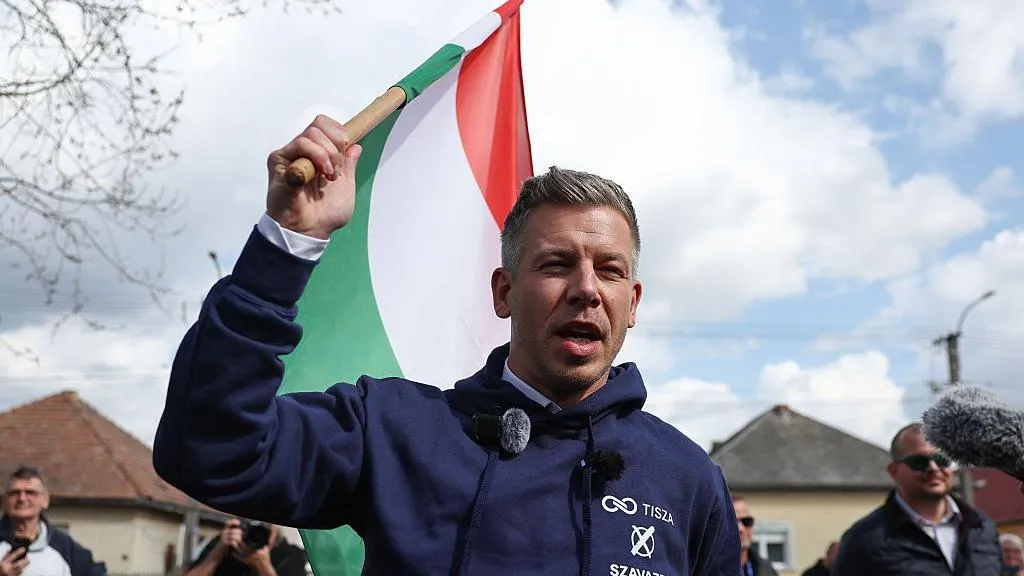
“Now or never,” Peter Magyar has been telling Hungarians, in a breathless campaign across the country in the run-up to 12 April elections that opinion polls suggest he can win.
This 45-year-old former Fidesz party insider represents the biggest threat to Viktor Orban’s rule in Hungary since he won the first of four consecutive victories in 2010.
Magyar’s slogan dates back to a revolutionary poet’s 19th Century rallying cry to rise up for the homeland.
After more than 100 campaign stops his message has been shortened to “Now”: the words “or never” have been crossed out, adding to the urgency.
He is on course to visit all of Hungary’s 106 constituencies, and he has given four, five, even six speeches a day. Magyar has built a powerful support base in more than two years of touring the country, even in the small towns and villages were Fidesz traditionally dominates.
Last year he walked 300km (185 miles) from Budapest to the Romanian border in a campaign to “reunite” the nation, in a bid to bring natural Fidesz voters to his side.
Magyar promises to tackle corruption, improve the economy and he has sought to woo Hungary’s disadvantaged Roma community. He has also promised to unlock billions of euros in EU funds, frozen largely because of concerns over Hungary’s rule of law.
But Orban has depicted him as a “puppet” of the EU and Ukraine, and he has been wary of getting too close to Brussels and has promised voters “we are the real party of peace”.
His self-confidence stems from a deep understanding of the rival he faces.
Until February 2024, Magyar was very much part of the Fidesz family.
He joined the party at university and married one of its rising stars in Judit Varga, with whom he had three children.
Then Magyar stunned Hungarians with a live appearance on a pro-opposition YouTube Channel called Partizán.
In a country of 9.6 million people, a million watched as a solemn Peter Magyar explained why he had had enough of his own party.
“Everyone warned me against it, friends, family people I know,” he told presenter Márton Gulyás. “Obviously I’ve been in this system, in this circle, for a very long time.”
Hungary was in the midst of a scandal in which President Katalin Novak had granted a pardon to a man who had helped cover up sexual abuse in a Hungarian state-run children’s home.
She resigned, and so did Magyar’s ex-wife. Varga had been justice minister and had co-signed the pardon. Two leading Fidesz women were left to carry the can. Varga had been destined for big things in Fidesz, having left her job as minister to spearhead Fidesz European election campaign. That career was over.
Now she was no longer part of the Fidesz machine, Peter Magyar sensed this was his moment.
“I do not want to be part of a system in which the real people in charge hide behind women’s skirts,” he wrote on Facebook.
Towards the end of his Partizán interview Magyar spoke of his hope for political change, while realising it would be very difficult while Orban was still in power.
The current opposition was totally inept, he complained, so change would have to come from within. But one day there would be change and when it did happen it could be fast, he predicted.
His YouTube appearance went viral.
“It was not a planned move,” he later told the BBC. “My mother called me not to go, but I did the opposite. Everybody knew the situation in Hungary – it’s not very safe to go against this government.”
Peter Magyar’s high-profile party marriage had fallen apart in 2023 but he was still an important figure in Fidesz even if he was little known to the wider public.
He was a natural fit for Orban’s social conservatives.
The son of two lawyers – his mother was as senior judge – Peter Magyar also counts a former Hungarian president as his godfather, and he was very interested in politics from an early age.
Magyar went to an elite Catholic boys’ high school near the centre of Budapest before studying law at a Catholic university in Budapest while Orban was serving his first term as prime minister from 1998-2002.
Magyar joined the party after Orban’s election defeat, and the woman he married, Judit Varga, was destined for Fidesz success, becoming justice minister in 2019, nine years after Orban’s return to office.
Magyar himself became a diplomat at Hungary’s permanent mission in Brussels, later running Orban’s team working with the European Parliament. He went on to serve on the boards of state-owned companies.
His disaffection with the party was gradual.