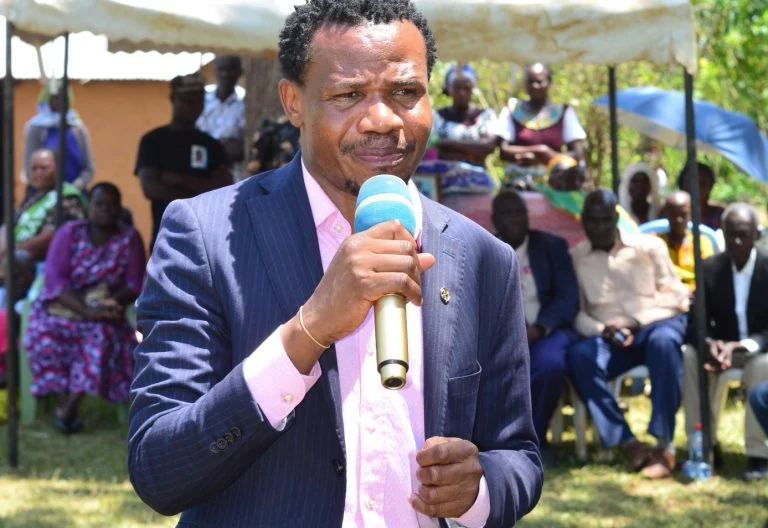
Mumias East MP Peter Salasya has accused President William Ruto of breaching the Constitution by hosting a ruling party meeting at State House, arguing that the move blurs the line between state and party affairs.
Salasya made the claim in a post on X on January 26, 2026, hours after Ruto chaired a United Democratic Alliance (UDA) National Governing Council meeting at the presidential residence in Nairobi.
The meeting drew senior party figures, including Deputy President Kithure Kindiki, Prime Cabinet Secretary Musalia Mudavadi, governors, MPs, senators and county assembly members.
During the session, Ruto reviewed his administration’s progress under the Bottom-Up Economic Transformation Agenda and discussed party strategy ahead of the 2027 elections. He also approved talks with the Orange Democratic Movement (ODM) to form a coalition, a move aimed at expanding UDA’s support base.
Ruto told the gathering that UDA should seek a decisive win in the next election.
“In the coming election, we want to win by a margin of between 2 and 3 million so that we unite the country and walk together,” he said.


He noted that the narrow margin in the last election made it necessary to consolidate support. He also praised the broad-based government arrangement with ODM, saying Treasury Cabinet Secretary John Mbadi and his team had performed well.
The President instructed UDA’s National Elections Board to repeat grassroots polls in areas with low turnout and said party nominations would follow established rules. He also urged Parliament to fast-track the National Dialogue Committee report.
Salasya condemned the use of State House for the meeting. He said the residence represents national unity and neutrality, not party politics.
“This is a serious constitutional violation, not a trivial political misstep,” he wrote. “State House is a national institution, not a party office.”
He added that turning it into a venue for partisan meetings amounts to an abuse of state power.
He compared the situation to other democracies, arguing that such boundaries remain protected elsewhere. Salasya said national institutions belong to the country, not to leaders temporarily in office, and warned that politicising State House undermines the neutrality of the presidency.
Salasya, a frequent critic of Ruto’s administration, has faced his own controversies, including a recent hate speech case in which a court ordered him to run a 14-day peace campaign. His remarks reflect wider concern about the growing overlap between state institutions and party politics in Kenya.