Stacy Boit,

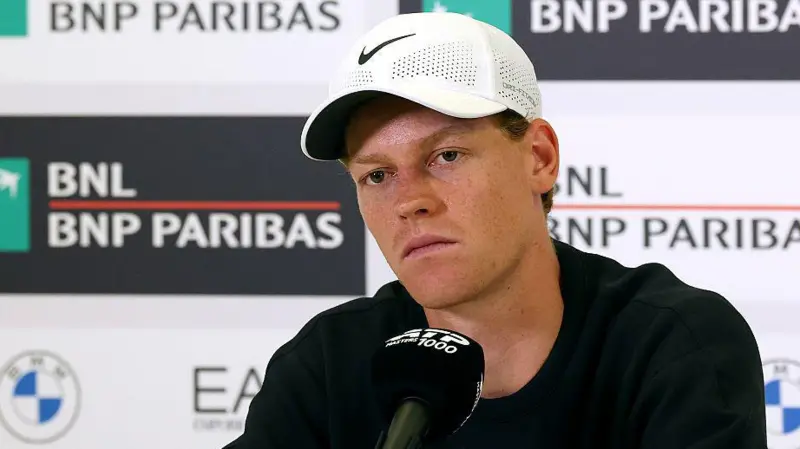
Jannik Sinner considers it “tough to say” whether he would ever boycott a Grand Slam over prize money, but the Italian claims players are not getting the respect they deserve.
His fellow world number one Aryna Sabalenka said on Tuesday that she believes players will “at some point” boycott one of the majors.
The top 10 players are demanding a higher percentage of the revenue generated by the four Slams, as well as benefit contributions and a greater say in areas such as scheduling.
“It’s more about respect,” Sinner said in Rome before his attempt to win a sixth consecutive Masters 1,000 title at the Italian Open.
“I think we give much more than what we are getting back. It’s not only for the top players – it’s for all of us players, from men’s and women’s side.
“The top 10 men and top 10 women, we wrote a letter and it’s not nice that after one year we are not even close to a conclusion for what we would like to have.
“Talking in other sports, if the top athletes, they send important letters, I truly believe that within 48 hours you have not only a response but you also have a meeting.
“Of course we talk about money. The most important is respect, and we just don’t feel it.”
The 24-time Grand Slam champion Novak Djokovic also joined the debate by saying “players know that they’ll always have my support”.
“I do like the fact that there is more conversations happening on this,” the 38-year-old Serb added. “It needs to be because players’ position is not where it needs to be with slams, with tours.”
Meetings have taken place between players and Grand Slam representatives. The players have made no progress in their request for benefit contributions, and rejected a meeting in Indian Wells in March to discuss the formation of a Grand Slam player council.
Grand Slam executives are currently limited in what they can discuss among themselves, or with the players, as they have been the subject of a lawsuit brought by the Professional Tennis Players’ Association which accuses them of “monopolistic control.”
Sinner expressed his disappointment at the 9.5% prize money offered by this month’s French Open – as players believe the total sum is still some way below the 22% of tournament revenue they feel entitled to.
The financial pot at last year’s US Open rose by 20%, with the figure for January’s Australian Open nearly 16% higher year on year.
“I think in the next couple of weeks we know also the prize money we’re going to have in Wimbledon,” Sinner said.
“We truly hope that it’s going to be better. Then, of course, US Open. So I do understand players talking about boycott because it’s somewhere we also need to start. It has been a very long time with this.”
Sinner stopped short of committing himself to boycotting one of the Slams.
“Of course, it’s tough to say. I cannot predict the future in a way,” he said.
“It’s the first time that I feel like the players are all in the same scenario and in the same point of view.
“I think it’s also right because without the players, they are not going to happen, any tournaments. In the same time we also know and we respect the tournaments because they make us bigger as athletes.
“Let’s see in the future.”
Djokovic also avoided a direct commitment to go on strike, but praised Sabalenka for her intervention.
“That’s a true leadership for me and I think she needs to maintain that. I salute that,” he added.
“We’re all part of the same sport. We all try to elevate the game, whether it’s players, tournaments, governing bodies. Unfortunately, often there is a conflict of interest that some people don’t want to address.
“I think that’s where the players really have the power. I’m always supportive of the stronger player position in the ecosystem.”