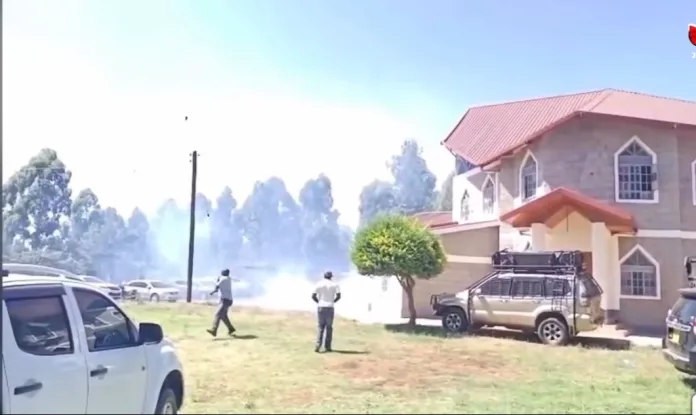
The country is grappling with fresh outrage following a disturbing incident at ACK Witima Parish in Othaya, where armed individuals, some in uniform and others in plain clothes, lobbed teargas at congregants during a church service on January 25, 2026. The incident, captured on video and widely circulated, has triggered condemnation from religious leaders, civil society, and human rights advocates, reigniting debate over police conduct, political interference, and the sanctity of places of worship.
The Inter-Religious Council of Kenya (IRCK) led the condemnation, describing the incident as deeply worrying and unacceptable. In a strongly worded statement, the council said the indiscriminate use of force against worshippers—including children—constituted a grave violation of the Constitution, infringing on fundamental rights such as freedom of religion and belief, human dignity, and the right to security of the person. The council emphasized that congregants were engaged in peaceful worship and posed no threat to public order that could justify such action.
Eyewitness accounts from the church describe scenes of panic as teargas canisters were thrown into the compound, forcing worshippers to flee amid choking fumes. Parents were seen shielding children, while elderly congregants struggled to escape the chaos. Church leaders said the service was disrupted without warning and that no explanation was given at the time for the deployment of force.
The incident has come against the backdrop of heightened political tensions and growing public anger over alleged police brutality. Rights groups argue that the events at ACK Witima reflect a worrying trend of shrinking civic and religious space, where force is increasingly used in situations that demand restraint and dialogue. Analysts warn that such actions risk normalising violence in spaces traditionally regarded as neutral and sacred.
IRCK warned that the incident poses a serious threat to religious freedom, social cohesion, and tolerance, particularly as the country edges closer to another high-stakes electioneering period. The council cautioned that politicising places of worship or using them as arenas for confrontation could deepen divisions and inflame tensions in an already polarized environment.
In its statement, IRCK urged politicians and all arms of government to keep their differences out of places of worship, stressing that churches, mosques, temples, and other sacred spaces must remain zones of peace, reflection, and unity. The council also called on the National Police Service (NPS) to publicly explain the circumstances surrounding the incident and to take firm, transparent action against those responsible.
As of now, the National Police Service has not issued a detailed public account of what prompted the teargas deployment, a silence that has further fueled public suspicion and demands for accountability. Human rights organizations are calling for independent investigations, while some leaders have urged Parliament and oversight bodies to take up the matter.
The events at ACK Witima Parish have become more than a localized incident; they have emerged as a national test of Kenya’s commitment to constitutional freedoms, restraint in policing, and respect for sacred spaces. As the country reflects on what unfolded in Othaya, pressure continues to mount on authorities to ensure accountability, restore public trust, and reaffirm that places of worship are not battlefields.