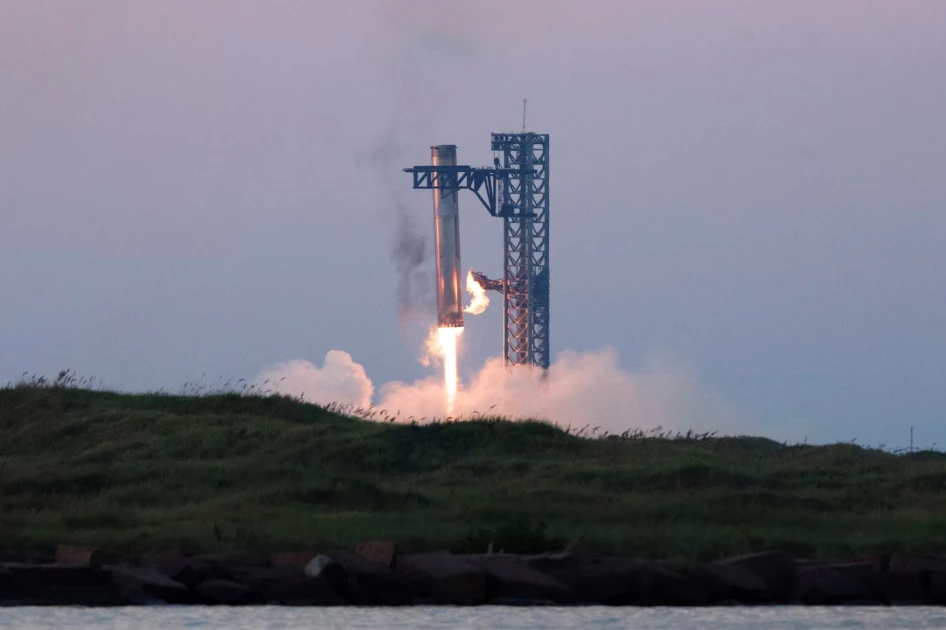
SpaceX launched its massive Starship rocket for the ninth time on Tuesday evening, marking a critical test for the company’s ambitions to reach the Moon and Mars. However, the flight ended in disappointment as the spacecraft spun out of control and disintegrated over the Indian Ocean, falling short of its major objectives.
The 403-foot (123-meter) rocket lifted off from Starbase, SpaceX’s private launch facility at the southern tip of Texas, where residents recently voted to organize as an official city. Hopes were high for this latest demonstration, especially following two previous attempts earlier this year that ended in fiery explosions just minutes after launch.
Unlike its predecessors, Tuesday’s mission saw Starship achieve a higher altitude and make it farther downrange. However, issues began soon after liftoff. A key mission objective, deploying mock satellites, was aborted when the payload door failed to fully open. Then, as the spacecraft approached the edge of space, it began to tumble uncontrollably due to what SpaceX later identified as fuel leaks.
The company confirmed that the vehicle experienced a “rapid unscheduled disassembly,” a term it uses to describe in-flight breakups. “Teams will continue to review data and work toward our next flight test,” SpaceX said in a post-flight statement.
CEO Elon Musk remained optimistic, describing the test as a “big improvement” over previous attempts. On X (formerly Twitter), he announced that future launches would proceed at a faster cadence, with plans for another three flights in the coming months.
This test flight also marked a first: the use of a recycled booster. The company did not attempt to recover it using its iconic “chopstick” arms at the launch tower, opting instead to push the hardware to its limits. The booster ultimately lost contact and crashed in pieces into the Gulf of Mexico.
Flight commentator Dan Huot acknowledged the difficulties during the live broadcast, stating, “Not looking great with a lot of our on-orbit objectives for today.” Communication with the spacecraft ceased shortly before reentry, and the webcast was subsequently cut.
Despite the setbacks, SpaceX had implemented a number of upgrades for this mission, including reinforced heat shield tiles and fittings for future booster recovery attempts. While this Starship was always intended to splash down in the Indian Ocean, the company hoped to collect data critical for controlled landings and future reuse.
NASA, which has contracted SpaceX to use Starship for its Artemis lunar missions, is closely watching the rocket’s progress. The agency expects the vehicle to be ready for an uncrewed moon flyby next year, followed by a crewed lunar landing in 2027, milestones that require Starship to demonstrate significant reliability improvements.
For now, SpaceX remains undeterred, pushing ahead in its pursuit of interplanetary travel, even as the path continues to be paved with trial, error, and debris.
Written By Rodney Mbua