By John Mutiso
Three people have died, and several others have been injured after police clashed with protesting residents over gold mining activities in the Ikolomani area in Kakamega County.
Police said that the victims were hired goons who attacked officers and journalists during the unrest.
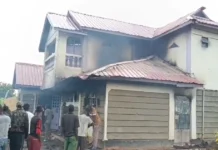
According to reports, the incident broke out on Thursday, December 4, when a team covering the gold miners’ protest in Isulu, Ikolomani, came under attack. Among the injured were police officers and journalists who had arrived at the scene to cover the demonstrations.
The violent confrontations left a trail of destruction, with burning debris visible on the streets as residents expressed their opposition to proposed mining activities in the area.
Earlier in the day, tensions had been building over a major gold mining proposal in Kakamega South that has faced strong resistance from local communities concerned about environmental, cultural, and social impacts.
A British-based mining firm recently announced the discovery of what it describes as one of Kenya’s largest gold deposits, with an estimated value of Sh683 billion.
The company’s feasibility study reveals that approximately 337 acres of predominantly privately owned land would be needed, potentially displacing around 800 households.
An Environmental Impact Assessment report submitted to the National Environment Management Authority (Nema) by the company’s Kenyan subsidiary confirmed 1.27 million ounces of gold at the Isulu-Bushiangala underground mining site in Kakamega South Sub-county.
Residents of Isulu, Bushiangala, and Musoli have formally opposed the project through a memorandum submitted to Nema. Community members have raised concerns about the conduct of consultations and their potential impact on the environment and local livelihoods.
“We object to the approval of this project because it is a private commercial venture, not a public purpose project, and therefore cannot lawfully acquire ancestral land without consent,” the memo states.
The document argues that the project could have a negative impact on cultural heritage, household incomes, and community welfare if adequate safeguards are not clearly established.
Residents claim that issues raised in an earlier petition submitted in July 2025 have not been fully addressed.
Community members note that a scheduled public hearing on November 11 did not take place, which they interpret as acknowledgment that further consultations may be required.
Local communities have also expressed worries about potential environmental damage, calling for greater clarity on how the mine would manage waste, protect water sources, including the Yala, Luyeku, Mukongolo, and Itechedi rivers, and address dust, fumes, and other emissions associated with mining operations.